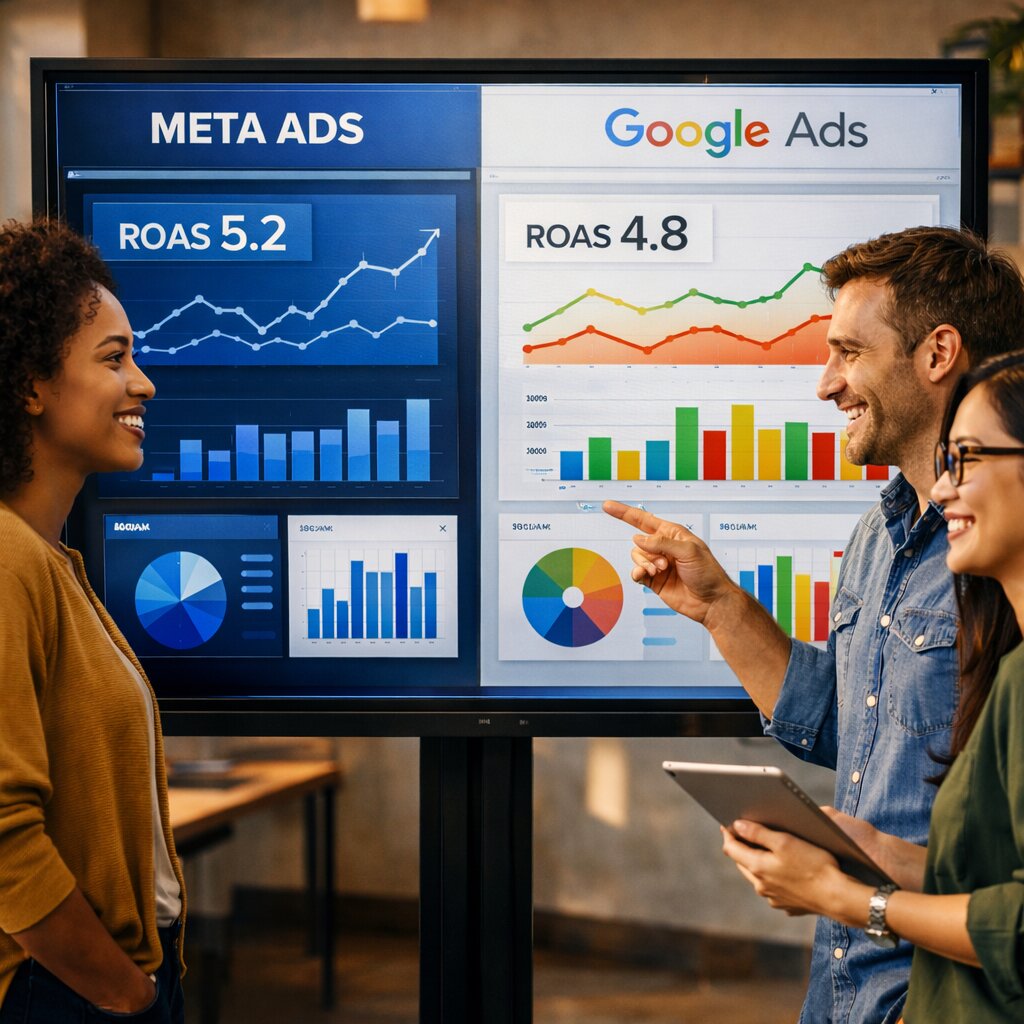
Meta Ads vs Google Ads ROI analysis for 2026 shows that Google usually leads on last click efficiency, while Meta often wins on discovery and customer lifetime value. Benchmarks from large multi account datasets indicate median Google Ads ROAS around 3.5:1 across industries and search campaigns above 5:1, while Meta’s median sits closer to 2.2:1 with stronger results in visual ecommerce niches. Rising media costs, privacy changes and modeled conversions mean neither platform is plug and play anymore, advertisers need clean first party tracking, server side integrations and regular incrementality tests to see true return. In practice, the brands that scale best in 2026 treat Google and Meta as a portfolio, protecting profitable search intent on Google, using Meta to create demand and then optimising for blended profit instead of chasing a single magic ROAS number.
- Best for high intent: Google Ads excels for search driven demand, local services and B2B leads.
- Best for discovery: Meta Ads shines for visual DTC brands, creator led campaigns and retargeting flows.
- Winning strategy: Combine both channels, define break even and target ROAS by margin, and shift budgets using cohort level profit, not just in platform dashboards.
Meta Ads vs Google Ads ROI analysis for 2026 is no longer a theoretical debate, it is a budget decision that can decide whether a brand grows or stalls. In 2025 global ad spend was estimated at around 1.17 trillion dollars and more than seventy five percent of that total flowed into digital channels, with search ads projected at about 295 billion dollars and social media ads at about 210 billion dollars of spend.[3][4][18] Google and Meta together capture a dominant share of that money, which means every improvement you make in channel mix, creative and bidding can move real revenue, jobs and valuations, not just dashboards.
Quick ROI snapshot, Meta Ads vs Google Ads in 2025
Before diving into nuance it helps to look at a simplified scoreboard, especially if you need to justify investment to founders or finance teams. The numbers below are not hard rules, they are recent benchmarks pulled from large multi account datasets that show how each platform tends to behave when thousands of advertisers spend real money.[1][2] Used properly they can anchor expectations for 2026 while you customise targets for your own margins and customer lifetime value.
| Metric | Google Ads | Meta Ads | What it means for 2026 |
|---|---|---|---|
| Median ROAS across industries | Around 3.5 to 1, with search campaigns around 5.2 to 1 on average[1] | Around 2.2 to 1 across Facebook placements with wide variance by niche[2] | Search usually wins on last click efficiency, but Meta can match or beat it in the right category and with strong creative and retention. |
| Typical cost structure | Higher average cost per click, around 5 dollars twenty six cents with strong intent and higher conversion rates[1][7] | Lower average cost per click, around 1 dollar seventy to 2 dollars with more impressions and weaker intent[1][2] | Google often costs more for each visit but wastes fewer visits, Meta is cheaper to reach people but many impressions never convert. |
| Strength of the channel | High intent queries, mature auction, deep integration with websites, analytics and offline conversions[1][6] | Massive reach, demographic and interest data, creative formats for video and commerce, strong retargeting[4][5][15] | Google is still the workhorse for direct response search, Meta is a discovery engine that also handles retargeting and mid funnel very well. |
| Weakness of the channel | Rising media costs, more competition, declining search ad impressions in some markets, pressure from generative AI answers that reduce clicks[2][22] | Attribution gaps after privacy changes, risk of low quality placements, brand safety concerns and exposure to fraudulent or scammy advertisers on the platform[12][14] | Neither channel is plug and play any more, both require strong measurement, creative testing and guardrails on where ads appear. |
| Where ROI tends to be strongest | B2B and high ticket local services, lead generation, high intent ecommerce searches and branded queries[1][16] | Visual consumer products, fast moving ecommerce, mobile apps, creator led brands and remarketing flows[2][15][17] | The channel that wins on ROI usually matches how people naturally discover and decide to buy your specific offer. |
| Scaling risk | Diminishing returns when you saturate core keywords, aggressive broad match and automated bidding can chase volume at the expense of profit if you stop monitoring[7][8] | Rapid budget increases can break attribution and creative fatigue arrives quickly, once warm audiences are exhausted, cold prospecting can look expensive if you ignore lifetime value[2][15] | In 2026 scaling is less about a magic platform and more about controlling marginal returns as you push beyond your easiest wins. |
How Google Ads ROI really behaves in 2026
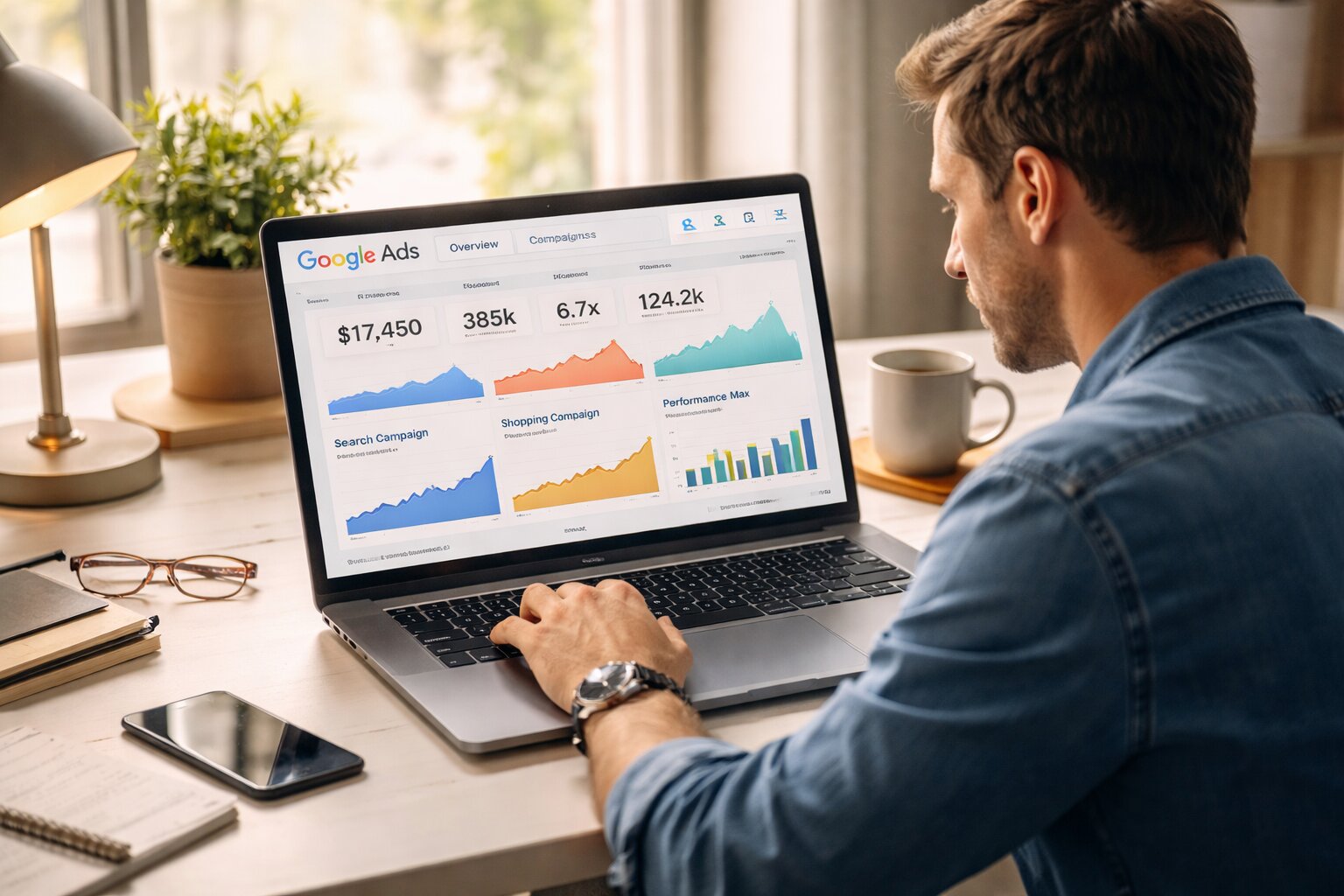
On paper Google Ads remains the most rational channel in digital advertising, because people tell you exactly what they want with a search query and you answer with an ad. Large benchmark studies of more than five thousand accounts report a median Google Ads return on ad spend of about 3.5 to 1 across industries with classic search campaigns delivering a median ROAS above five to one and many professional services and automotive categories sitting comfortably above three to one.[1] At the same time analysts tracking media spend have flagged that paid search budgets keep growing while impressions decline and cost per click increases, which means advertisers are paying more to fight over a slowly shrinking pool of clickable inventory.[2][7][8]
Cost, intent and the search advantage
The central reason Google still looks so strong on ROI is intent. When someone searches for an emergency dentist, cloud accounting software or a specific product model, they are far closer to purchase than a random person scrolling through a feed. Benchmarks suggest average conversion rates for search ads around four percent which is comfortably higher than most paid social traffic, especially for service businesses and software.[16] Even if your cost per click is between three and nine dollars in competitive verticals, each click carries a meaningful chance to become a high value customer, and that probability compounds when you include phone calls, store visits and repeat purchases.
From a scaling perspective the intent advantage means you often reach profitability faster on Google than on Meta, because you need fewer impressions and less creative testing to prove a concept. Many advertisers see search campaigns hit break even ROAS in weeks while social prospecting needs months to stabilise. The trade off is that once you own your core brand and high intent keywords, every incremental dollar is forced into broader matches, lower intent queries and more expensive auctions where marginal ROAS usually drops.
Performance Max and the automation trade off
Performance Max campaigns promise to simplify this complexity by letting Google allocate your budget across search, shopping, display, YouTube and discovery placements with a single objective. Benchmark data for 2025 places median Performance Max ROAS around 2.6 to 1 which is lower than manual search but still profitable for many ecommerce brands when you consider remarketing and new customer acquisition together.[1] The appeal is obvious, when the algorithm works it can find pockets of intent you would never think to target manually.
The risk is opacity. Performance Max hides search term data and mixes multiple channels in one performance number, which makes it harder to see where profit really comes from. Agencies reporting on 2025 trends describe a pattern where Performance Max drives large volumes at acceptable blended ROAS while quietly cannibalising branded search and retargeting that would have converted anyway.[7][8] For 2026 the smarter approach is to treat Performance Max as a complement to carefully protected brand and high intent campaigns, not a full replacement for human structured search strategy.
Where Google Ads still wins on profitability
For local lead generation, B2B and certain high ticket ecommerce, Google remains the first channel to scale because lifetime value and high intent queries create a cushion against rising click costs. Health care practices, legal services and specialist business to business firms still report average ROAS between roughly three and four to one on Google when campaigns are tightly geofenced and paired with strong landing pages and call handling.[1][6][7] In those cases Meta is often a useful support act for remarketing and awareness rather than the main profit centre.
Google also keeps an advantage in measurement. Although the industry spent years preparing for the disappearance of third party cookies, Google ultimately abandoned plans to fully deprecate those cookies in Chrome and even retired the Privacy Sandbox project branding, keeping existing browser controls instead.[9][10][11] That decision means search advertisers retain relatively stable tracking and attribution, especially when they combine Google Ads, Google Analytics and offline conversion imports. There is still signal loss from privacy regulation and consent banners, but the ground under search campaigns is less volatile than the mobile app heavy environment where Meta operates.
How Meta Ads ROI really behaves in 2026

Meta Ads operate on a different psychological and technical foundation. People scroll through feeds to be entertained and connected, not to look for suppliers, and the advertising system infers intent from behaviour and creative engagement rather than explicit search queries. Independent benchmarks for 2025 put the median Facebook ROAS at about 2.19 to 1 across all industries, with high margin categories like luxury goods and home and garden often reaching three and a half to four to one on well optimised campaigns.[2] Other cross platform datasets report slightly higher medians for Meta around 2.2 to 1 when compared against search and other social placements.[1]
These numbers initially look weaker than Google, yet they hide two important advantages. First, Meta can generate very high ROAS on retargeting and warm audiences, where click through rates and conversion rates spike well above average.[15] Second, Meta frequently outperforms Google for visual impulse driven products such as fashion, beauty and certain consumer electronics, especially when brands combine creator content and social proof with fast shipping and simple offers.[17][13]
Prospecting, retargeting and where the real profit sits
Meta campaigns rarely behave the same across cold, warm and hot audiences. Retargeting pools built from site visitors, email lists and previous buyers regularly generate ROAS between four and twelve to one for ecommerce brands, because the platform simply nudges users who already know the product.[2][15] Prospecting into cold interest based audiences often delivers ROAS in the two to four to one range and sometimes lower, which looks unimpressive until you account for customer lifetime value and the lift it provides to search and direct traffic.
From a scaling standpoint the trap is obvious. If you only look at last click ROAS, you will over invest in retargeting and starve cold acquisition, until your warm pools dry up and performance collapses. The brands that still scale Meta profitably in 2026 typically treat prospecting ROAS as a feeder metric for the whole customer file, not a standalone score, and they monitor blended profit across owned channels rather than obsessing over individual ad sets.
Attribution gaps and the hidden Meta performance
Meta was hit hard by mobile privacy changes, especially Apple iOS tracking restrictions, which reduced the platform’s ability to attribute conversions accurately. Industry analysis suggests some mobile heavy businesses see twenty to thirty percent of conversions disappear from Meta dashboards even though revenue still arrives in their commerce systems.[2][15] That means reported ROAS may understate true performance, particularly for brands with strong email and direct channels where customers come back through non ad clicks.
To close the gap, Meta has pushed server side Conversions API integrations, improved aggregated event measurement and leaned heavily on modeled conversions, where machine learning fills in missing events. This makes campaign reporting less intuitive yet more robust at scale, because optimisation no longer depends entirely on pixel fires that may never land. For serious 2026 advertisers the minimum viable Meta stack includes proper Conversions API setup, clean event naming, consistent use of UTM parameters and external source of truth dashboards, whether in an analytics platform or a data warehouse.
Brand safety, fraud and the cost of cheap reach
Another factor hidden in ROI spreadsheets is brand risk. Investigative reporting based on leaked internal documents suggests Meta generated a significant portion of its 2024 revenue from advertising that platforms themselves classified as scams or banned content, with billions of scam ads served each day and relatively low enforcement rates across many markets.[12] While Meta has pledged stronger moderation, this track record matters for brands that care about adjacency, especially in regulated industries or markets where consumers are already suspicious of online ads.
Cheap reach loses its appeal if your creative appears next to deceptive offers or if users begin to associate your brand with the noise of a cluttered feed. In practice this pushes cautious advertisers toward stricter placement controls, whitelisting, block lists and heavier investment in first party brand building channels such as email, communities and offline experiences, using Meta as a paid amplifier rather than the core trust engine.[14][13]
Meta Ads vs Google Ads ROI by business model
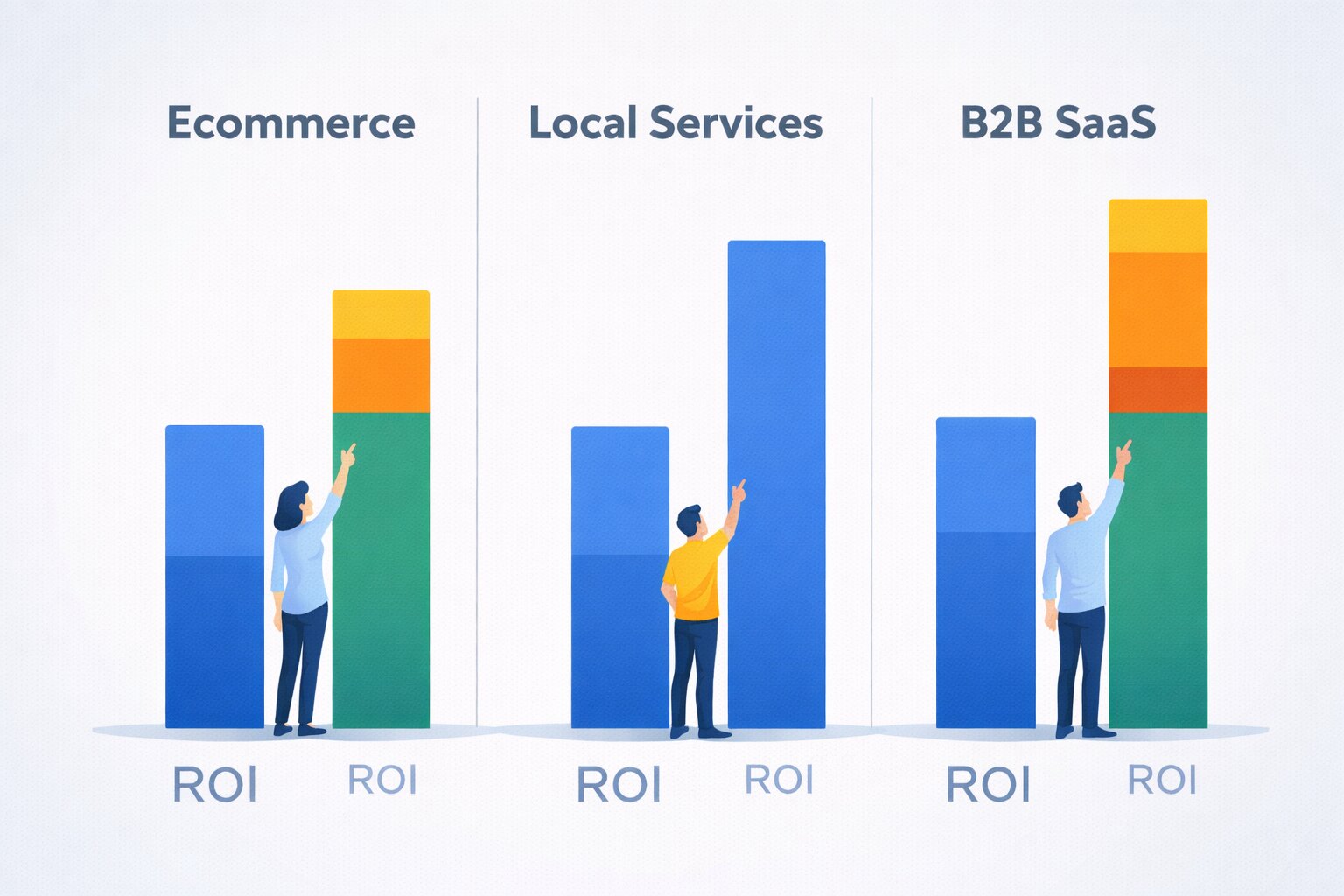
There is no universal winner in Meta Ads vs Google Ads ROI analysis for 2026, because the right answer depends on how people naturally decide to buy what you sell. The same platform that prints money for one brand can quietly destroy margin for another if the intent pattern does not match. A more useful way to think about the question is to map common business models against the strengths and weaknesses of each channel.
Ecommerce and direct to consumer brands
For ecommerce, especially visually driven consumer goods, Meta still often provides the fastest path from zero to one. Creator style video, user generated content and carousel formats allow you to test offers, price points and angles quickly, then push winning creatives into Advantage Plus shopping campaigns for scale.[15][17] Many brands report Meta prospecting ROAS in the two to four to one range that looks modest but becomes very attractive once you add email flows, cross sells and repeat purchase patterns over six to twelve months.[2]
Google enters the picture when you have clear search demand. If people actively look for your brand name, your category or specific use cases, search and shopping campaigns can capture that intent at strong ROAS and protect you from competitors bidding on your name.[1][16] A common pattern in 2026 for mid size ecommerce is to acquire first time buyers mainly on Meta at blended break even or slightly profitable ROAS, then harvest high intent repeat and competitor traffic on Google where the margin is thicker.
Local services and lead generation
Local service providers such as dentists, plumbers, law firms and clinics still lean heavily on Google Ads because search behaviour aligns perfectly with urgent intent. Benchmarks show legal services and medical practices achieving average Google ROAS between roughly three and four to one even with expensive clicks, due to high customer lifetime value and strong conversion rates from well optimised landing pages and call handling.[1][7][8]
Meta can still play a valuable supporting role. Lead generation campaigns with educational content and retargeting can warm up audiences before they search, especially for non urgent offers like cosmetic procedures, coaching or elective surgeries. However if you had to pick one channel to scale first for a local practice in 2026, Google usually delivers more predictable and defensible ROI, because a significant share of demand still starts with a search query and ends with a phone call.
B2B SaaS and long funnel offers
For B2B SaaS and complex services, both Google and Meta face challenges, but in different ways. Search works well for problem aware queries such as project management software for agencies or data warehouse consulting, yet competition is intense and clicks can cost tens of dollars in crowded categories.[1][6] Meta can reach decision makers with thought leadership and case study creative yet often struggles to attribute revenue when deal cycles last many months.
Here the ROI question shifts from immediate ROAS to pipeline impact. Google often excels at capturing bottom funnel demand and delivering high intent demo requests, while Meta shines at filling the top of the funnel with engaged audiences who later search, respond to email or attend events. In 2026 the most effective B2B setups tend to run always on Google search around core intent, with Meta and other social channels focused on content distribution, event promotion and account based marketing sequences rather than direct sign up pushes.
Scaling strategy, from first profitable campaign to omnichannel budgets
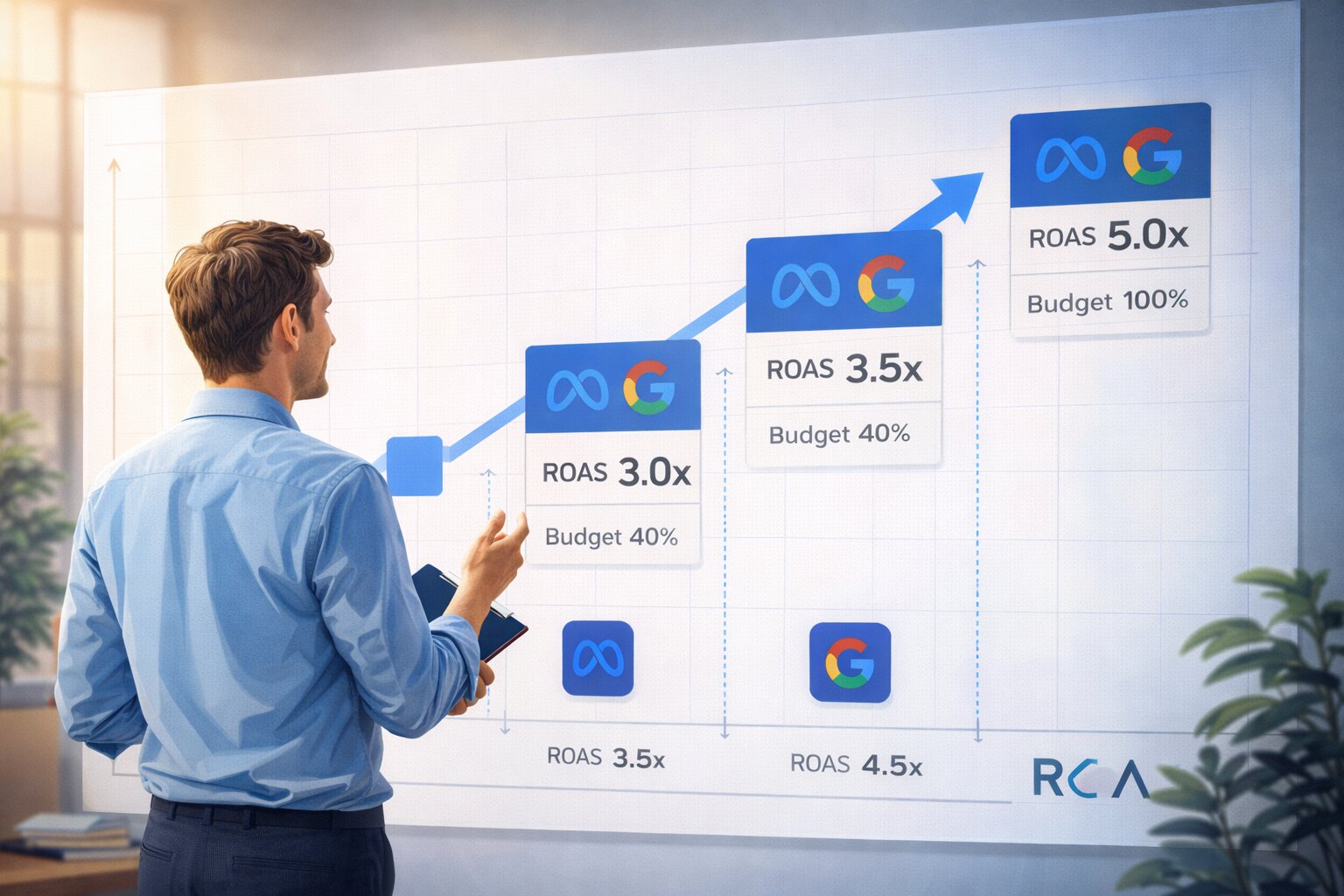
Once you have stable campaigns on one or both platforms, the real question becomes how hard you can safely scale without destroying ROI. Here classic concepts like break even ROAS and target ROAS matter more than channel loyalty. Practical guides suggest that most businesses should know their break even ROAS based on gross margin then aim for one and a half to two times that number while testing and roughly two to three times while scaling for profit.[2]
On Google this often means protecting non negotiable campaigns such as brand search and core high intent terms with conservative target return strategies, while using Performance Max and display to explore incremental volume at slightly lower ROAS. On Meta it means separating prospecting from remarketing, accepting that cold campaigns can run near break even as long as blended account ROAS and profit look healthy over monthly or quarterly cohorts.
A practical 2026 rule of thumb is to scale budgets in measured steps while watching marginal ROAS rather than average ROAS. If doubling spend on a campaign only reduces ROAS slightly and unit economics stay within your target range, you can keep pushing. If every incremental dollar buys significantly worse returns, it is time to improve creative, expand audiences or move surplus budget into other channels instead of forcing a tired campaign to work harder.
Budget allocation examples for 2026
Although every business is different, a few patterns are emerging in how performance focused teams allocate spend between Meta and Google. Young ecommerce brands often start the year with something like sixty percent of spend on Meta, thirty percent on Google and ten percent on experiments such as influencer sponsorships or TikTok, then gradually increase Google’s share as branded search volume and returning customer revenue grow.[13][17]
Local lead generation businesses frequently invert that ratio and keep at least half of their paid media budget on Google search with a smaller portion on Meta for remarketing and audience expansion. B2B companies tend to view Meta and other social channels as content distribution layers on top of organic search, partnerships and outbound sales, rather than as direct response machines, which naturally caps Meta share of spend even when creative performs well.
In all three cases the smartest teams do not treat channel allocation as a one time set and forget decision. They review blended profit by cohort, experiment with creative and landing page changes, and move budgets quarterly as they spot fatigue or fresh opportunities. The winners in 2026 look less like platform loyalists and more like portfolio managers who re balance investments when market conditions shift.
Measurement in a post cookie maybe world
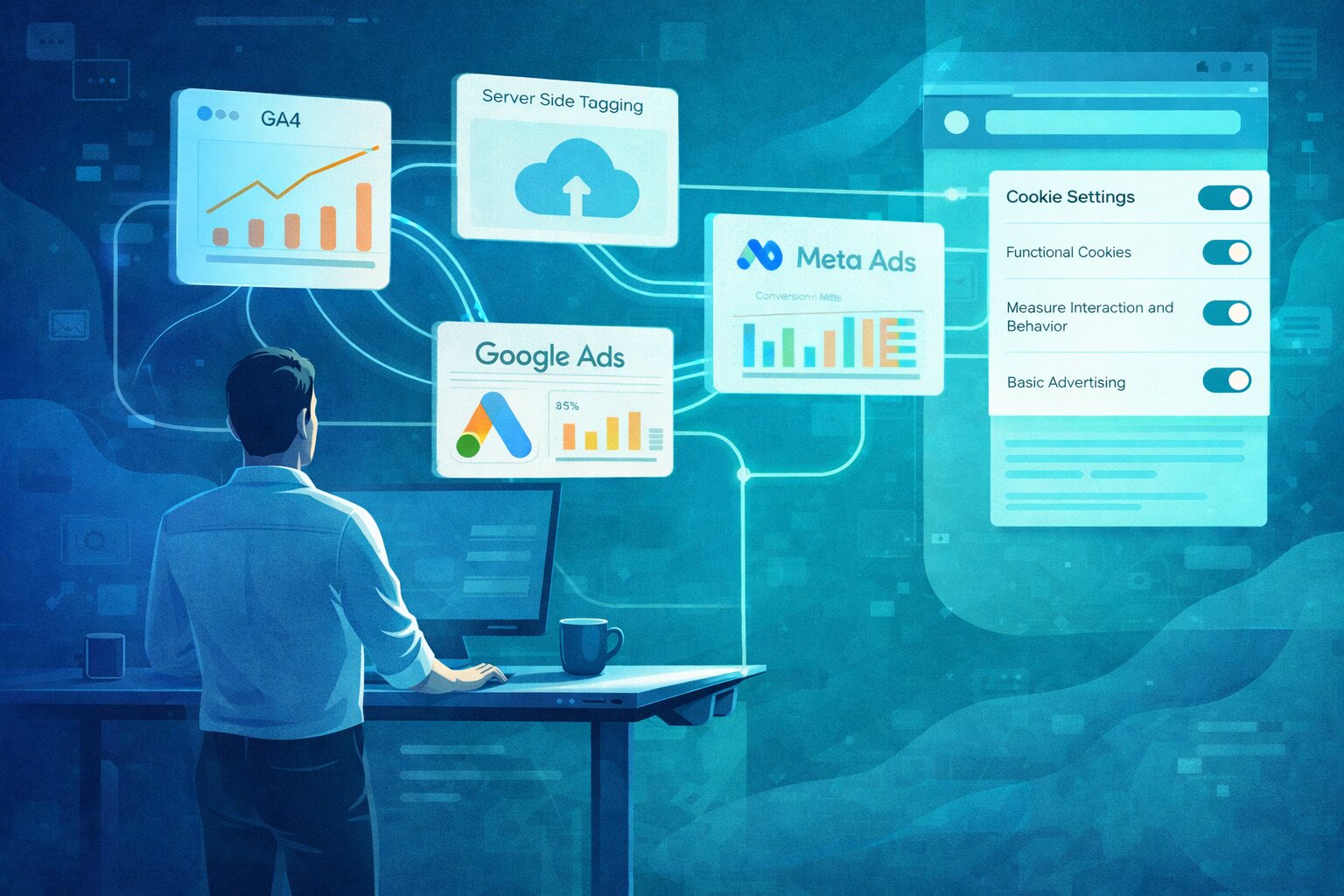
For years the advertising industry prepared for a clean break from third party cookies, only to watch that narrative change. In 2025 Google confirmed it would not deprecate third party cookies in Chrome and would instead keep existing cookie controls while sunsetting its Privacy Sandbox branding after limited adoption.[9][10][11] That decision avoided a sudden shock for search and display advertisers but did not reverse broader privacy trends, especially on mobile and in regional regulation.
Meta has already been living in a world of partial visibility, with mobile operating system changes and consent rules limiting how much user level data its pixel can send back. To compensate both Meta and Google have leaned heavily into modeled conversions, aggregated reports and consent aware tagging. GA4, server side tags and direct integrations between ad platforms and commerce systems are now standard components of serious performance setups, not nice extras.[1][2][23]
From an ROI standpoint the implication is simple. In 2026 you can no longer trust any single platform dashboard as your source of truth. Instead you triangulate. You compare Meta, Google and analytics numbers, monitor total revenue and lead volume during heavy test periods and rely on incrementality tests or lightweight media mix models when you plan big shifts in spend. The brands that do this well often discover that both Meta and Google perform better than their in platform ROAS suggests, which gives them the confidence to scale while competitors stay conservative.
A practical measurement stack for 2026
A practical measurement stack for Meta Ads vs Google Ads ROI analysis in 2026 includes a few non negotiable pieces. First, robust first party tracking that respects consent, which means clean analytics implementation, server side event forwarding where appropriate and well structured UTM parameters on every campaign.[9][19] Second, platform integrations such as Google offline conversion imports and Meta Conversions API so that algorithms can optimise against real business outcomes instead of soft metrics.
Third, at least one regular incrementality practice, which might be geo based holdout tests on Meta, keyword level experiments on Google or time based pauses for specific audiences. Finally, an internal habit of reviewing profit and payback period alongside ROAS so that budget decisions factor in cash flow and lifetime value, not just short term efficiency.
So, which channel should you scale first in 2026
When you put the benchmarks, business models and measurement realities together, a pattern emerges. Google is usually the safest first channel to scale when you sell something people actively search for and when each new customer delivers high lifetime value, since search intent supports strong ROAS even in an inflated media environment.[1][6][7] Meta is usually the more powerful engine for discovery when your product is visual, shareable and impulse friendly, and when you are willing to take a portfolio view of ROI that includes email, repeat purchases and organic search lift.[2][15][17]
In practice the highest performing teams in 2026 run both channels as complementary instruments rather than rivals. They protect profitable search and branded campaigns on Google, use Meta to fill the funnel with new audiences and creative insights, then recycle learning and audiences between platforms. They accept that single channel ROAS will look lower than it did in the glory years of cheap digital media, yet overall profit and resilience can be higher because they own more of the customer relationship and depend less on any one algorithm.[14][13]
For your own brand the most important step is to answer two questions honestly, where do your best customers actually start their journey and how long does it take to recover your acquisition cost. If that journey starts with a problem aware search and your payback window is short, Google deserves more of the early budget. If that journey starts with a story, a community or a creator, and if you can afford a longer payback period, Meta deserves a leading role.
Whichever path you choose, treat Meta Ads vs Google Ads ROI analysis for 2026 as an ongoing experiment rather than a one time verdict. Test, document, adjust and share your findings with your team and peers. If you have your own data points or hard learned lessons from scaling either platform, add them in the comments so we can all learn from real campaigns, not just benchmarks.
References
- Focus Digital — Average ROAS for Google Ads | 2025 Report
- Trendtrack — What is the Average ROAS for Facebook Ads in 2025
- MarketingLTB — Digital Advertising Statistics 2025
- Insider Intelligence / eMarketer — Worldwide Ad Spending Forecast 2025
- Sculpt — Share of Social Media Ad Spend Q3 2025
- Insider Intelligence / eMarketer — Exclusive Data, 4 Trends in Paid Search Advertising
- Karooya / Tinuiti — Digital Ads Benchmark Report Q2 2025
- DAC Group — 2025 Media Inflation, What Advertisers Need to Know Now
- Usercentrics — Google’s Changing Approach to Third Party Cookies
- Reuters — Google Opts Out of Standalone Prompt for Third Party Cookies
- Times of India — Google Kills its Six Year Old Project, Privacy Sandbox
- Reuters — Meta is Earning a Fortune on a Deluge of Fraudulent Ads
- The Guardian — Social Media Creators to Overtake Traditional Media in Ad Revenue
- Vogue — Is the Era of Digital Brand Building Over?
- Lebesgue — Meta Ads Performance, What is Happening with Facebook Advertising
- Ewebmarketing — Google Ads vs Facebook Ads, Which Performs Better in 2025
- Innovate Wings — Is Meta Ads Better Than Google in 2025? We A/B Tested It
- Nahid Hasan (LinkedIn) — Digital Ad Spend Is Not Dropping, It Is Exploding
- Adtelligent — How Third Party Cookies Elimination Will Affect Programmatic Ecosystem
- Google — Privacy Sandbox Feedback Report 2025 Q1
Ready to apply this to your business?
Let's Talk Strategy →