Margabagus.com – The global AI agents market is exploding from $5.1 billion in 2024 to a projected $47.1 billion by 2030 – that’s a staggering 45.8% annual growth rate. But here’s what most business leaders miss: we’re not just talking about chatbots anymore. These are sophisticated autonomous AI agent teams that can plan, reason, collaborate, and execute complex business processes while you sleep. The question isn’t whether this technology will transform your industry. It’s whether you’ll be leading the charge or playing catch-up.
The Evolution From Single Agents to Autonomous Teams

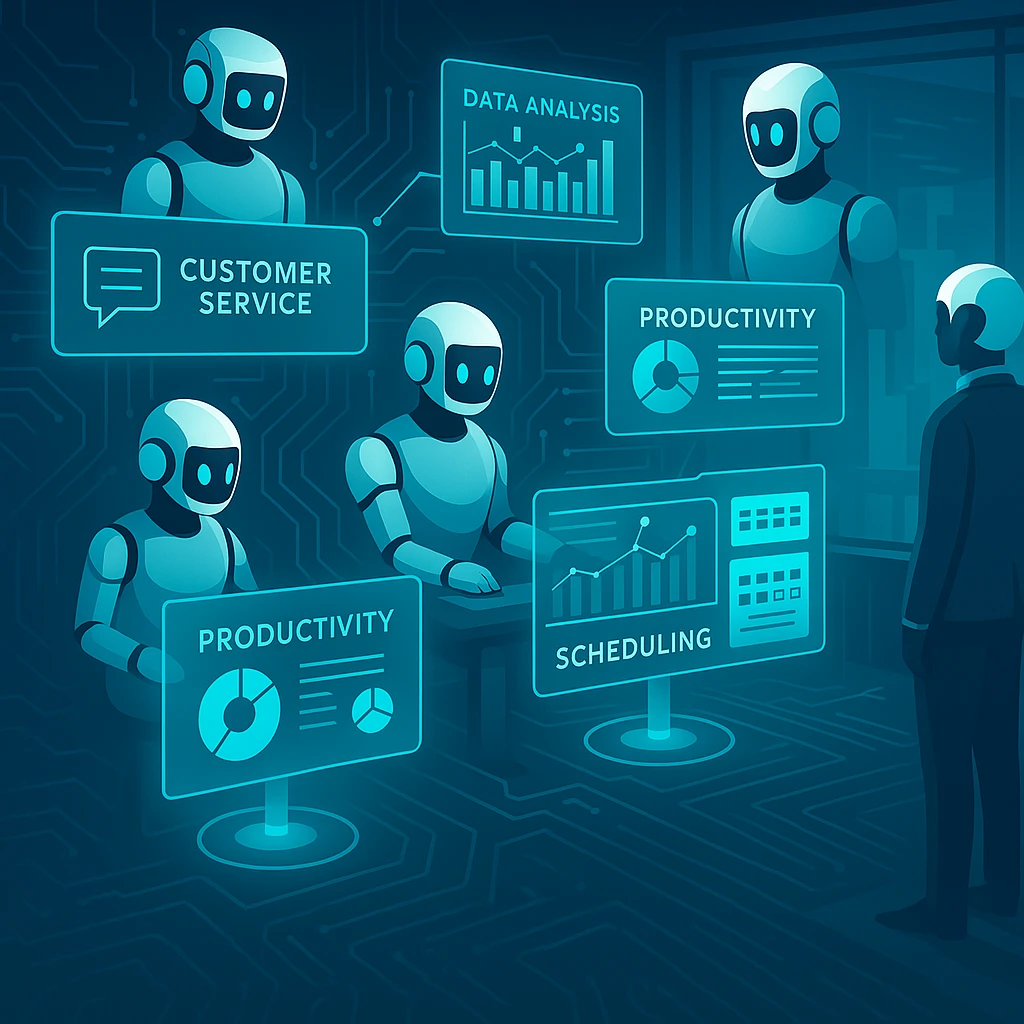
Remember when AI meant one smart assistant handling basic tasks? Those days are over. Multi-agent systems now function like “colonies of bees,” with each agent specializing in different roles – one handles perception, another planning, creating a coordinated ‘hive mind’ of AI workers.
Think about it this way: instead of hiring one super-employee to handle everything, you’re building specialized teams where each member excels at their specific function. Microsoft’s Ray Smith explains why this matters: “It’s very hard to create a reliable process that you squeeze into one agent. Breaking it up into parts improves maintainability and makes building solutions easier, but it also significantly enhances reliability”.
The breakthrough? These agents don’t just work independently – they communicate, coordinate, and learn from each other. In 2025, functional agents manage distinct parts of the customer journey while maintaining context seamlessly across teams. Your marketing agent passes critical lead information to your business development agent, who then hands off to account management with full context intact.
Check out this fascinating article: The Ultimate AI Agent Tools and Frameworks Comparison Guide for 2025: Which Solution Is Right for You?
Real-World Results: The Numbers Don’t Lie
Let’s cut through the hype with hard data. Companies using AI agents report that 83% of sales teams with AI saw revenue growth in the past year, compared to just 66% of teams without AI. But productivity gains tell an even more compelling story:
ServiceNow’s integration of AI agents led to a 52% reduction in time required to handle complex customer service cases. That’s not incremental improvement – that’s transformation.
Here’s where it gets interesting: salespeople spend 71% of their time on non-selling tasks, while service reps spend 66% of their time on non-customer facing work. Autonomous AI agent teams are specifically designed to eliminate this waste. According to Statista’s 2024 survey, 85% of respondents reported that AI-driven automation led to higher productivity and efficiency in their organizations.
Wiley provides a perfect case study. They’ve seen a more than 40% increase in case resolution with Agentforce, outperforming their old bot significantly. Meanwhile, Deloitte’s Zora AI platform aims to reduce finance team costs by 25% and increase productivity by 40%.
The Architecture of Autonomous Success
What makes these systems so powerful? It’s all about intelligent specialization and seamless coordination. Modern multi-agent systems operate on three key principles: agent autonomy (independent decision-making), decentralization (local information processing), and emergent behavior (complex patterns arising from simple interactions).
Picture your business as an orchestra. Traditional AI was like having one incredibly talented musician trying to play every instrument. Multi-agent systems create specialized ensembles where each AI agent handles specific responsibilities while sharing information and coordinating with others.
Microsoft’s GitHub Copilot coding agent exemplifies this evolution – it goes beyond suggesting code snippets to autonomously solving programming tasks, refactoring code, improving test coverage, and implementing new features while collaborating with other agents across all stages of software development.
The magic happens in the coordination layer. These systems employ “AI watchdog” agents to monitor their own AI-driven processes for signs of emergent risky behavior, creating a web of safeguards that catch issues more quickly than periodic human checks.
Industry Applications: Where the Rubber Meets the Road
Financial services are leading the charge with compelling use cases. Personal finance AI agents now work like automated advisor teams: one agent optimizes your budget by negotiating bills, another invests savings based on goals, and another monitors for fraud – all coordinated through a higher-level personal finance planner agent.
Manufacturing showcases the power of autonomous teams beautifully. In smart factories, if one robotic arm is busy or down, other arms automatically adjust to take over tasks without halting production. AI-powered automation in manufacturing results in a 25% increase in productivity, according to McKinsey.
Healthcare leverages multi-agent systems for patient monitoring, where AI agents track vitals and send real-time alerts to healthcare teams for faster, proactive care, while other agents work on drug discovery by simulating biological processes.
Check out this fascinating article: Build Your First AI Agent: Step-by-Step Guide 2025
The 2025 Tipping Point
OpenAI CFO Sarah Friar predicts: “I think we are going to see a lot of motion next year around agents, and I think people are going to be surprised at how fast this technology comes at us”. The data supports her optimism.
Deloitte predicts that 25% of companies using generative AI will launch agentic AI pilots or proofs of concept in 2025, growing to 50% in 2027. But early adopters aren’t waiting. The share of companies running fully AI-led operations jumped from 9% in 2023 to 16% in 2024, with these businesses seeing 2.4 times higher productivity.
Microsoft’s Ece Kamar notes: “Workers at nearly 70% of Fortune 500 companies already use Microsoft 365 Copilot, and in 2025, a new generation of AI-powered agents will do more — even handling certain tasks on behalf of users”.
Implementation Strategy: Your Roadmap to Success

Starting your autonomous AI agent teams journey requires strategic thinking, not just technology deployment. Early enterprise deployments have yielded up to 50% efficiency improvements in functions like customer service, sales, and HR operations.
Begin with low-to-medium complexity use cases. Focus on repetitive tasks that require human intervention for domain knowledge – this allows teams to learn, iterate, and build trust while minimizing risk. Customer support ticket management offers an excellent starting point, where intelligent agents can classify issues, prioritize based on urgency, and route tickets to appropriate team members.
For marketing leaders, 58% of companies are using automation to enable new products and services, while 47% highlight heightened personalization as a key benefit. AI agents can monitor campaign performance metrics across channels, autonomously adjusting targeting, messaging, and spend based on real-time data.
The key is starting small and scaling strategically. Phased AI adoption is crucial – identify specific processes where AI offers immediate benefits, implement in targeted areas, then gradually scale as employees become more adept.
Overcoming Implementation Challenges
Let’s address the elephant in the room: reliability concerns. IBM’s Marina Danilevsky cautions: “Getting the job right most of the time isn’t enough” for enterprise adoption. That’s why designing rollback mechanisms and audit trails is integral to making these agents viable in high-stakes industries.
The infrastructure question looms large. As one industry expert notes: “2025 isn’t going to be the year when we see fully developed agentic AI. 2025 is the year we build the infrastructure for it”. This means investing in the foundational elements that enable seamless agent coordination.
Human oversight remains crucial. Microsoft’s Ece Kamar emphasizes: “In 2025, a lot of conversation will be about drawing boundaries around what agents are allowed and not allowed to do, and always having human oversight”.
The ROI Reality Check
The financial case for autonomous AI agent teams is becoming undeniable. 62% of companies anticipate a full 100% or greater return on investment from their AI agent deployments. Companies adopting agentic AI report an average revenue increase of 6% to 10%.
Marketing teams are seeing particularly strong returns, with 80% of marketers in 2025 reporting that AI tools exceeded their ROI expectations. In e-commerce, AI agents boosted efficiency by 76%, with 69% of retailers seeing higher profits through smart personalization.
The productivity multiplier effect is real. Customer support agents using generative AI assistants boosted productivity by 14% on average, while workers are 33% more productive during each hour they use generative AI.
Check out this fascinating article: The No-Code Revolution: Building Custom AI Agents Without Writing a Single Line of Code
Future-Proofing Your Business
Research indicates that tasks AI agents can autonomously complete with 50% success rate have been doubling approximately every seven months. This exponential improvement curve suggests that within five years, AI agents could handle many tasks currently requiring human effort.
The timeline for artificial general intelligence is compressing. OpenAI’s Sarah Friar predicts AGI achievement “in the shorter term” – closer to two years than a decade. For business leaders, this means the window for competitive advantage through early adoption is narrowing rapidly.
NVIDIA CEO Jensen Huang declared 2025 the “Year of AI Agents,” projecting these autonomous programs represent a “multi-trillion dollar opportunity” and heralding an “Age of AI Agentics”. He even envisions IT departments functioning as HR departments for AI agents, managing expanding rosters of digital employees.
Your Next Steps
The autonomous AI agent teams revolution isn’t coming – it’s here. The critical question for businesses is not whether to adopt autonomous agents, but how quickly they can integrate them. Those who hesitate risk being left behind.
Start by identifying your highest-value, most repetitive processes. Invest in training programs that educate employees about AI capabilities and effective tool usage. Encourage collaboration between AI and human teams to ensure shared goals.
87% of executives believe generative AI will augment jobs rather than replace them, suggesting most roles will evolve with AI support. The companies thriving in this transition are those fostering experimentation cultures. Organizations with this open mindset achieve 22% higher revenue growth rates than those who don’t.
The future belongs to businesses that understand this fundamental truth: autonomous AI agent teams aren’t about replacing human intelligence – they’re about amplifying it. The new paradigm will be Human Intelligence + Artificial Intelligence = Elevated Collaborative Intelligence.
Your competitors are already building their autonomous teams. The question is: will you be leading this transformation, or will you be scrambling to catch up while they work around the clock?
The choice is yours. But remember – these teams never sleep, never take breaks, and never stop improving. In 2025, that’s not just an advantage. It’s a necessity.
Ready to apply this to your business?
Let's Talk Strategy →