Table of Contents
- At a glance, ElevenLabs voice cloning consent in 2026
- Why ElevenLabs voice cloning consent became a 2026 frontline issue
- A wave of scams, a patchwork of laws, and a new definition of consent
- How ElevenLabs voice cloning works today, and where consent sits in the workflow
- Instant versus professional cloning, and why consent should be stricter than the user interface
- Identity verification, ownership declarations, and the limits of platform safeguards
- ElevenLabs Terms of Service and safety policies that shape consent
- User voice models, licensing, and the necessary rights clause
- Prohibited uses, No Go Voices, and election season safeguards
- Regulatory pressure on synthetic voices in 2026
- Why human detection of AI voices cannot replace consent and disclosure
- Practical consent models for creators, studios, and platforms
- Written consent templates, and what they should cover
- Records, retention, and audit readiness
- A simple compliance checklist for ElevenLabs voice cloning projects
- Open questions, grey areas, and how experts expect 2026 to evolve
- Where this leaves you if you plan to use ElevenLabs in 2026
ElevenLabs voice cloning consent is no longer a niche legal footnote, it has become a frontline issue for anyone who wants to use synthetic voices without walking into a reputational or regulatory disaster. As deepfake voice scams rise, one global study found that around one in four adults has already encountered some form of AI voice scam, and a significant minority has been directly targeted with cloned voices that sound like family members or colleagues [1][2]. At the same time regulators in Europe and the United States are rolling out new rules that treat cloned voices as protected identity, not just harmless digital effects [3]. If you plan to build content, products, or customer experiences on top of ElevenLabs in 2026, you need to understand how consent works in practice rather than assume the default settings will keep you safe.
At a glance, ElevenLabs voice cloning consent in 2026
Before diving into legal detail, it helps to see the big picture on one screen. The table below summarizes how ElevenLabs positions consent, where the company draws hard lines, and what this means for creators, studios, and businesses.
| Aspect | What it means in practice | Where it is defined |
|---|---|---|
| Who you can clone | Only your own voice or a voice you are clearly authorized to share, commercial projects should have written releases | ElevenLabs Terms of Service and Voice Processing Notice, plus help center guidance [4][5] |
| Consent requirement | ElevenLabs markets voice cloning as available only with explicit permission from the voice owner, you must secure and document that permission yourself | Product pages and safety materials, plus your own contracts [6] |
| No go voices | Safeguards block the creation of clones that approximate certain high risk voices, notably political figures in active election cycles | No Go Voices policy and safety documentation [7] |
| Traceability and logging | All generated audio can be traced back to the account that created it, which supports investigations and legal discovery | ElevenLabs safety page and help center [5][8] |
| External regulation | EU AI Act, US deepfake and right of publicity laws, and national media rules add duties for disclosure and consent that sit on top of ElevenLabs policies | Deepfake law overviews and regulatory guidance [3][9] |
| Your responsibilities | You must collect and store consent, decide when and how to label AI audio, train your team, and respond if something goes wrong | Your own governance, contracts, and compliance checklist informed by ElevenLabs rules |
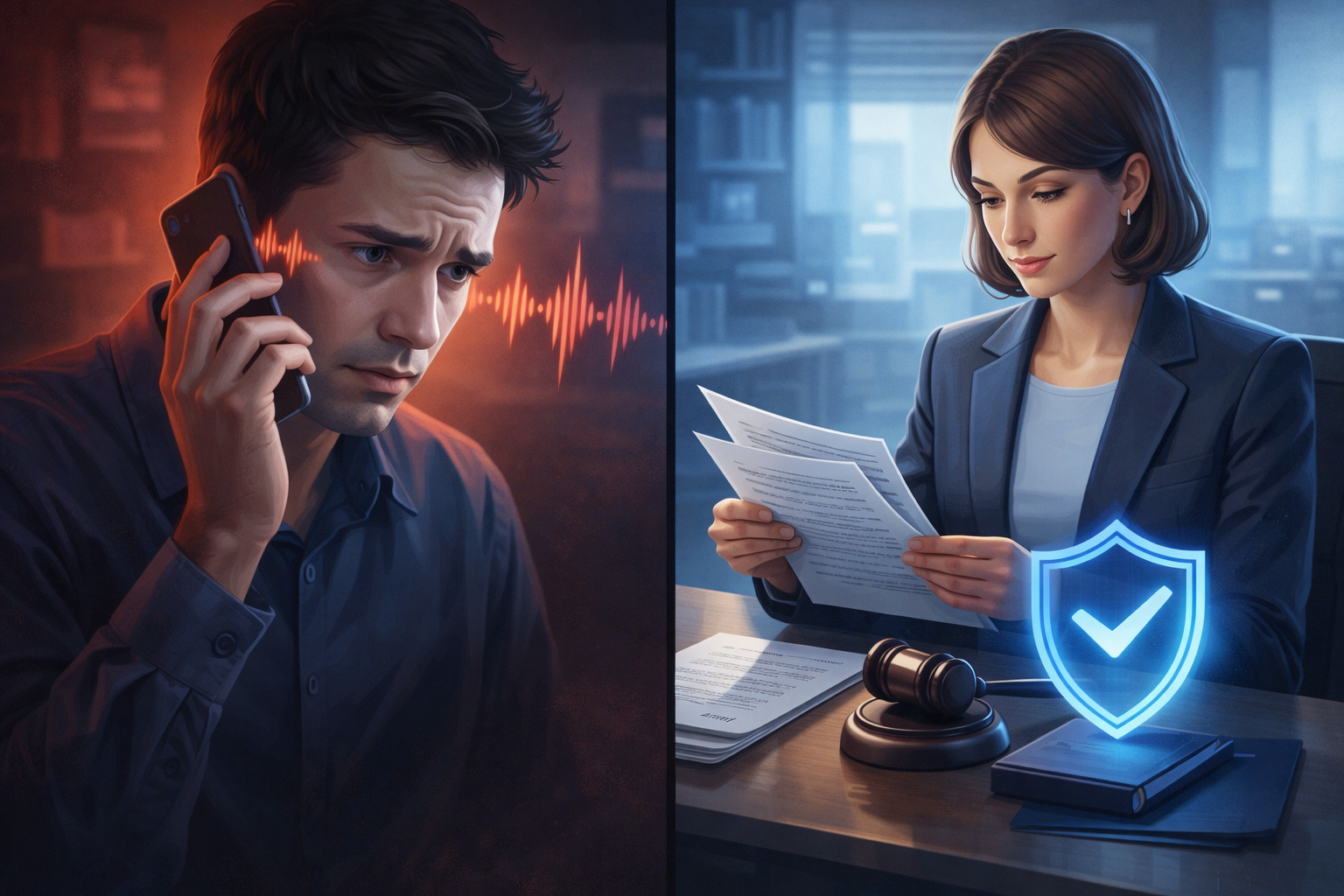
Rising AI voice scams and new laws turn voice cloning consent into a frontline risk and compliance question.
Why ElevenLabs voice cloning consent became a 2026 frontline issue
Voice cloning has moved from novelty to infrastructure, and that shift explains why consent has become a board level topic rather than a side note in a terms page. On the threat side, fraud researchers now describe voice cloning as one of the most democratized deepfake attack vectors, with low cost tools allowing scammers to generate convincing clones from a few seconds of scraped audio [1]. Laws like the Tennessee ELVIS Act, which explicitly protects an individual voice and prohibits commercial AI cloning without permission, show how legislators now treat synthetic voices as an extension of the person rather than a generic sound effect [3]. In parallel, the EU AI Act requires that synthetic media including AI generated voices be clearly disclosed as such in many contexts, which means companies cannot hide AI audio behind fine print anymore [9].
For ElevenLabs, this environment has turned safety from a feature into a core product pillar. The company openly acknowledges that its tools can be misused and pairs their marketing of lifelike multilingual voice clones with language about explicit permission and safeguards built into the platform [6]. That combination, a fast creative tool coupled with policy driven friction, sets the baseline for how responsible teams are expected to behave in 2026. Consent is not just a checkbox in the interface, it is the foundation for everything you generate with these models.
At the same time, independent academic research is closing any remaining gap between perception and reality. A 2025 study led out of UC Berkeley found that people are often unable to reliably distinguish AI cloned voices from real speakers, and that even when listeners know they are being tested their detection accuracy hovers only modestly above chance [10]. In other words, if you rely on your audience to simply notice that something sounds artificial, you are betting against the data.
A wave of scams, a patchwork of laws, and a new definition of consent
The growth of AI voice scams has forced regulators and platforms to treat consent as both an ethical and a security concept. Industry data highlighted cases where cloned voices were used to impersonate senior executives in convincing video calls, leading to multi million dollar wire transfers, as well as a rapid increase in consumer phone scams that exploit urgency and family relationships [1]. When governments moved to respond, most opted for targeted rules rather than one global statute, which is why 2026 looks like a patchwork.
On one branch of this patchwork sit deepfake specific rules. The Tennessee ELVIS Act protects voice as part of an individual likeness, while the US TAKE IT DOWN Act and the UK Online Safety Act focus on non consensual explicit deepfakes, forcing platforms to remove harmful synthetic media quickly once notified [3][9]. On another branch sits the EU AI Act, which does not single out voice by itself but treats AI generated media as content that must be clearly labeled when presented to the public [9]. The net effect is that consent is no longer just about whether a voice owner said yes once, it is about how that synthetic output is disclosed, governed, and used across borders over time.
All of this feeds back into ElevenLabs voice cloning consent in a practical way. The company can enforce some guardrails centrally, for example by blocking attempts to generate clones that approximate certain political voices, logging outputs per user account, and terminating users who violate its Prohibited Use Policy [5][7]. But only you can decide whether you should generate a particular clip at all, what the audience will be told, and whether your documentation would withstand scrutiny if a regulator, platform, or talent agency ever asks what you did.
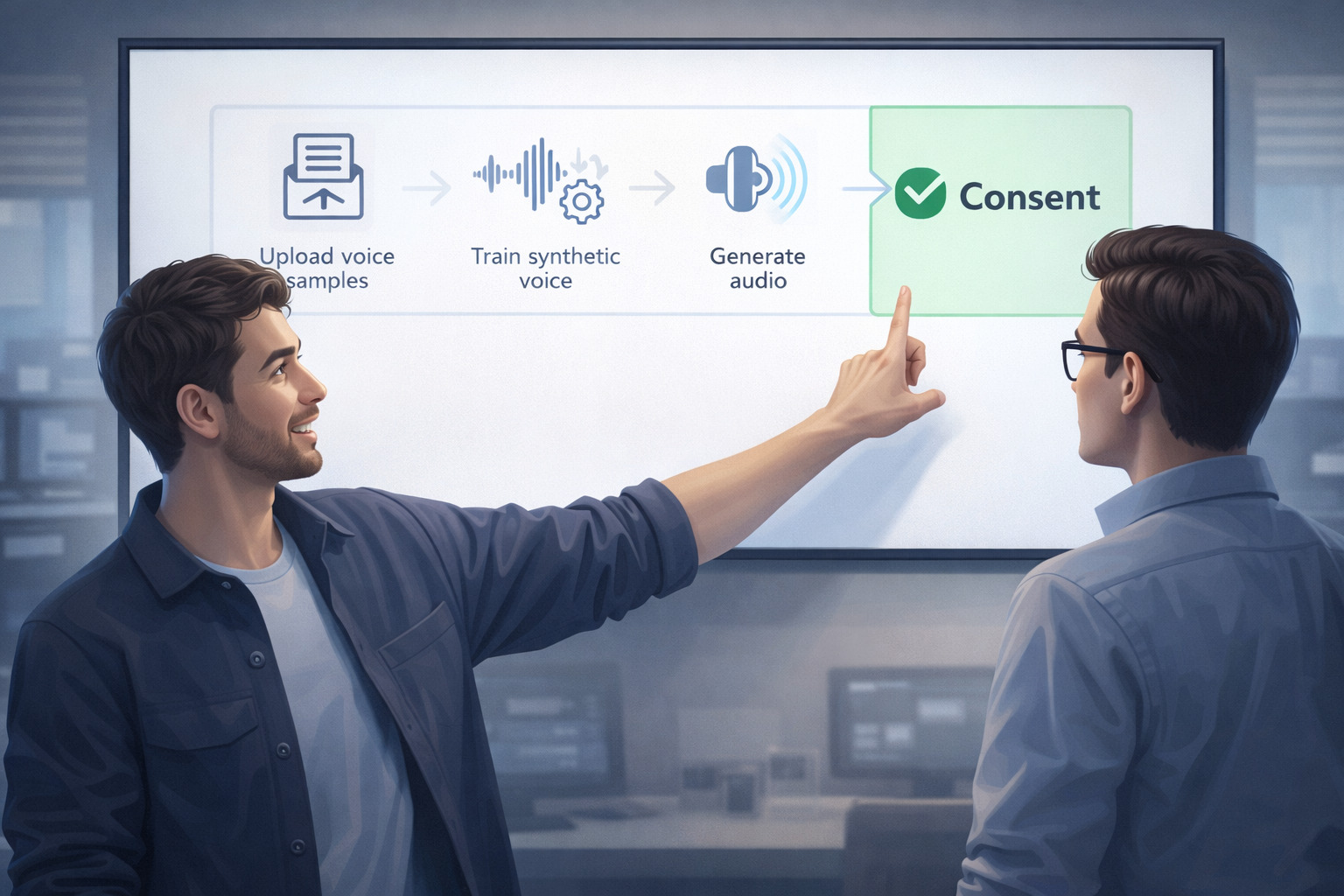
In a responsible workflow, consent is embedded alongside upload, training, and generation, not treated as an afterthought.
How ElevenLabs voice cloning works today, and where consent sits in the workflow
From the outside, ElevenLabs presents voice cloning as a straightforward creative tool, you upload or record samples, let the system train, and then type text to hear your synthetic voice read it back. Under the hood the company offers two primary modes, instant voice cloning that can work from tens of seconds of audio and a professional voice cloning track that expects longer, cleaner recordings and delivers higher fidelity models for long term projects [6][11]. Both modes can generate speech in dozens of languages, control emotion and pacing, and serve everything from audiobooks and games to brand campaigns.
What does not change between these modes is the consent expectation. ElevenLabs marketing materials repeatedly stress that voice cloning is only possible with explicit permission from the voice owner and that the platform is designed for legitimate uses such as accessibility, content production, and voice preservation rather than impersonation [6]. When you upload audio, the system treats that audio as Input that belongs either to you or to someone who has granted you the right to share it, and the Terms of Service require you to have all necessary rights before you press upload [11]. In practice that means the consent process happens before ElevenLabs ever sees the files.
The workflow also includes technical checks and verification steps. For professional voice cloning, users are asked to verify the voice after uploading samples, ideally using the same microphone and speaking style, and ElevenLabs can deny or delay activation if verification fails [11]. This is not a replacement for legal consent, but it creates a basic barrier against uploading random clips of celebrities or colleagues pulled from the internet. Combined with tracing every generated clip back to a specific user account, it forms the skeleton of a trust and safety regime around the core synthesis engine [5][8].
Instant versus professional cloning, and why consent should be stricter than the user interface
Instant voice cloning is attractive because it lowers friction. A short voice note, maybe recorded on a laptop microphone, can be enough to create a usable synthetic voice for prototyping or internal drafts [6]. In creative teams this often leads to improvisation, people record each other, test ideas, and share samples casually. The danger is that this informality leaks into production workflows and blurs the line between a quick test and a released asset.
Professional voice cloning by contrast is explicitly positioned as a long term investment. ElevenLabs recommends hours of clean, varied recordings, emphasizes quality control, and provides a more involved training pipeline for voices that will carry entire books, games, or brand channels [11]. This is where voice actors, influencers, and executives are likely to sign formal licenses that specify what the clone can be used for, how long, on which platforms, and for what compensation [5]. If you are working at this level, consent tends to be handled through contracts and legal review rather than an informal email.
The risk in 2026 is that the legal system no longer cares whether you thought of a project as a quick experiment or a serious deployment. If a cloned voice ends up in a public campaign or viral clip without proper authorization, the fact that it was generated using an instant mode does not make the misuse less actionable. For that reason many practitioners now recommend treating every ElevenLabs voice model as if it were a professional one from day one, complete with written consent, clear scope, and an agreed process for revocation or revision [9][12].
Identity verification, ownership declarations, and the limits of platform safeguards
ElevenLabs can see certain things very clearly, such as whether a file was uploaded from your account, which prompts produced a given clip, and whether that clip resembles a known list of no go voices [5][7]. It cannot see the contract you have with a voice actor, the side letter your agency negotiated with an athlete, or the internal policy you wrote about synthetic audio for customer support. That boundary explains why the company leans so heavily on representations in its Terms.
In section four of the non EEA Terms of Service, ElevenLabs requires users to warrant that they have all rights necessary to grant the platform a license to their Input, including any voices embedded in that audio, and that the content and any user voice models will not violate the rights of others [11]. The same section explains that ElevenLabs will use that Input including voice data to provide and improve the services and develop new models, while promising not to commercialize a user voice on a standalone basis without permission [11]. In other words, the platform promises certain guardrails for how it will use voices but shifts responsibility for obtaining and documenting consent back onto you.
Consent therefore becomes a three way relationship. The speaker grants rights to the client or creator, the client grants a license to ElevenLabs, and the platform enforces technical and policy rules on top. When any one of those links is weak or ambiguous, the entire structure becomes vulnerable to disputes and takedowns.
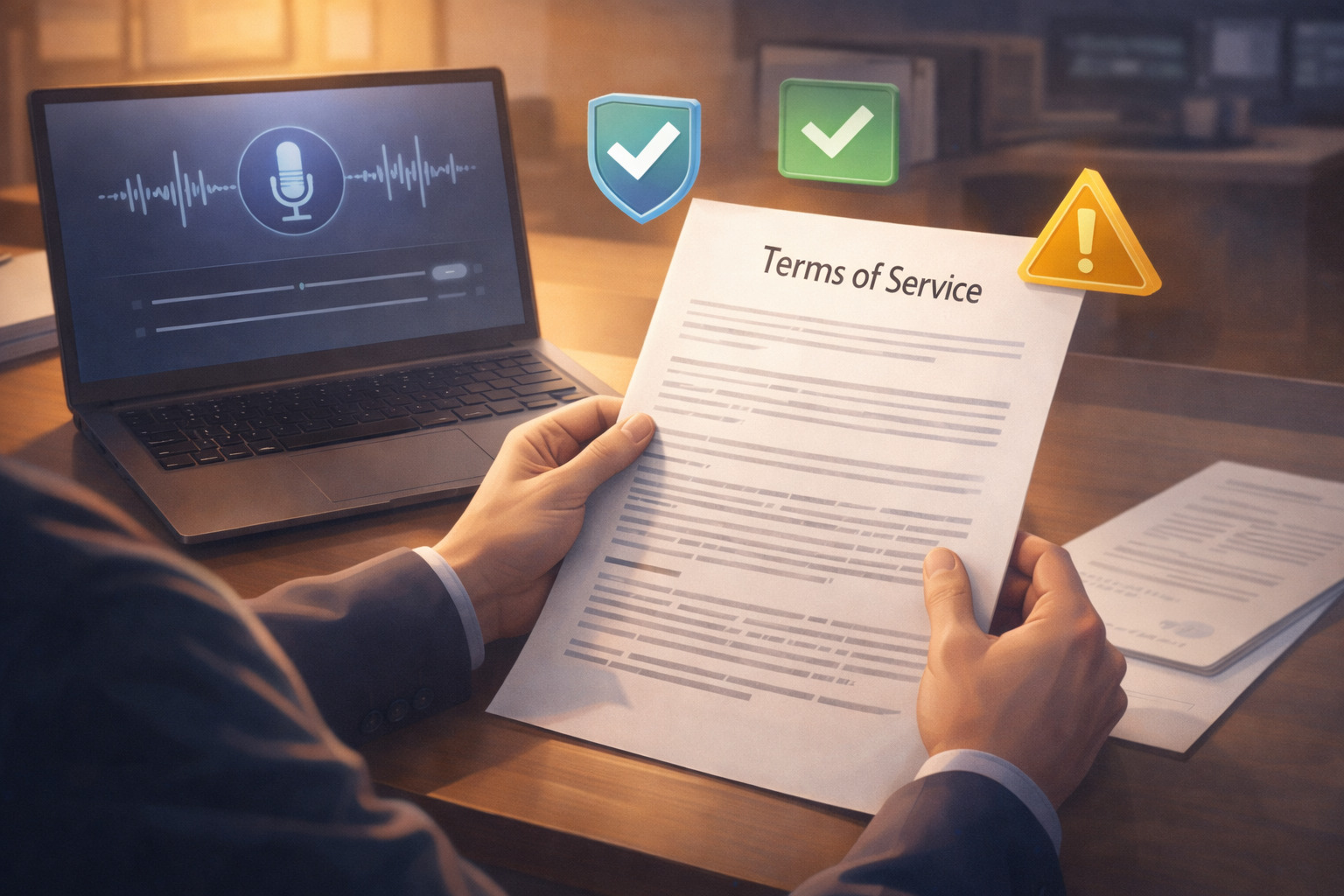
Terms of Service and safety policies quietly define how far you can go with voice cloning and whose rights you must protect.
ElevenLabs Terms of Service and safety policies that shape consent
Beyond the high level marketing language, ElevenLabs backs its consent story with specific safety and policy mechanisms. Its safety page describes a multi layer program built around principles such as safety by design, traceability, transparency, agility, and collaboration, with a dedicated cross functional team that evolves safeguards as new risks appear [5]. The same page highlights that all generated content can be traced back to the user who created it and that an AI speech classifier and support for standards like C2PA help others detect whether audio came from ElevenLabs [5]. These features do not create consent on their own, but they give platforms, regulators, and rights holders tools to investigate misuse.
The company also maintains a Prohibited Use Policy that bans harassment, impersonation, and other abusive behaviors, and it reserves the right to remove content, delete voices, or suspend accounts if users violate those terms [11]. That enforcement toolkit has already been invoked in real cases when synthetic voices were used to spread political misinformation or offensive content, and the company notes that serious violations can be referred to law enforcement [5][7]. For organizations that worry about brand risk, this kind of enforcement can be a feature because it signals that the vendor will back their public commitments with action.
Crucially, ElevenLabs has begun to codify specific guardrails around sensitive voices. Through the No Go Voices policy, the company restricts the creation of clones that approximate the voices of political figures, especially those actively involved in US and UK election cycles, and blocks banned voices so they can no longer be used on the platform [7]. This does not eliminate the possibility of misuse, but it raises the cost of generating election related disinformation with ElevenLabs and sends a clear signal about how the platform interprets its own consent and impersonation rules.
User voice models, licensing, and the necessary rights clause
The legal core of ElevenLabs consent model sits in the way it defines user voice models and content rights. A user voice model is essentially a synthetic voice built from your recordings or recordings you are authorized to share, and the terms explain that users retain rights over their input and outputs, but grant ElevenLabs a broad license to use that material to run and improve the services [11]. That license is perpetual, worldwide, and sublicensable, although the company states that it will not commercialize an individual voice on a standalone basis without permission.
For organizations, the more important line is the necessary rights clause. By using the service, you represent and warrant that your inputs and any user voice models will not infringe the rights of any other person, and that you have the authority to grant ElevenLabs the license described in the terms [11]. This shifts liability for unauthorized cloning onto the customer, which is why in house legal teams increasingly insist on seeing voice talent contracts before a single file is uploaded.
Some studios respond by adding explicit synthetic voice clauses to their talent agreements. These clauses spell out that the actor consents to voice cloning for defined projects or time frames, that the client can grant a license to vendors such as ElevenLabs for limited purposes, and that the actor retains rights against unauthorized third party uses. While these clauses are still evolving, they already reflect a consensus that a simple line about audio recording is not enough in a world where that recording powers a flexible AI model [9][12].
Prohibited uses, No Go Voices, and election season safeguards
ElevenLabs prohibited uses and No Go Voices policies serve as a safety net, but they are also a map of where consent is most fragile. The No Go Voices list specifically targets political voices that could be weaponized in election interference campaigns, reflecting a broader industry move to carve out special handling for public officials and candidates [7]. Blocking these voices slows down bad actors who might otherwise generate convincing robocalls or viral clips to suppress turnout or spread false statements.
The prohibited content and uses policy extends that idea to everyday scenarios. Users may not employ the service to harass, defraud, or impersonate others, and the company reserves the right to ban repeat or serious violators and to work with authorities when illegal misuse occurs [5][11]. For teams designing consent workflows, these policies highlight specific red zones, political messaging, financial fraud, non consensual intimate content, and impersonation for gain, that should trigger extra review even if a basic consent form exists.
Regulatory pressure on synthetic voices in 2026
ElevenLabs does not operate in a vacuum, it sits inside an evolving legal environment for synthetic media where audio deepfakes have moved from curiosity to core governance challenge. This environment matters because even perfect compliance with a platform Terms of Service does not guarantee compliance with local law. In 2026, three strands of regulation stand out for anyone working with AI voices.
The first strand focuses on transparency. The EU AI Act requires that AI generated content including audio be clearly labeled as such when it might be mistaken for genuine human output, and those labeling duties become mandatory from August 2025 onward [9]. Although ElevenLabs users can technically generate unlabeled files, European regulators now expect downstream publishers to tell audiences when a voice is synthetic, especially in news, political communication, or sensitive contexts. Similar expectations are emerging in platform policies, where social networks and video hosts ask uploaders to declare whether they used AI to generate audio or faces.
The second strand focuses on personality rights and right of publicity. Laws like the Tennessee ELVIS Act explicitly treat voice as part of a person protected identity and forbid the use of AI to clone that voice for commercial purposes without permission [3]. Legal scholars also point to court decisions such as the Li v Liu case in China, where judges found that a deepfake voice clone infringed an individual personality rights even though the image was not copied, extending traditional protections into the synthetic era [3][13]. For a global ElevenLabs deployment this means that consent requirements do not end with a signature on a Western style contract, they must be interpreted through local personality and privacy law.
The third strand covers deepfake abuse more broadly. Recent laws target non consensual intimate imagery, abusive deepfake pornography, and the distribution of synthetic media designed to harass or mislead, often giving victims fast takedown rights and imposing duties on platforms to act when notified [3][9]. While ElevenLabs prohibits such uses in its own policies, the legal risk for a brand or studio that releases harmful content remains significant even if the platform later suspends an account.
Why human detection of AI voices cannot replace consent and disclosure
One lingering hope in public debates has been that people will eventually learn to spot synthetic voices the way they can often spot a fake email. The evidence points in the opposite direction. In the UC Berkeley study on AI powered voice clones, participants were asked either to judge whether two clips came from the same person or to decide whether a single clip was real or AI generated, and in both cases their accuracy was only modestly above chance and dropped further for shorter or more scripted audio [10]. Many listeners reported feeling confident about their judgments even when they were wrong.
Other survey work on deepfake perception paints a similar picture, people regularly overestimate their ability to detect synthetic media while underestimating how believable that media is to others [1][10]. For organizations building user experiences on top of ElevenLabs, this means that silent cloning without disclosure is not just ethically questionable, it is empirically risky. Audiences and customers will often assume that what they hear is human unless told otherwise.
Technical watermarking and classifiers help, and ElevenLabs has released an AI speech classifier and joined initiatives around content provenance standards such as C2PA and the Content Authenticity Initiative [5][8]. These tools are important for investigations and platform enforcement, but they do not exempt creators from the basic duty to obtain consent and to tell people when a voice is synthetic.
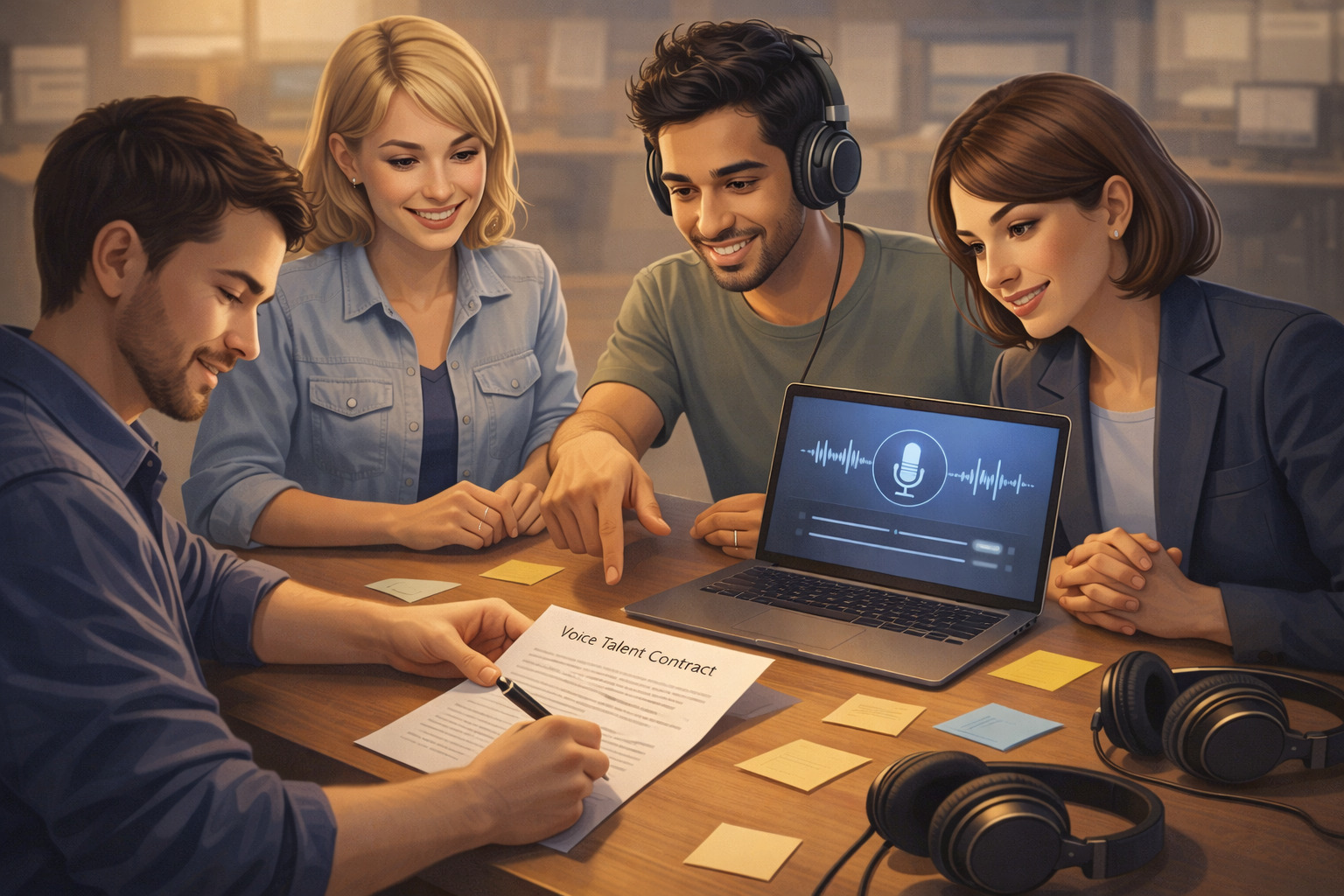
Studios and platforms need clear written consent models that link talent agreements to the tools they actually use.
Practical consent models for creators, studios, and platforms
Because ElevenLabs voice cloning consent happens largely outside the interface, teams need internal models for how they obtain, record, and revisit permissions over time. In practice, three broad patterns are emerging among professional users, baseline consent for personal voices, structured contracts for talent, and platform level policies for user generated content.
For individuals using ElevenLabs to clone their own voices, consent issues are simpler but not trivial. People who record their voice for accessibility, podcasting, or content localization still need to understand that the service license allows ElevenLabs to process and retain their audio, that they can request deletion of their personal data, and that choosing whether to allow training use of their content affects how their voice contributes to future models [11]. Clear in app messaging and documentation help, but many users will only encounter these details if they actively click through to the privacy policy or data use settings.
For studios and agencies working with voice actors or creators, written consent becomes the default. Talent contracts increasingly include clauses that authorize voice cloning for specific projects, languages, and platforms, often alongside minimum fees, buyout structures, or residual share agreements when synthetic voices are reused [5][12]. Industry guidance in markets such as India even recommends verifiable written consent for any use of synthetic celebrity voices in advertising or endorsements, reflecting a wider move toward documented permissions instead of informal approvals [12].
Platforms that let end users generate synthetic voices add another layer. If you expose ElevenLabs through your own interface, you are responsible not only for your own use of voice models but also for the behavior of your customers. That usually means building your own prohibited use rules that mirror or exceed ElevenLabs policy, running your own abuse detection, and providing clear routes for people to report unauthorized cloning or harmful content. In some cases, it may also mean refusing high risk categories entirely, for example banning political impersonation or opting out of synthetic celebrity voices even if the base technology could technically support them.
Written consent templates, and what they should cover
A practical way to operationalize consent is to treat it like a structured template rather than an open ended conversation. Modern synthetic voice consent forms tend to cover at least five elements, identity, scope, duration, compensation, and revocation. Identity clauses specify exactly whose voice is being cloned and confirm that the signer has authority to grant rights over that voice. Scope clauses describe where and how the clone can be used, for example in audiobooks, marketing videos, or customer support bots, and whether future uses such as training unrelated models are allowed.
Duration and territory clauses define how long the consent lasts and in which regions it applies, which matters for distribution on global platforms. Compensation sections line up fees or revenue shares with the scope of use, often including higher rates for synthetic voice use in advertising than in internal training content [12]. Finally, revocation and review clauses explain how either party can revisit or terminate the arrangement, which is important in a fast changing regulatory landscape where both laws and platform policies can shift within a single contract period.
Records, retention, and audit readiness
Consent that exists only as a verbal understanding or an email thread is fragile. In regulated industries, and increasingly in creative sectors, clients expect that consent for synthetic voices will be documented in a way that can be produced if a dispute or audit arises. That means keeping copies of signed contracts, tracking which ElevenLabs user accounts are allowed to use particular voice models, and maintaining logs that link major releases or campaigns back to their underlying permissions.
Security experts who look at AI voice risks emphasize process, not just technology. They advise organizations to build layered verification steps into workflows, for example requiring a second approver to sign off on synthetic voice use in investor calls or public earnings commentary, and mandating out of band confirmation for any high risk use such as authorizing large financial transactions via AI generated audio [9]. In that kind of environment, ElevenLabs becomes one part of a broader governance system, and consent is treated as a living record rather than a one time box to tick.
A simple compliance checklist for ElevenLabs voice cloning projects
A checklist will not solve every edge case, but it can reduce the chance that a busy team forgets a critical consent step when deadlines loom. The following list assumes you are using ElevenLabs in 2026 for anything beyond purely personal experimentation, from podcasts and learning content to games, brand campaigns, and support experiences.
- Identify whose voices are involved List every human voice you plan to clone or synthesize with ElevenLabs, including your own, guest speakers, executives, and actors.
- Confirm legal rights and obtain written consent For each voice, check whether you own the rights or need explicit permission, and capture that permission in a written agreement or consent form that covers scope, duration, compensation, and revocation.
- Map platform terms to your contracts Review ElevenLabs Terms of Service, Prohibited Use Policy, and safety documentation and confirm that your talent contracts allow you to grant ElevenLabs the licenses those terms require.
- Classify use cases by risk level Tag projects that involve politics, finance, health, minors, or sensitive identity topics as high risk, and require additional review and sign off before publishing synthetic audio.
- Apply disclosure and labeling rules Decide how you will disclose AI generated voices to your audiences, especially in regions where the EU AI Act or similar transparency rules apply, and standardize language for scripts, credits, and on screen notices.
- Configure technical safeguards Enable relevant ElevenLabs safety features, use your own abuse detection or watermark checks where appropriate, and avoid attempting to bypass No Go Voices or other platform guardrails.
- Restrict access and train your team Limit access to voice models in ElevenLabs to trained staff, provide guidance on consent and prohibited uses, and make it easy for people to ask questions when in doubt.
- Log key decisions and releases Keep a simple record of who approved each major use of synthetic voices, which scripts were used, and where audio was published, so you can reconstruct events if concerns are raised later.
- Prepare a response plan for misuse or complaints Document how you will respond if someone reports that their voice was cloned without permission or if a synthetic clip is misused, including contact points at ElevenLabs and procedures for takedown requests.
- Review your program annually Revisit your consent forms, contracts, and internal policies at least once a year in light of new platform updates, laws, and industry norms around AI audio.
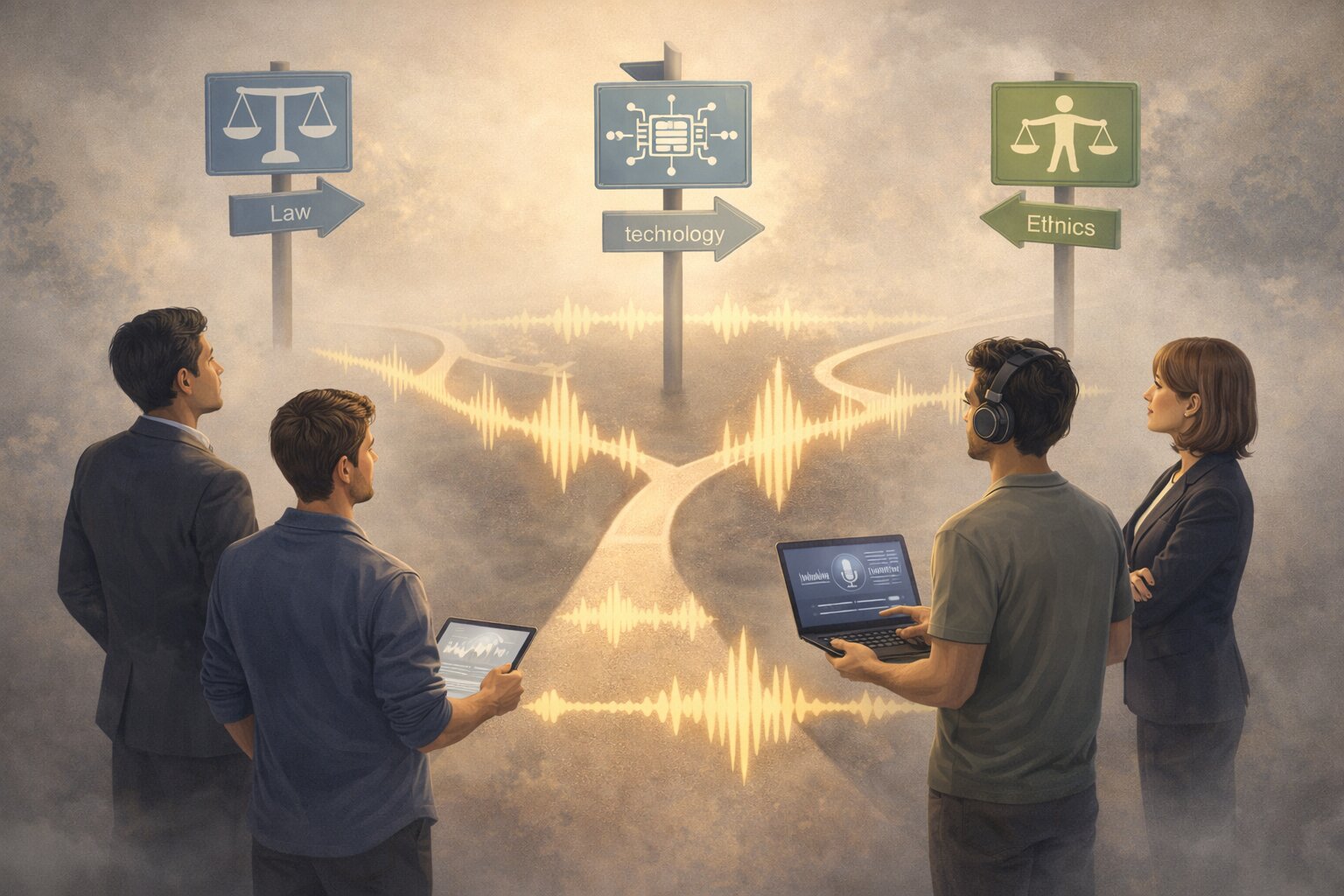
Even in 2026, experts still debate grey areas around derivative voices, group recordings, and future use of synthetic audio.
Open questions, grey areas, and how experts expect 2026 to evolve
Even with a robust checklist, ElevenLabs voice cloning consent in 2026 remains a moving target. Several unresolved questions animate the current debate. One concerns derivative voices that are styled after a genre, region, or archetype but not any one individual, where it is unclear how far personality rights extend. Another involves group voices, such as choral recordings or crowd scenes, where a model might capture aspects of many people even if no single voice is individually identifiable.
Legal scholars note that courts and regulators are still feeling their way through these scenarios, often by analogy to older cases involving lookalike performers or soundalike advertisements that imitated famous singers without sampling their recordings [13]. In those analogies, what matters is not only technical similarity but also how the public perceives the voice and whether the use trades unfairly on someone reputation. That implies that context, marketing, and audience expectation will be just as important as waveform analysis.
On the technical side, researchers are racing to improve detection and watermarking. Studies consistently show that humans are not reliable deepfake detectors, which puts pressure on machine based classifiers and content provenance standards to fill the gap [10]. ElevenLabs participation in initiatives such as C2PA and the Content Authenticity Initiative indicates that the company expects synthetic media to move toward a tagged by default model where downstream tools can identify AI content even if listeners cannot [5][8]. As that ecosystem matures, consent practices will likely evolve to include not only getting permission, but also embedding that permission in the metadata and provenance trail of each clip.
Where this leaves you if you plan to use ElevenLabs in 2026
Taken together, the picture that emerges is both promising and demanding. ElevenLabs gives individuals and organizations an accessible way to create high quality synthetic voices, preserve identities, and scale content across languages and formats. At the same time, the legal and social environment around voice cloning has hardened, with new laws that protect voice as a core part of identity, research that shows how easily people can be fooled, and platform safeguards that link every output back to a specific account.
If you want to build on ElevenLabs in 2026 without undermining trust, the path forward is clear enough even if the details keep shifting. Treat consent as a structured process rather than a one time signature, give listeners honest disclosure when a voice is synthetic, respect platform guardrails instead of trying to route around them, and regularly revisit your approach as laws and norms continue to evolve. Most importantly, design workflows where the most tempting shortcuts are the ones your team is trained not to take.
If you have experiences with ElevenLabs voice cloning consent, questions about specific use cases, or examples of policies that work well in your organization, feel free to share them in the comments so we can learn from each other and refine these practices together.
References
- DeepStrike, Deepfake Statistics 2025, including data on AI voice scams and fraud losses ↩
- Barrington et al, People are poorly equipped to detect AI powered voice clones, 2025 ↩
- AICerts, Voice Cloning Risks and Controls for Shareholder Communications, summary of deepfake regulations including Tennessee ELVIS Act and EU AI Act ↩
- ElevenLabs Help Center, Are there any restrictions on what voices I can upload for voice cloning ↩
- ElevenLabs Safety page, describing safeguards, traceability, enforcement, and AI speech classifier ↩
- ElevenLabs Voice Cloning product page, including statements about explicit permission and responsible use ↩
- ElevenLabs Help Center, What are No Go Voices ↩
- ElevenLabs blog, Voice Cloning deep dive and how to get started ↩
- DeepStrike, regulatory landscape overview including EU AI Act, TAKE IT DOWN Act, UK Online Safety Act, and Tennessee ELVIS Act timeline ↩
- Barrington et al, People are poorly equipped to detect AI powered voice clones, detailed experimental results ↩
- ElevenLabs Terms of Service, section on Content, User Voice Models, necessary rights, and licenses ↩
- Truefan, comparison of emotional voice AI tools and emphasis on verifiable written consent for voice cloning in advertising and endorsements ↩
- Sheppard Mullin, Deepfake Detection in Generative AI, including discussion of Li v Liu and personality rights in voice cloning ↩