
Meta Ads Creative Strategy 2026 is about building a reusable UGC library that feeds automation tools such as Advantage Plus without losing control of brand or performance.
- UGC ads often earn higher engagement and conversion than studio assets when they follow clear testing structures and brand guardrails.
- Meta is pushing toward fully automated campaigns by 2026, so marketers need organized creative inputs, clean tracking, and disciplined naming.
- This guide shows how to design a UGC content matrix, brief creators, plug assets into Advantage Plus, and review results with transparent scorecards.
In 2026, Meta ads are running on top of some of the most powerful commercial artificial intelligence systems in the world, with billions of people scrolling through Facebook, Instagram, and Reels every day. Meta reported more than three point four billion daily active people across its family of apps in March 2025, with ad impressions still growing and the average price per ad rising about ten percent year over year, while total quarterly revenue reached around forty two billion dollar.[1][2] At the same time, industry studies keep repeating the same uncomfortable truth for brand marketers, user generated content often drives more engagement and stronger purchase intent than polished studio advertising.[4][5] Those two forces together create the real heart of meta ads creative strategy 2026, automation gets smarter, and unfiltered human voices quietly start to outperform perfect brand videos.
This article walks through how to build a user generated content library that actually works with Meta automation, rather than fighting against it. You will see what recent data says about UGC performance, how Meta itself is reshaping the ad platform with Advantage Plus products, and how to design a content and testing system that scales across campaigns instead of reinventing the wheel every month. The goal is simple, help you ship ads that feel human, fit the feed, and still satisfy the most demanding performance dashboards.

Why Meta Ads Creative Strategy 2026 Starts With UGC, Not Studio Shoots
Meta is no longer only a placement for bright glossy brand campaigns, it is an engine that translates signals into sales at enormous scale. In its first quarter 2025 earnings release, Meta highlighted a double digit increase in revenue and continued growth in ad impressions, which means competition in the auction stays intense for every marketer who relies on the platform.[1] External analysis suggests that artificial intelligence driven tools already contribute a meaningful share of performance gains, especially for Reels, where adoption of AI ad products has been linked to higher conversion rates and revenue per user.[3][3a]
While the auctions become more efficient, attention becomes more expensive. Research from multiple sources shows that audiences trust and engage with user generated content far more than traditional advertising. CrowdRiff reports that more than ninety percent of consumers trust word of mouth and UGC more than standard brand advertising, and roughly eighty five percent say UGC influences them more than polished brand photos.[4] A 2025 benchmark report on UGC versus studio ads found that social campaigns featuring UGC can see engagement rates up to twenty eight percent higher than brand created content, with some platforms showing several times higher conversion rates for UGC posts.[5][6]
Academic work supports the same direction. A 2025 study on UGC marketing strategies concluded that UGC can significantly deepen consumer engagement and strengthen trust based relationships between consumers and brands, because people treat other users as co creators who shape brand reputation collectively rather than passive recipients of corporate messages.[7] Put simply, Meta ads creative strategy 2026 has to treat ordinary customers and creators as an extension of the marketing team, rather than a nice to have extra.
Understanding Meta Ads Creative Strategy 2026 and Advantage Plus Automation
Any serious discussion about meta ads in 2026 has to acknowledge the automation roadmap. In mid 2025, reporting based on internal Meta plans suggested an ambition to fully automate the ad process by the end of 2026, where an advertiser could theoretically upload a product image, select a budget, and let Meta artificial intelligence handle targeting, creative variation, and placements end to end.[3] Meta already offers Advantage Plus products that move in this direction, such as automated shopping campaigns and Advantage Plus placements, audiences, and budgets that give more control to the system and less to the media buyer.[8]
Meta describes Advantage Plus as a suite of tools that uses leading artificial intelligence to optimize campaigns, from discovering new customers to testing creative combinations. Official resources emphasize that Advantage Plus shopping and app campaigns can automatically explore many placement and audience combinations to find the lowest cost conversions.[8] Independent 2025 guides confirm that these tools can cut setup time, identify high converting audiences, and nudge advertisers toward very broad targeting, particularly when paired with Conversions API data and standard events.[9][10]
For creative strategy, this has two important implications. First, the system itself becomes very good at mixing and matching creative variations to different micro audiences, so you no longer want one heroic brand video, you want a library of modular UGC assets that can serve as ingredients. Second, the line between manual and automated campaigns gets blurry, marketers still need clarity about what goes into the machine and what comes out. A strong meta ads creative strategy 2026 therefore focuses on structured creative inputs, naming conventions, and feedback loops so that UGC does not vanish into a black box.
Where Automation Helps and Where Human Strategy Still Matters
Automation excels at discovering patterns that humans cannot see at scale, such as which combination of hook, background, and creator style resonates with a given cluster of users. It compounds its advantage when you give it a wide and diverse pool of UGC that still respects brand boundaries and messaging priorities.
Human strategy still matters in three areas. First, deciding which stories deserve UGC coverage at all, such as real customer transformations, behind the scenes proof, and objection handling. Second, designing briefs that help creators record content that feels natural but still lands one or two necessary proof points. Third, interpreting performance data back into insights that inform the next round of briefs instead of stopping at simple winner and loser labels.

Designing a UGC Content Matrix for Meta Ads Creative Strategy 2026
The foundation of a UGC library that beats polished ads is a content matrix. Rather than collecting random one off videos, you map UGC to funnel stages, formats, and strategic angles. The matrix gives automation something meaningful to remix, and it gives your team a shared language when planning and reporting.
Start with three simple funnel stages, awareness, consideration, and conversion. For each stage, pair at least two UGC formats with clear roles. Awareness might depend on short Reels where creators dramatize a familiar daily problem. Consideration might lean on screen recording style demos with voiceover explanations. Conversion might use direct response testimonial videos where real customers describe specific outcomes and show proof.
Then, layer on hook angles. Performance agencies in 2025 often describe hooks in terms of problem, promise, proof, and process, which map well to UGC. For each funnel stage and format pair, you want at least two distinct hook options, for example, a problem focused hook where the creator dramatizes frustration, or a proof focused hook where the creator shows a result or statistic on screen in the first three seconds.
Here is a simple content matrix for a UGC library that supports meta ads creative strategy 2026.
| Funnel stage | UGC asset type | Hook angle focus | Best primary placement | Main metric to watch |
|---|---|---|---|---|
| Awareness | Short selfie style story clip | Problem and empathy | Reels and Instagram Stories | Thumb stop rate and view through rate |
| Awareness | Green screen trend explainer | Cultural relevance | Reels and Explore | Shares and profile visits |
| Consideration | Screen recording demo with voiceover | Process and education | Facebook and Instagram Feed | Click through rate and detail views |
| Consideration | Side by side before and after video | Proof and outcome | Reels and Feed | View completion and add to cart rate |
| Conversion | Direct testimonial selfie | Proof and objection handling | Feed and Advantage Plus placements | Cost per purchase and return on ad spend |
| Conversion | Unboxing or setup video | Ease and reassurance | Feed and Stories | Checkout completion and refund rate |
This type of table becomes the backbone for briefs, budget plans, and testing roadmaps. It also gives you a way to see at a glance where your UGC library has gaps, perhaps you have many proof heavy assets at the bottom of the funnel but almost no playful problem stories at the top.
Building a UGC Content Library That Feeds Meta Ads at Scale
Once the matrix is defined, the next task is operational, how do you collect and organize UGC so that it can support meta ads creative strategy 2026 without becoming chaos. The answer combines creator collaboration, rights management, and a simple internal catalog.
First, decide which UGC sources are in scope. Typically this includes formal creator partnerships, affiliate or ambassador programs, organic customer posts that you request permission to use, and internal content such as founder videos or staff demos. Documentation from UGC research in 2025 highlights that trust increases when audiences perceive content as authentic and user initiated even when brand partners are compensated, as long as disclosure is clear.[7]
Second, define minimum technical standards so that content works in paid placements. For example, you may require vertical framing that respects safe zones for text overlays, clear audio, and native camera style editing rather than heavy motion graphics. Meta itself recommends creative that fits the look and feel of each placement, particularly Reels, where vertical framing and quick hooks are essential.[10]
Third, treat the UGC library like a product catalog, not a dumping ground. Give every asset an identifier, attach tags for funnel stage, hook angle, creator, product line, and performance tier, and store it in a shared environment the media and creative teams can search. This is where a simple spreadsheet template can drive real leverage, you do not need an expensive asset management system to start practicing disciplined cataloging.
You can download a starter template for this at the link below and adapt it inside Google Sheets or Excel.
Download, UGC Meta Ads Creative Library Checklist 2026
Use this template to log every UGC asset, connect it to campaigns, and record creative learnings over time.
Download the UGC Meta Ads Creative Library Checklist 2026
This file includes columns for campaign objective, funnel stage, placement focus, UGC type, hook angle, creator, usage status, linked campaign, performance snapshot, audience notes, creative learnings, and next action with dates. The goal is to make it easy for you and your team to scan what exists, what is working, and what needs to be recorded next.
Meta Ads Creative Testing Framework for UGC in 2026
A UGC library only beats polished ads when it is tested systematically. Meta ad auctions reward relevance and engagement, so creative rotation and experimentation become as important as targeting choices. Performance marketing teams in 2025 commonly report that creative testing is responsible for a significant share of return on ad spend improvements, particularly when paired with broad targeting and Advantage Plus structures.[9][11]
For a practical meta ads creative strategy 2026, you can think in three test levels.
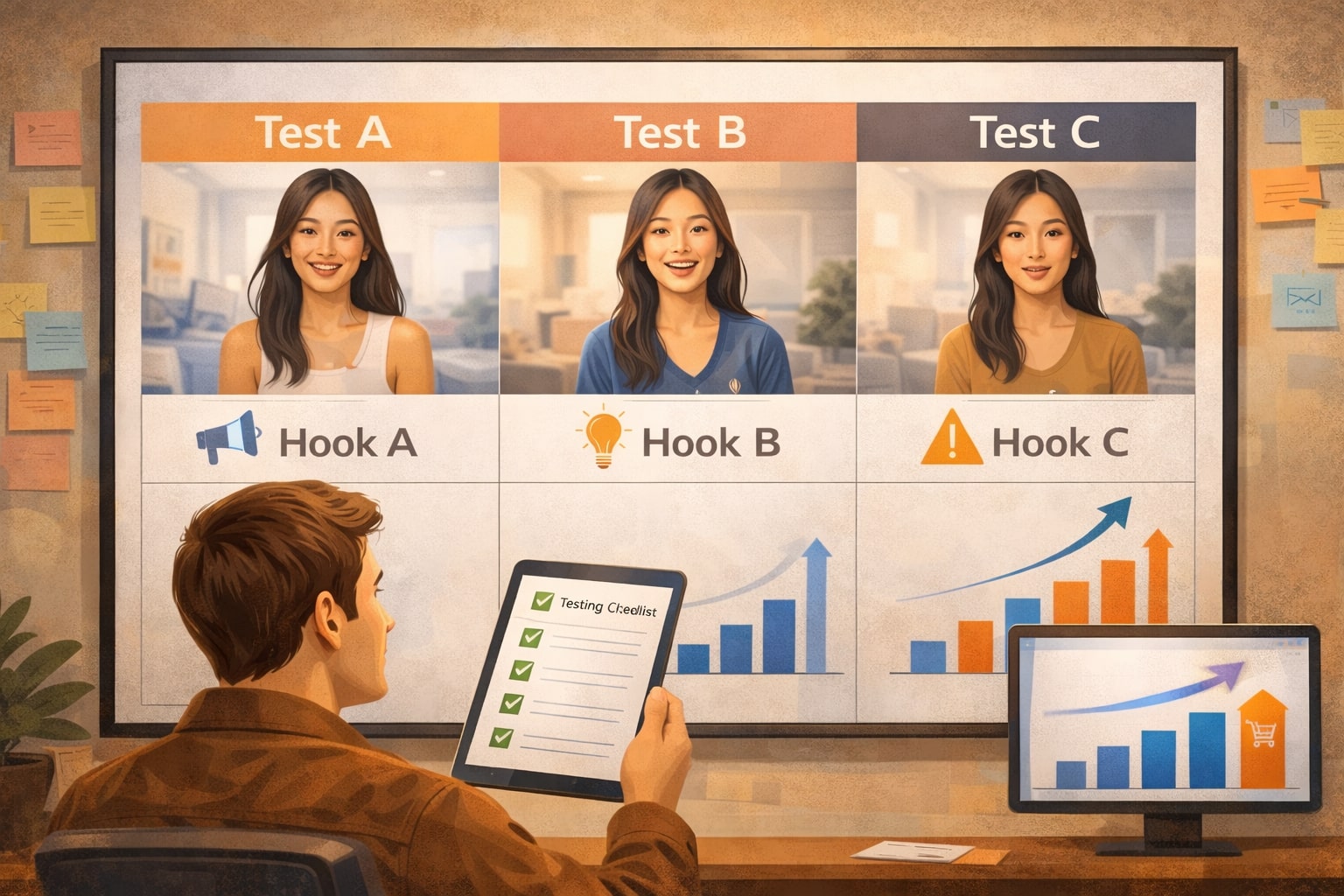
First, test hooks inside the same creative concept. Take one UGC testimonial script and record three openings, one focuses on the painful starting point, one jumps straight to the result, one uses a surprising fact or number. Run those variations in a controlled ad set or creative test, and watch early signals like thumb stop rate, three second views, and cost per click. Early hook testing gives you usable data without waiting for full conversion cycles.
Second, test concepts inside the same audience and offer. Compare an origin story UGC video where the founder explains why the product exists with a customer story video where a real buyer narrates their experience. Keep audience, budget, and landing page constant so that performance differences reflect creative impact rather than confounding factors.
Third, test cross funnel asset mixes inside Advantage Plus or broad targeting campaigns. This is where automation and UGC work together. You feed the system a healthy mix of top and middle funnel UGC and let it discover who needs which message. Remember that automation does not remove the need for test discipline, it just changes where you apply that discipline.
A simple testing cadence might reserve ten to twenty percent of spend for new creative experiments at any time, with the rest allocated to proven winners. Every two weeks, you graduate the best performing test assets into your scaling campaigns and retire or rewrite underperformers. The UGC library spreadsheet then becomes a living log of this evolution rather than a static archive.
How to Brief Creators for Meta UGC Ads Without Losing Control
The most common fear when brands embrace UGC is loss of control. The temptation is to respond with rigid scripts that turn creators into actors, which defeats the point. Instead, effective meta ads creative strategy 2026 relies on structured freedom.
Good briefs clarify four elements while leaving room for personal style. First, context, who the audience is, what problem they care about, and where the ad will appear, for example Reels versus Feed. Second, non negotiable facts, any claims that must be accurate and in some markets compliant with regulation. Third, proof materials, screenshots, product shots, or data points that creators can reference. Fourth, format guidance, such as requested length, framing, and direction on whether to use captions or on screen text.
Within that frame, creators should speak in their own tone, mention real experiences, and show real environments rather than staged sets. Studies on UGC effectiveness argue that authenticity is what makes UGC content persuasive, people can detect overly polished staging and tune out quickly.[5][6] Marketers who embrace real moments, small imperfections, and unscripted details often see better results, because those small signals tell viewers this is a person like them, not a brand costume.
Using Advantage Plus With a UGC Library Without Losing Transparency
Advantage Plus campaigns promise better performance with less manual effort, but many teams worry that strategy will disappear inside black box automation. The key to resolving this tension in meta ads creative strategy 2026 is to treat Advantage Plus as a creative delivery engine rather than a strategy substitute.
If you want a step by step walkthrough that focuses specifically on Advantage Plus setup and controls, you can read my separate guide Meta Ads in 2026, How to Use Advantage Plus Without Turning Your Strategy into a Black Box.
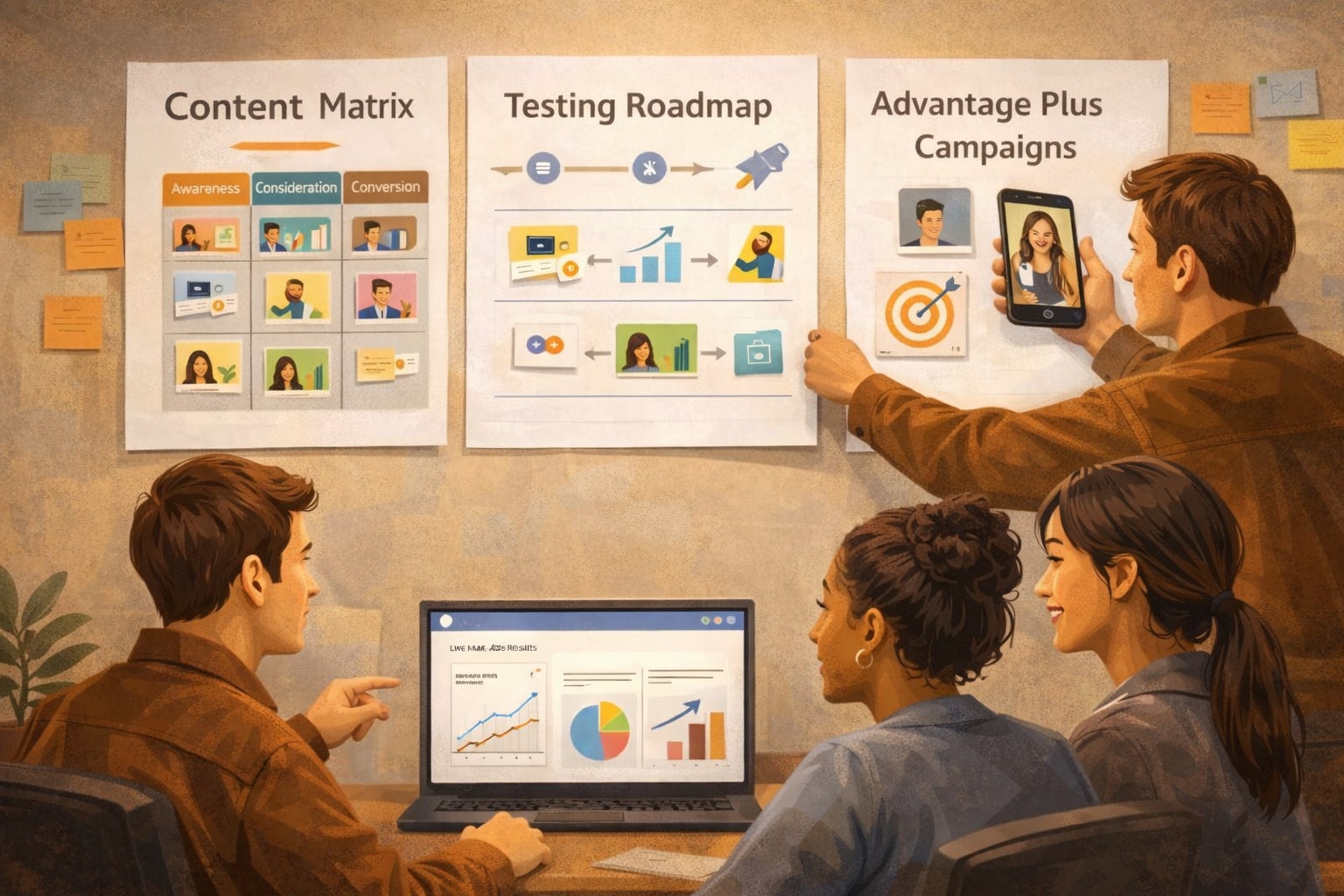
First, separate creative planning from campaign setup. Design your UGC matrix, testing plan, and naming conventions outside Ads Manager, then use Advantage Plus or broad campaigns to push that plan into the auction. For each upload, follow a consistent naming pattern that encodes funnel stage, concept, and hook angle. That way, performance reports and breakdowns still tell a coherent story even when placement and audience details shift automatically.
Second, use available reporting tools such as breakdowns by creative asset, placement summaries, and any opportunity scores or diagnostic signals Meta exposes, to evaluate which UGC elements pull their weight.[12] Even when the platform does not show every micro decision, you still see relative performance between individual videos and images.
Third, keep a written record of test hypotheses and outcomes. When you spin up a new Advantage Plus test batch filled with fresh UGC, write down what you expect to happen and what you will decide based on the results. After the test, summarize learnings in your spreadsheet template, including which hook angle worked, which creator resonates with which country or age band, and whether certain placements over deliver. Over time this narrative layer becomes the antidote to black box anxiety.
Turning Your UGC Library Into a Repeatable Meta Ads Playbook
By this point, meta ads creative strategy 2026 stops looking like a single campaign and starts feeling like a repeatable operating system. You have a clear view of how Meta artificial intelligence is evolving, why UGC tends to outperform polished ads, how to structure a content matrix across the funnel, how to test systematically, and how to brief creators without stripping away authenticity. Most important, you have a simple way to log, score, and re use UGC assets instead of letting them disappear into ad account archives.
If you adopt even a lightweight version of this system, you will notice that creative debates inside your team change. Instead of arguing tastes, you compare hooks and concepts against real performance data and clearly labeled UGC categories. Instead of scrambling to create entirely new studio assets whenever results dip, you look for specific gaps in the UGC library and commission targeted recordings to close them. That is how a user generated content library quietly starts to beat polished ads at scale.
If you have tested any of these approaches in your own Meta campaigns or have questions about adapting them to your niche, feel free to share your experience or ask in the comments. Other marketers reading this article will appreciate real examples, and your questions may shape future deep dives on creative frameworks and Advantage Plus strategies.
References
- Meta Investor Relations, Meta Reports First Quarter 2025 Results
- inBeat, Meta Statistics for 2025, Users, Revenue, Ads
- IG, Meta Q2 2025 earnings, AI bets meet reality check
- Reuters, Instagram will make up more than half of Meta ad revenue in 2025
- CrowdRiff, User generated content statistics
- UGC Content, UGC vs Studio Ads, 2025 Benchmarks
- Archive, User generated content engagement statistics 2025
- ResearchGate, User generated content marketing strategies and consumer engagement
- Meta Business Help Center, Advantage Plus Shopping Ads
- Pansofic, Meta Ads 2025 Setup and Campaign Strategies
- Adsmurai, What are Meta Advantage Shopping campaigns and how do they work
- MagicBrief, Meta Advantage updates that will simplify campaign setup
- BIRCH, Meta Opportunity Score Explained
Ready to apply this to your business?
Let's Talk Strategy →