Fast path to legal voice cloning with ElevenLabs
- Get explicit written consent and a short verification audio from the voice owner.
- Create the clone in ElevenLabs, confirm you have the right and consent, screenshot the confirmation.
- Label outputs clearly, for example “AI generated voice used with permission,” align with EU AI Act and YouTube rules.
- Run the ElevenLabs AI Speech Classifier on a sample and save the result with your consent files.
- Track requests, signatures, and takedowns in the Voice Consent Kit spreadsheet.
- Choose a plan that fits consent needs, Instant Voice Cloning on Starter or Professional Voice Cloning on Creator and above.
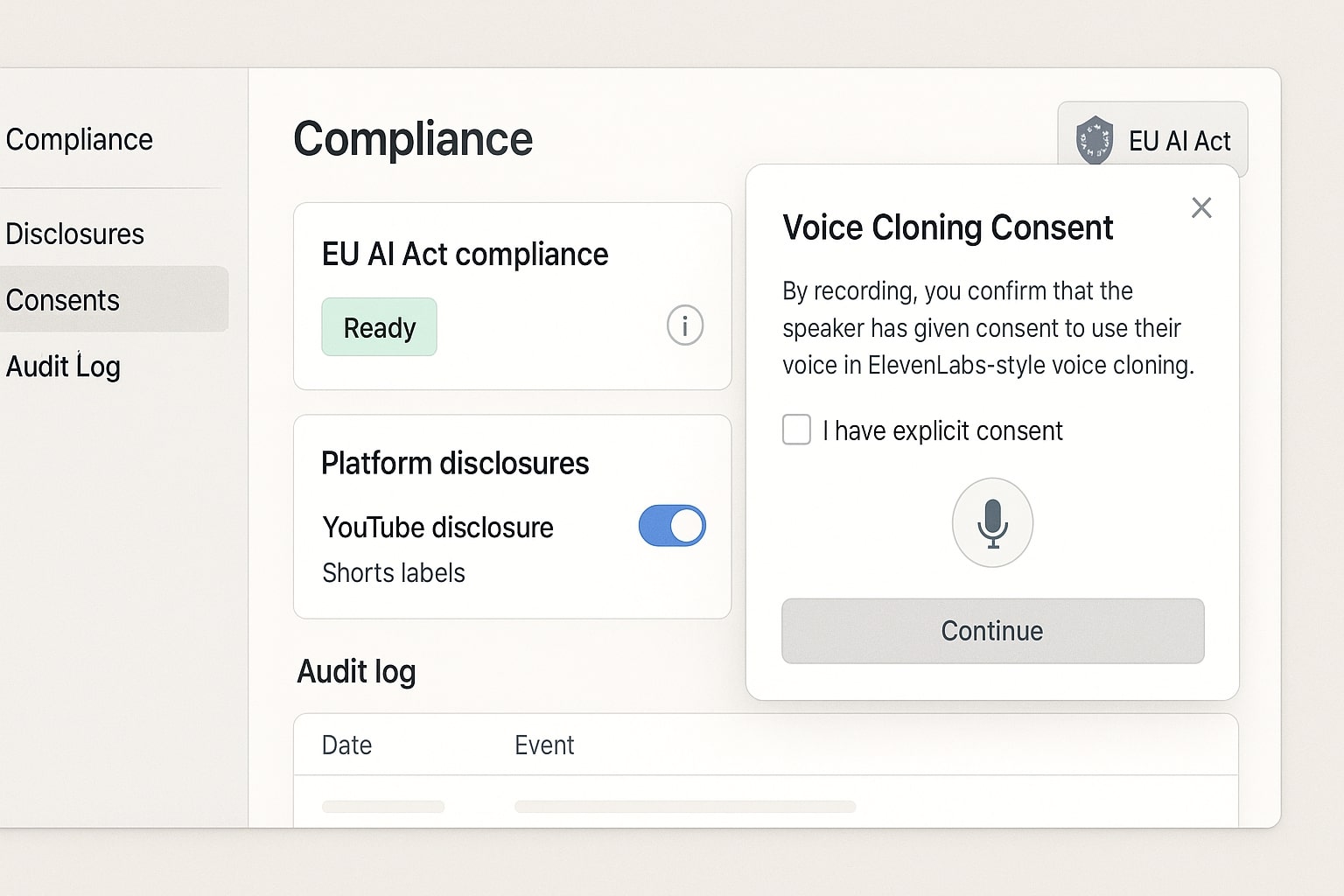
Getting ElevenLabs voice cloning consent right is not a nice to have, it is a production blocker with legal, platform, and monetization consequences. Since February 2025 the EU AI Act has begun phasing in transparency duties for synthetic media and general purpose AI systems, with additional timelines throughout 2025 and beyond, which means mislabeled or undocumented voice clones can trigger takedowns or fines in Europe. Spain has already proposed penalties up to €35 million or seven percent of global revenue for unlabeled AI content, a signal of where enforcement is headed.[6][13] In the United States regulators are tightening guardrails, from the FTC’s push to ban AI impersonation of individuals to state level laws like Tennessee’s ELVIS Act that explicitly protect voice as identity.[9][10] ElevenLabs itself prohibits cloning another person’s voice without consent and exposes an AI Speech Classifier to help verify machine generated audio, which means your projects need a clean paper trail before the first line gets recorded.[1][5]
Why ElevenLabs Voice Cloning Consent matters in 2025
Regulation has shifted from recommendations to rules. The EU AI Act requires obvious disclosures for synthetic media and sets staged obligations for general purpose models and higher risk systems in 2025 and 2026.[6][7] Platforms are aligning, for example YouTube now requires creators to disclose realistic synthetic content that a viewer could mistake for real, and that includes AI generated voices in lifelike videos and podcasts.[8] ElevenLabs adds its own layer, asking you to confirm you have the right and consent to clone a voice when you create a voice in the dashboard, and its Use Policy bans impersonation without consent outright.[4][1]
Behind the scenes your legal exposure maps to three buckets, right of publicity and impersonation law in the US, data protection and transparency duties in the EU and UK, and contract and platform rules inside the tools you use. If you can prove informed consent, label outputs consistently, and respect revocation, your projects will survive audits and algorithmic classifiers.
Check out this fascinating article: ElevenLabs Voice Cloning Consent Policy (2025): Legal, Ethical, and Product Implications
Fast preflight checklist to secure voice cloning consent before you hit record
Before opening ElevenLabs, prepare in this order. Each item is short, practical, and audit ready.
1. Purpose and lawful basis
Describe the project, audience, territory, platforms, and whether the use is commercial. Note if the voice owner is a private individual or a performer represented by an agent. In the EU document your transparency plan and the legal basis for any processing of personal data, with explicit consent if the voice sample is used for identification which can count as biometric data under GDPR [6]
2. Identify the voice owner and decision maker
Capture legal name, stage name, country, and contact route. If there is a rights holder or estate, record that entity as the counterparty. Some US states like California allow lawsuits for unauthorized use of name and voice for commercial purposes, so get the sign off from whoever controls publicity rights [11]
3. Send a clear consent request
Provide a short script, how long the clone will be used, the channels, whether you will allow third parties to reuse it, and how revocation works.
4. Receive signed consent and verify identity
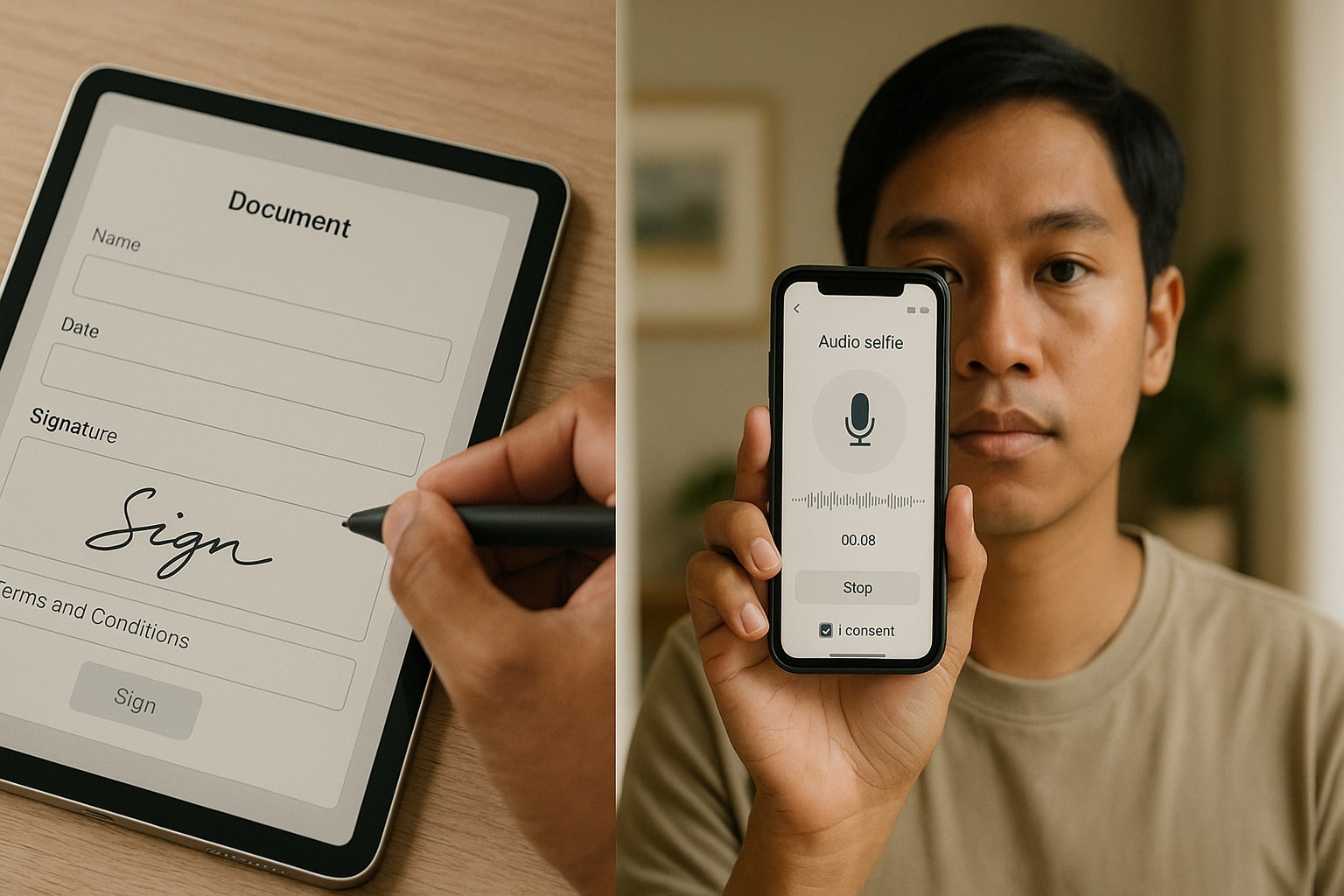
Keep a signed document and a short verification audio from the voice owner stating that they consent to you cloning their voice for the described use. ElevenLabs’ privacy policy explicitly references processing a recording to verify the person’s voice and consent when another user wishes to use it, which aligns with this step [3]
5. Plan your disclosure
Decide how you will label synthetic voice in titles, captions, pod notes, show descriptions, and on site. YouTube requires disclosure for realistic synthetic media, and the EU AI Act expects clear markings for AI generated content [8][7]
6. Choose the right ElevenLabs plan
If you need Instant Voice Cloning you can start on Starter. For Professional Voice Cloning and higher quality audio you need Creator or above. See comparison table below to estimate your minutes and costs [12]
Step by step, the fastest way to get ElevenLabs voice cloning consent
This field tested flow prioritizes speed without skipping compliance.
Step 1, use a one screen consent form
Draft a single page document that covers identity, scope of use, compensation, revocation, and disclosure. Keep the language plain. Add an appendix with the reading script and project codes. Require a brief selfie style audio clip in the sign flow that says, for example, “I am [legal name], I consent to [your company] cloning my voice for [project] on [platforms] for [duration].” This aligns with ElevenLabs’ consent verification practice and gives you a standalone artifact you can store with the signed PDF.[3]
Step 2, send the request through the channel that will be auditable
Email beats chat for signatures, but if the relationship starts in DMs, move to an e signature link. Where a manager or estate is involved, address both the performer and the rights holder.
Step 3, capture proof and hash it
Store the signed file, the consent audio, and the email thread in a folder with an immutable timestamp. At minimum save a checksum in your project notes. For repeat collaborations, maintain a “consent versions” log and refresh annually or when scope changes.
Step 4, create the clone inside ElevenLabs
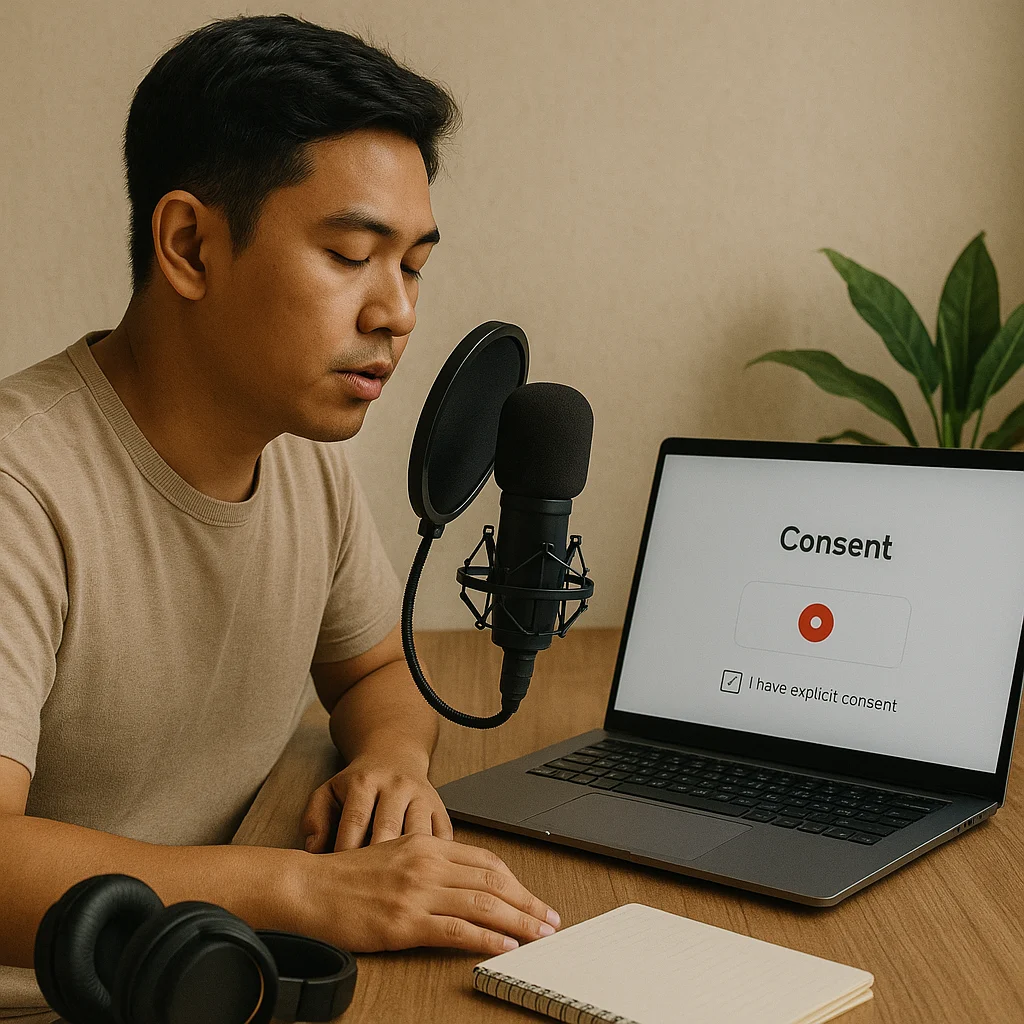
Go to Voices, choose Instant Voice Cloning or Professional Voice Cloning depending on plan. Upload the sample audio, then on the confirmation screen check that you have the right and consent to clone the voice, name and label the voice, then save. Grab a screenshot of the confirmation state and file it with your consent packet. ElevenLabs’ product guide shows that consent confirmation step in the IVC modal.[4]
Step 5, label every output
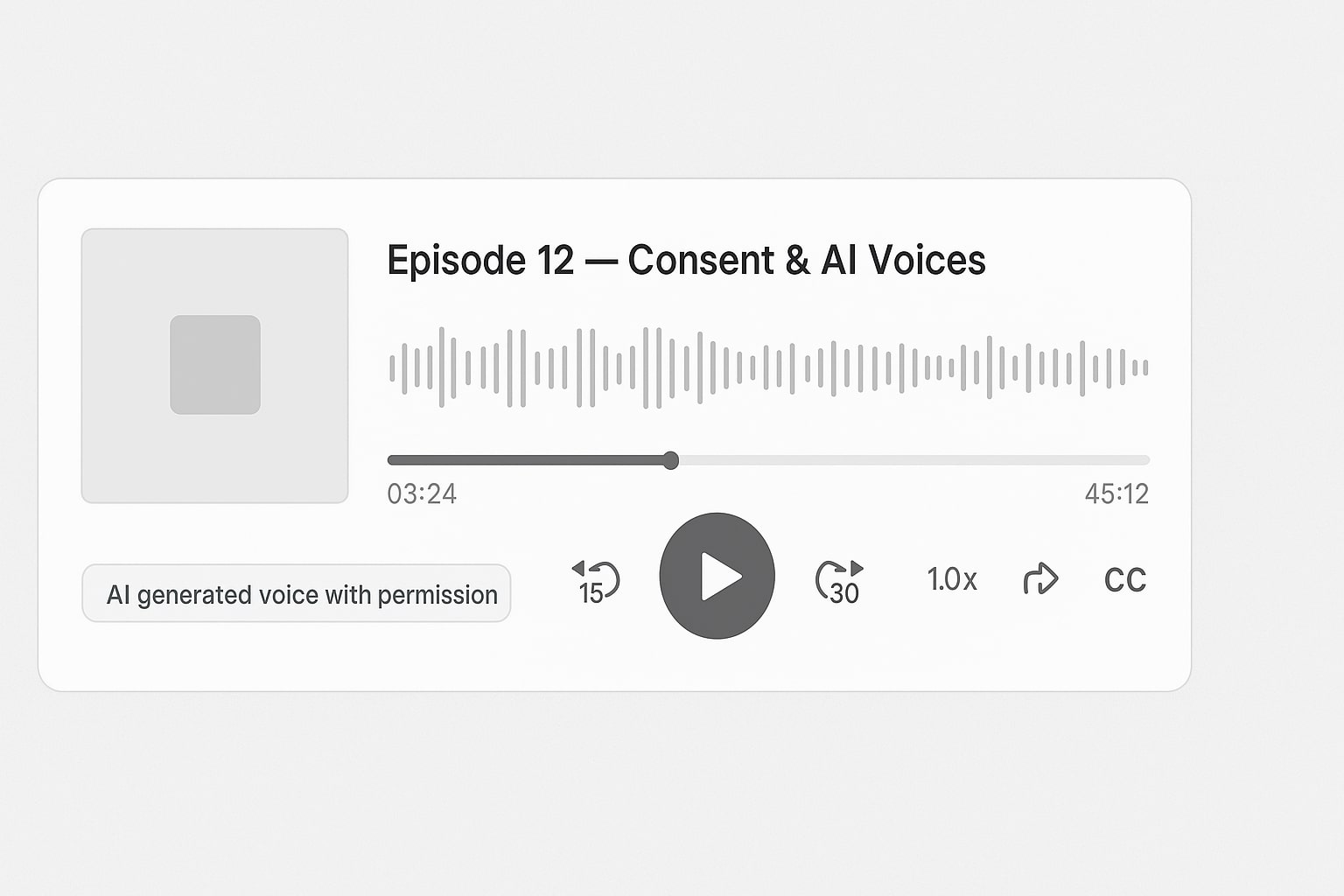
Add a sentence in your description such as “This narration uses an AI generated performance with permission from [name].” On YouTube, toggle the synthetic content disclosure when the voice is realistic, which the platform requires for content a viewer could mistake as real [8]. For EU audiences also include a short note like “AI generated voice” near the play control to meet transparency expectations under Article 50 of the AI Act.[7]
Step 6, run a detection receipt
Upload a sample of your published audio to ElevenLabs AI Speech Classifier and save the result page as a PDF. Keep it next to your consent files. The classifier tells you the probability the clip was created with ElevenLabs, which is often requested during platform or brand audits.[5]
Step 7, wire a takedown route
Create a contact email for voice concerns and include it in video or episode notes. Your response plan should cover genuine mistakes, malicious misuse, and revocation by the voice owner. In the US the FTC has signaled it will use all tools available to target AI enabled impersonation, so rapid response is not optional.[9]
Check out this fascinating article: How ElevenLabs Performs in Practice: A Deep Dive into Brand Voice, Quality, Licensing, and Pricing
How to prove consent inside ElevenLabs during an audit
Auditors and brand safety teams ask for three things, the signed consent, the verification audio, and evidence from the tool showing you confirmed rights. ElevenLabs gives you two extra artifacts that help.
-
The IVC confirmation shows you affirmed you have the right and consent to clone the voice. Keep that screenshot with timestamp [4]
-
The AI Speech Classifier result demonstrates provenance of a published clip and aligns with ElevenLabs’ safety tooling, which the company highlights on its Safety page [5]
If a dispute escalates, ElevenLabs’ Terms clarify how your voice input may be used to provide and improve the services, while stating that your voice will not be commercialized on a standalone basis without permission. Understanding this language helps you explain scope to talent and brands.[2]
Labeling synthetic voice, keep platforms and regulators happy
Do not bury the disclosure. Put it in the first lines of your description, in spoken intro copy for podcasts, and in on screen text where feasible. This aligns with YouTube’s requirement that creators disclose realistic synthetic media, and with the EU AI Act’s transparency obligations for AI generated content.[8][7] For ads, include the disclosure in the creative and the landing page.
For brand and enterprise work, consider content provenance signals. ElevenLabs publicly references C2PA in its footer which indicates participation in open provenance efforts. Combined with your own logs, this helps reviewers trace who produced what, and when.[12]
ElevenLabs voice cloning pricing compared, what each tier unlocks
Below is a snapshot of ElevenLabs’ 2025 pricing and key consent relevant features. Prices are monthly with annual billing options noted on ElevenLabs’ page. Minutes shown are approximate based on credits and published multipliers at the time of writing. Always confirm on the official pricing page before purchasing.[12]
| Plan | Monthly price | Minutes included | Voice cloning capability | Audio quality | Notes |
|---|---|---|---|---|---|
| Free | $0 | ~20 | None for commercial use | 128 kbps, 44.1 kHz | Attribution required, no commercial license |
| Starter | $5 | ~60 | Instant Voice Cloning | 128 kbps | Commercial license, Dubbing Studio included |
| Creator | $22 list, first month often $11 | ~200 | Professional Voice Cloning | up to 192 kbps | Usage based billing available |
| Pro | $99 | ~1,000 | Pro VC included | 128 and 192 kbps, 44.1 kHz | API PCM output |
| Scale | $330 | ~4,000 | Pro VC, multi seat | 128 and 192 kbps | Team workspace |
| Business | $1,320 | ~22,000 | Three Professional Voice Clones | 128 and 192 kbps | Low latency TTS, seats included |
When consent complexity is high, Creator and above make sense because Professional Voice Cloning and higher bitrate give cleaner verification clips and enterprise controls. For small pilots the Starter tier with Instant Voice Cloning and a solid consent packet is often enough.
Templates you can use, voice consent kit for Google Sheets
Heading, Download the Voice Consent Kit for ElevenLabs Projects
Speed up approvals with a ready to use workbook. It includes a one page checklist for the entire consent flow and a contact log to track requests, signatures, and verification audio. Duplicate the file per project, link your signed PDFs and classifier receipts, and you have an audit pack any brand team can read in minutes.
Get the template now
Download the Voice Consent Checklist Kit (XLSX)
Open it in Google Drive, choose File then Import then Upload, then select “Replace spreadsheet” or “Append” to merge into your existing tracker.
Risk scenarios and crisp responses creators actually use
-
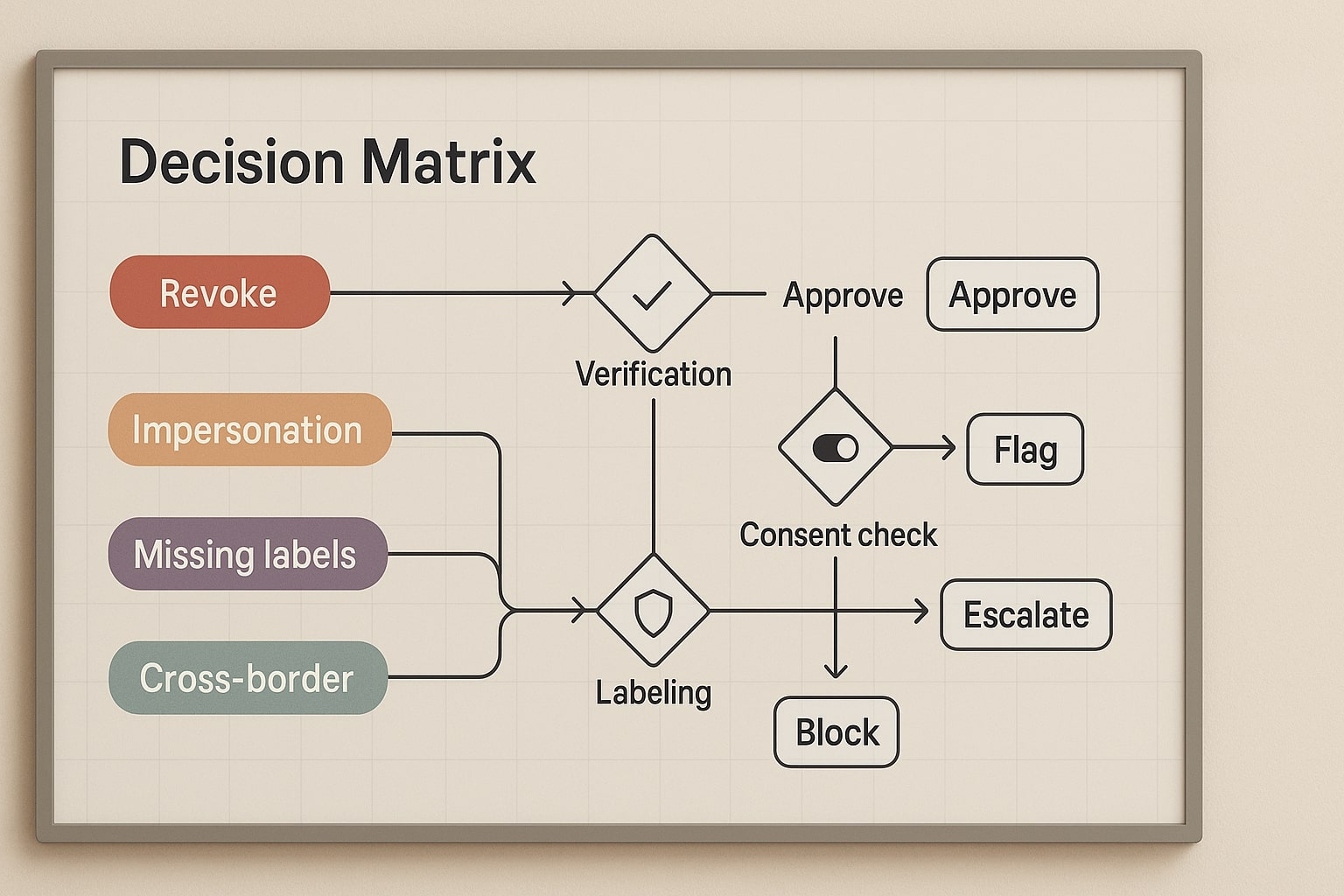
A performer revokes consent after publication
Pause distribution in good faith and follow the takedown process in your contract. Offer to replace with a neutral synthetic voice you own outright. Where publicity rights are strong, for example in California Civil Code 3344, fast remediation reduces litigation risk.[11] -
A third party posts a fake using your project voice
Publish a short post with your disclosure and a pointer to the original. Submit the fake to the ElevenLabs AI Speech Classifier and share the result with the platform’s abuse team.[5] -
You get a platform warning for missing labels
Update descriptions, add an audio bumper that states the content uses an AI generated voice with permission, and enable the platform disclosure control. YouTube explicitly requires disclosure for realistic synthetic content.[8] -
Cross border releases
For EU aimed releases, keep the AI label near the player and in captions per the AI Act’s transparency obligations. For US releases, avoid celebrity soundalikes without permission because right of publicity can cover voice even where statutory wording varies by state.[7][11]
Frequently missed details that save you later
-
Name the voice asset with the owner’s name and scope in ElevenLabs so the label itself tells reviewers you have rights.
-
Keep the original dry recording from the voice owner, plus the cloned output, plus the classifier receipt, so you can demonstrate chain of custody.[5]
-
Teach your editor a standard disclosure sentence and paste it into all episode templates.
-
Refresh consent when scope changes, for example moving from organic YouTube to paid ads or live event playback.
-
Document minors and estates carefully, rights are different and stricter. In California there is a separate post mortem right of publicity that lasts seventy years.[11]
Final thoughts, get creative work out faster by making consent boring and repeatable
Great projects move quickly when approvals are easy to read. Your goal is to make consent a one screen decision for the talent and a one folder answer for auditors. If you found this guide useful or want a review of your consent wording, drop a question in the comments, share your scenario, and I will help you tune the checklist.
References
- ElevenLabs — Prohibited Use Policy
- ElevenLabs — Terms of Use
- ElevenLabs — Privacy Policy, consent and verification
- ElevenLabs — Instant Voice Cloning, confirmation of right and consent
- ElevenLabs — AI Speech Classifier
- European Parliament — EU AI Act summary and timelines
- EU AI Act — Article 50, transparency for synthetic content
- YouTube — Disclosing altered or synthetic content
- FTC — Proposed rule to combat AI impersonation of individuals
- Tennessee — ELVIS Act signed into law
- California Civil Code §3344 — Right of publicity including voice
- ElevenLabs — Pricing and plan comparison 2025
- Reuters — Spain plan to fine unlabeled AI content up to €35m or 7% revenue
Ready to apply this to your business?
Let's Talk Strategy →