SEO in the AI Overviews era is about designing reference quality pages that AI trusts enough to quote while still driving meaningful clicks and conversions.
- Understand how AI Overviews change click behaviour and why zero click does not mean zero value.
- Build reference quality pages that show depth, structure, and clear E E A T signals for sensitive and complex topics.
- Use quick summaries, FAQs, tables, and schema so AI can safely reuse your explanations while users still have reasons to visit.
- Rethink KPIs to include brand visibility inside AI answers, not only classic blue link CTR.
- Adopt an ongoing playbook to refresh data, improve evidence, and adjust to new SERP layouts through twenty twenty six.
Search used to feel like a straight line, a query followed by ten blue links and a decision about which one to click first. In twenty twenty six, SEO in the AI Overviews era is closer to an answer layer that sits above everything, summarising the web before a user ever reaches your page. AI Overviews can compress dozens of documents into a few sentences, include links to supporting pages, and still deliver zero click sessions that never leave Google. For anyone who earns a living from organic traffic, that is not a cosmetic change, it is a rewrite of the playing field.
Google has been clear that AI features like AI Overviews and AI Mode are powered by the same core ranking systems that drive classic search, not by a separate index.[1] The rollout has been aggressive. When Google first expanded AI Overviews beyond Labs in May twenty twenty four, it said the feature would reach hundreds of millions of people immediately and more than a billion users by the end of the year.[2] By mid twenty twenty five, Google was calling AI Overviews one of the most successful launches in the history of Search and reported that queries which trigger this experience now generate more than ten percent additional usage in major markets like the United States and India.[3]
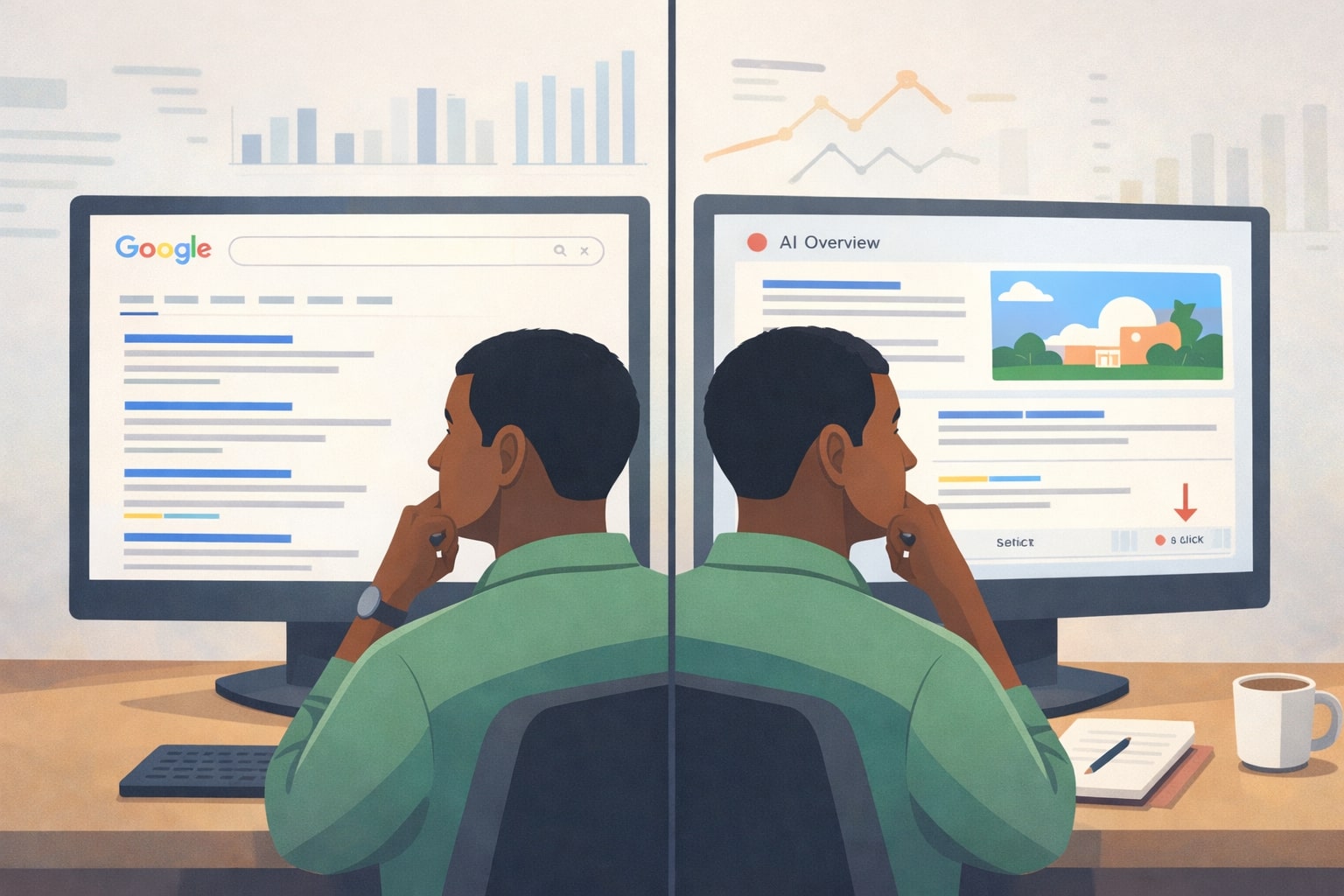
At the same time, independent studies have documented a sharp decline in click through rates when AI Overviews appear. Research compiled in late twenty twenty five shows organic CTR on queries with AI Overviews falling by around sixty percent and paid CTR on those same queries dropping even further.[6] Another analysis of billions of searches found that AI Overviews now appear on more than thirteen percent of queries and reduce average click through from fifteen percent on classic results to about eight percent when an AI summary is present.[7] The message is uncomfortable yet simple, SEO now has to work in an environment where answers come first and clicks are a bonus.
SEO in the AI Overviews era twenty twenty six, what actually changed
For most users, AI Overviews feel like a polite assistant that goes ahead of them, reads the web, and hands back a short explanation with some links. Technically, they are generative summaries built from multiple pages that Google already considers relevant, composed by large language models on top of the existing ranking stack.[1][4] For SEOs, the important shift is that search behaviour and surface area changed faster than the underlying ranking principles.
Google says AI Overviews are triggered mainly on complex, multi step, and exploratory queries where a user might otherwise need to refine their search several times.[1][5] Early analyses showed that they appeared more often on long tail informational queries, not classic head terms, but twenty twenty five data from Semrush suggests coverage steadily expanded across a broader mix of intents as Google gained confidence in the models.[5] Parallel research into zero click search trends indicates that AI Overviews accelerate an existing pattern, people increasingly stop at the results page once they feel their question is answered.[7]
From an SEO perspective, this changes what winning looks like at the top of the funnel. There are now several overlapping outcomes for the same query, including your page ranking in the classic organic list, your brand being cited as a source under the AI Overview, your content shaping the wording of the summary itself, or your site being partly displaced by direct, on page answers that users never click. The following table compares classic blue link SEO with the AI Overviews era using metrics drawn from recent studies.
| Aspect | Classic blue link era | With AI Overviews present in twenty twenty five |
|---|---|---|
| Main answer surface | Organic result snippet under ads | AI summary at the very top with supporting links |
| Share of queries affected | Small share with rich snippets or featured boxes | Around thirteen percent of all queries and growing[7] |
| Typical informational CTR | Around fifteen percent on average[7] | Around eight percent when an AI Overview appears[7] |
| Change in organic CTR | Baseline | Around sixty percent decline reported in independent studies[6] |
| User behaviour | Scan titles, choose a link, bounce if wrong | Read summary, maybe click for depth, often stop on results page |
AI Overviews are not simply another type of rich result, they compress whole journeys and collapse several older SEO micro wins into a single decision by the user, stay on the SERP or go deeper. Winning in twenty twenty six therefore means designing reference quality pages that AI can trust enough to cite and that still give humans a reason to click.
For a closer look at the interface where these AI answers actually show up, including how users can switch into a more conversational experience, you can read my guide to Google AI Mode and what really changes for SEO.
How Google AI Overviews work and why reference quality wins
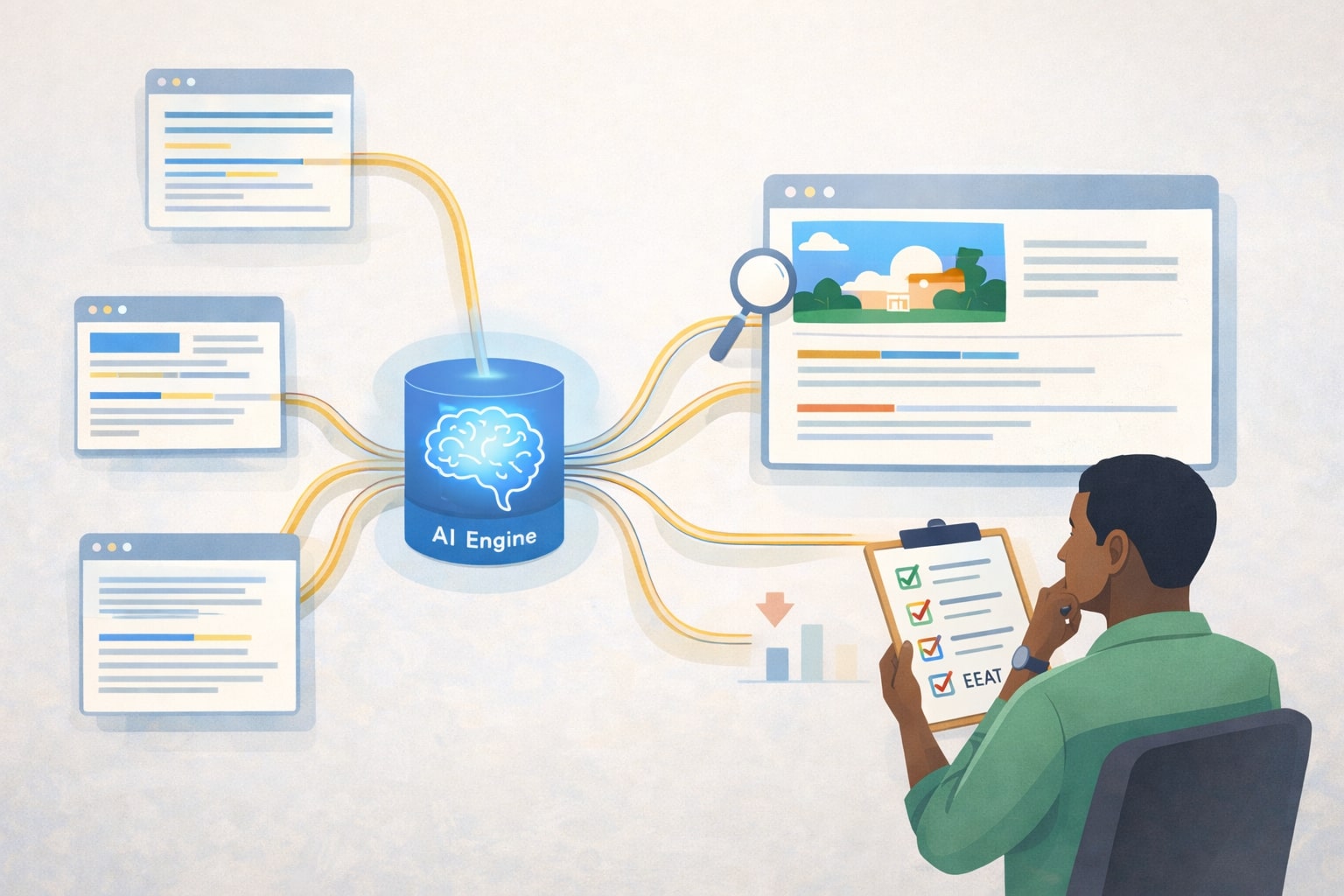
To design for the AI Overviews era, it helps to understand how these answers are assembled from your content. Google explains that AI features use a query fan out approach, where the system issues multiple related searches on your behalf, explores clusters of subtopics, and looks for pages that jointly provide a complete, reliable answer.[1] Instead of linking to a single perfect page, the model typically blends information from several documents, sometimes including videos or other media, then cites a handful of them as sources under the summary.[4][5]
Importantly, Google emphasises that there are no special technical requirements to appear in AI Overviews beyond the usual fundamentals of crawlability, indexability, and helpful content.[1][9] The models sit on top of existing ranking systems, which are themselves influenced by the signals described in the Search Quality Rater Guidelines, including experience, expertise, authoritativeness, and trustworthiness, collectively known as E E A T.[10] In other words, AI Overviews reuse the same understanding of which pages are high quality, then ask the model to compose a summary that is consistent with those pages.
For site owners, this means that shallow content designed to target a single phrase is unlikely to be enough. Pages that perform well in AI Overviews tend to show three consistent traits. First, they cover the topic with enough depth and nuance that a model can safely reuse their explanations. Second, they present information in a structured way, with clear headings, lists, and tables that make it easier to extract key steps or comparisons.[11] Third, they carry visible signals of credibility and accountability, such as named authors, references to primary sources, and clear risk guidance where the topic touches health, finance, or other sensitive areas.
If you want a model level view of why Google can move this fast with AI answers, you can read my article on how Gemini 3 changes SEO, AI Overviews, and content strategy on Google, where I unpack what this generation of models makes possible for search and content workflows.
From ranking pages to composing answers
Classic SEO treats ranking as the final goal, get your page high enough, and people will click. Under AI Overviews, ranking is more like an eligibility filter, a first step that decides whether your content even enters the pool of pages that the model can draw from. The model then retrieves passages across several of those pages, weighs their relevance to each part of the question, and decides how to phrase the answer.
Because AI Overviews often answer multi step queries, your page may contribute only to one slice of the overall summary, for example the section that explains risks, or a step by step list on how to perform an action. That means marginal improvements in clarity or completeness on a single subtopic can be enough to turn your page into the preferred source for that part of the answer, even if your overall domain is smaller than household brands.
Another under appreciated detail is that AI Overviews have to balance usefulness with safety. Investigations into incorrect or harmful answers, especially in health, have pushed Google to emphasise safety layers, use more conservative wording, and rely more heavily on reputable sources when a query could affect medical, financial, or legal decisions.[1][10] That makes it even more important for your content to make qualifications explicit, for example by stating when a recommendation assumes a certain audience, context, or level of risk.
Signals that matter more for AI summarisation
While Google maintains that there are no AI Overview specific ranking factors, several technical and content level signals clearly matter more once generative answers enter the picture. Structured HTML becomes more important because lists, headings, and tables give the model stable anchors for each part of the question.[11] Schema markup such as Article, HowTo, and FAQPage can provide additional hints, although Google says these are not mandatory to appear in AI features.[1] Internally coherent sections, where each paragraph explores one idea and flows into the next, reduce the risk of the model misinterpreting context when it lifts a sentence or two into the summary.
Evidence and attribution also matter. Pages that cite primary sources, show updated dates, and draw clear lines between established facts and opinions make it easier for AI systems and quality raters to treat them as reference material rather than thin commentary.[9][10] Finally, user engagement signals, such as dwell time and pogo sticking, still feed back into ranking systems that AI Overviews depend on, so a page that answers quickly, reads smoothly, and gives users clear next steps remains valuable even if some sessions never reach it.

Defining reference quality pages for the AI Overviews era
The phrase reference quality is not a formal Google ranking term, yet it captures how AI Overviews seem to select their favourite sources. A reference quality page is not just long, it is a stable, well maintained, and citable resource that another system can rely on to explain a topic without constant supervision. In practice, that means your content needs to be accurate, comprehensive within its scope, and structured so that individual sections still make sense when read in isolation.
Reference quality pages share several characteristics. They make the main question obvious in the first screen, then continue with clear subheadings that map to real user questions. They include concise explanations, but also acknowledge nuance, edge cases, and situations where the general advice does not apply. They point to external authorities where appropriate and avoid over claiming, especially on topics where incorrect or misleading information would create real harm.[9][10]
From an operational point of view, designing for reference quality means accepting that one page will carry more strategic weight than many smaller posts. Instead of publishing dozens of thin variations around similar keywords, it becomes more effective to maintain fewer, stronger pages that deserve to be called definitive. Those pages can then accumulate links, user trust, and model familiarity over time.
Topical depth without unnecessary noise
Depth in the AI Overviews era is not about stuffing every possible subtopic into one document, it is about covering the set of questions a reasonable person would ask on the way to a decision. That includes context, such as why the issue matters, as well as process, such as how to perform a task or choose between alternatives. It also includes trade offs, for instance when one solution is safer but slower, and another is faster but requires more expertise or budget.
One useful way to think about depth is to treat your page as the script that a well trained assistant would use if they had to answer the query in a call with a customer. The assistant needs enough detail to sound competent, enough structure to stay on track, and enough caution to avoid promising something they cannot deliver. If your content can support that level of conversation, it likely has sufficient depth for AI Overviews to reuse.
What you want to avoid is ornamental depth, pages full of generic paragraphs that repeat the same idea in slightly different language. That kind of padding may increase word count, but it weakens the signal to noise ratio and makes it harder for both users and models to find the important parts. The helpful content guidance from Google explicitly warns against content created primarily to attract search traffic without adding real value.[9]
Clear question led structure for humans and AI
Structure is where human readability and AI optimisation meet. When your headings echo real queries, you make it easy for people to scan the page and decide which section to read next. At the same time, you give AI systems anchors that match sub questions they plan to answer inside an overview, for example how does AI Overviews affect CTR or how to measure AI Overviews visibility.
Under each heading, aim for at least one paragraph that explains the idea in plain language before you introduce lists, tables, or diagrams. This gives both readers and models enough context to interpret the details that follow. Use consistent heading levels, with a clear distinction between H2 sections that cover major aspects of the topic and H3 subsections that unpack one slice of that aspect. For example, a section on KPIs can have H3 subsections for brand visibility, lead quality, and revenue attribution.
Tables are especially helpful when you need to compare options, show before after patterns, or summarise frameworks. Several AI Overview optimisation guides emphasise that HTML tables and lists make it easier for AI to extract structured information and reuse it accurately.[11] In sensitive areas, structured warnings and eligibility criteria can also help models present safer answers.
Evidence, sources, and risk handling
In twenty twenty five and twenty twenty six, scrutiny of AI Overviews increased as journalists and researchers exposed a series of incorrect or misleading answers, especially in health related searches. That led to public reminders from Google that its systems are designed to prioritise helpful, reliable content and that unmaintained or inaccurate pages can lower perceived quality.[1][9][10] For site owners, the safest response is to treat every factual claim the way you would treat a quote in a serious publication, which means you should be able to trace it back to a primary source.
Cite data from original research when possible and be explicit about dates, sample sizes, and any limitations that matter. Where you rely on benchmark studies created by SEO tools or agencies, make that clear and avoid presenting their numbers as universal facts. If there is disagreement between credible sources, acknowledge it and explain how you interpret the evidence for your audience.
Risk handling deserves its own line in your content checklist. Whenever a recommendation might not be appropriate for certain people or situations, say so. In medical content that means clarifying that information is educational and that diagnosis or treatment decisions belong with qualified professionals. In financial content that means distinguishing between general education and personalised advice. Doing this consistently not only protects users, it also aligns with the way quality raters are instructed to score pages that could significantly affect someone’s health, wealth, or safety.[10]

Designing pages that AI Overviews love to cite
If reference quality is the North Star, page design is how you bring it into the real constraints of publishing. Google insists that there are no special SEO hacks for AI Overviews, but best practice guides and real world experiments point to recurring page level patterns that keep showing up in the sources under AI summaries.[1][5][11] These patterns are less about manipulating the model and more about making your content easy to understand, segment, and quote.
A practical way to approach this is to treat every strategic article as a small toolkit. The body of the content carries the main explanation, while specific reusable blocks, such as quick summaries, step lists, and FAQs, give AI and humans reliable shortcuts. When you design your page template with these blocks in mind, you make it much easier to adapt to future AI features without needing to rebuild everything from scratch.
On page building blocks for AI Overviews
Several optimisation studies agree on a core set of on page elements that tend to correlate with inclusion in AI Overviews and similar answer surfaces, even if they cannot prove causation. At the top of the article, a short, factual summary or TLDR that answers the main question in two to four sentences gives the model a safe initial draft to work from.[11] This block also serves human readers who want a quick overview before committing to the full piece.
Further down, you can include clearly labelled sections for step by step instructions, frameworks, or checklists. For example, a reference page blueprint section can describe in order how to research AI Overview presence for a keyword, how to map user intent, and how to structure the final article. These sequences are attractive for AI systems because they align neatly with the way an overview answers how to questions.
FAQ sections deserve special attention. Google already supports FAQ rich results through schema, and AI Overviews may treat well written FAQs as a pool of precise question answer pairs.[1][11] Place FAQs near the end of the article, after the main explanation, and focus on specific, high intent questions rather than vague prompts. Provide short, direct answers, but avoid oversimplification on sensitive topics.
Schema, technical SEO, and AI feature eligibility
From a technical standpoint, the same fundamentals that matter for classic SEO still apply. Your pages need to be crawlable, indexable, and fast enough that users do not abandon them after the click. Core Web Vitals remain a useful benchmark because they correlate with user experience and have dedicated reporting in Search Console.[8] For AI Overviews specifically, structured data is less about direct ranking boosts and more about making the content easier to categorise.
Implement appropriate Article or TechArticle markup so Google understands that a page is an in depth piece of content rather than a thin landing page. Add FAQPage schema when you include FAQs and HowTo schema when you describe a sequence of steps that users can follow.[1] Validate your markup with Google’s Rich Results Test and keep an eye on Search Console enhancement reports to catch errors early. While Google says you do not need special tags to appear in AI Overviews, structured data clearly helps its systems interpret page purpose more reliably.
Technical hygiene also includes canonicalisation, hreflang where relevant, and careful handling of parameterised URLs so that query fan out does not land on duplicate or low value versions of your content. For sites with many near duplicate pages, consider consolidating content into stronger reference pages that receive clearer canonical signals, reducing the risk that AI Overviews pick a weak variant as a source.
E E A T elements that AI can read
E E A T may sound abstract, yet many of its signals manifest in concrete, machine readable ways. Experience and expertise appear through the author biography, the credentials listed on that biography, and the consistency between the author’s topic area and the article they wrote.[10] Authority emerges from the pattern of mentions and links across the web that point back to your site and its authors. Trustworthiness shows up in transparent policies, clear contact information, and a history of correcting mistakes.
On page, you can support these signals by including a visible byline with the author’s name and a short line about their expertise. Link the name to a richer author page that explains their background, shows other articles they have written, and clarifies how they stay up to date in their field. For medical or financial topics, mention affiliations with recognised institutions or certifications where appropriate, without overstating claims.
Site wide, make sure your About, Contact, and policy pages are easy to reach from every article, ideally in both header and footer. When you publish corrections or updates, consider adding brief change logs to important reference pages so that users, quality raters, and AI systems can see that the content is actively maintained. Google’s own documentation notes that unmaintained and inaccurate content is a reason for low page quality scores.[10]
Rethinking KPIs when clicks decline
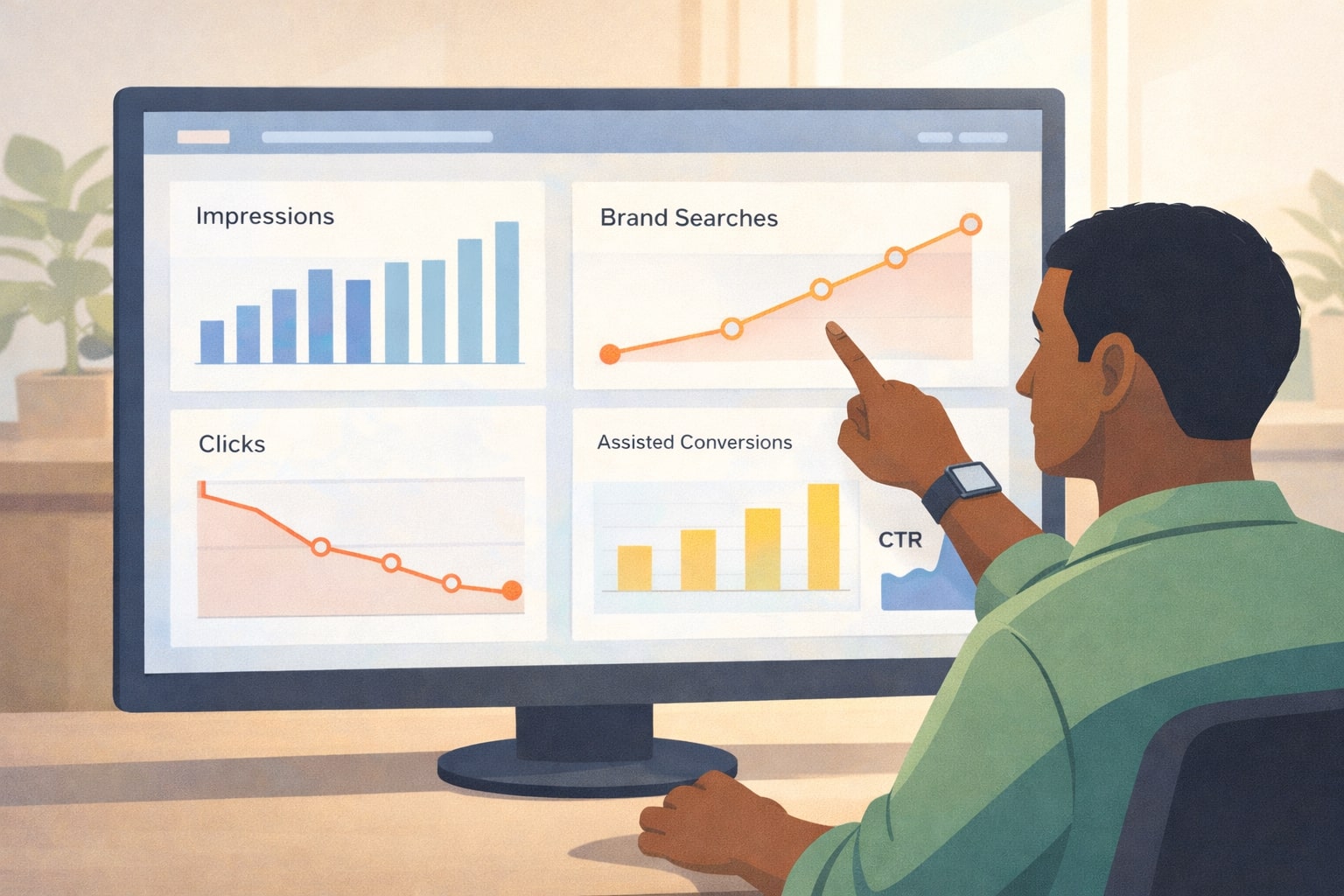
If AI Overviews reduce clicks, a natural question follows, does SEO still pay off. Data from several industry studies paints a more nuanced picture. Although average click through rates drop sharply on queries with AI Overviews, brands that are cited within the AI summary often see higher click share compared with competing links further down the page.[6] Some surveys even report that a majority of businesses now perceive AI Overviews as a net positive for visibility or rankings, despite the overall shift toward zero click.[8]
To make sense of this, SEOs need to broaden their measurement beyond simple clicks per query. Brand visibility inside AI answers matters, especially for complex journeys where the first interaction is informational and later interactions move through branded or navigational queries. Lead quality can improve if AI Overviews filter out low intent visitors and send you users who already understand the basics.
At the same time, it would be naïve to ignore the traffic losses. Publishers who relied heavily on ad supported informational content, particularly in news, have already felt the impact of more zero click sessions.[7] For these sites, diversifying acquisition channels, strengthening newsletters, and building direct relationships with audiences becomes essential, since relying solely on search referrals is increasingly risky.
Reading Search Console in the AI Overviews era
One source of frustration for practitioners is that Google Search Console currently does not provide a native dimension that tells you when an impression involved an AI Overview or whether your site was cited in the summary.[12] You can still see queries, pages, impressions, clicks, and average positions, but you cannot separate sessions with AI answers from those without them. Several guides recommend proxy methods, such as analysing queries where you consistently rank in the top two positions yet see sudden drops in CTR after twenty twenty four.
Even without a dedicated filter, Search Console remains the best starting point to watch how your AI sensitive topics behave. Group queries by topic or intent, track their trend lines over sixteen months, and annotate major Google announcements, such as the initial AI Overview rollout and subsequent expansions.[8] Combine this with analytics data to see whether the users who still click are engaging more deeply, for example by reading multiple pages or completing key events.
As Search Console experiments with AI powered configuration features that automatically build reports from natural language prompts, it may become easier to surface patterns without manual filtering.[13] In the meantime, discipline in naming conventions, query grouping, and annotation will go a long way.
Brand, demand, and assisted value
Beyond pure search metrics, the AI Overviews era pushes SEO closer to brand and demand generation. When users see your name repeatedly under trustworthy answers, even if they do not click every time, you earn familiarity. Over time, that can show up as more branded search, direct visits, and higher conversion rates from other channels.
To quantify this assisted value, track branded query volume, changes in conversion rates for visitors who first arrived on informational pages, and lift in performance for paid campaigns that target audiences previously exposed through organic content. Use controlled tests where possible, for example by launching a new reference page in one market and comparing downstream brand metrics with a similar market that does not yet have that content.
The key is to treat AI Overviews not as a pure threat, but as a force that raises the bar. Pages that are good enough to power safe, reliable AI answers will almost always be strong assets for other parts of your marketing system.
An operational playbook for teams in twenty twenty six

Translating all of this into day to day work requires a repeatable playbook. Many teams are already stretched, and the idea of redesigning every page for AI can feel overwhelming. Instead of a one time overhaul, think in terms of continuous upgrading of your most important topics and a structured checklist that keeps everyone aligned.
Start by identifying the small set of topics where your brand truly needs to be reference level, often these are the problems your product solves, the frameworks you teach customers, or the issues where you want to own the narrative in your industry. For each topic, decide which page will act as the primary reference and which supporting pages will funnel internal links and context into that reference.
Next, run each reference page through a simple but rigorous evaluation. Does it have a clear, query aligned structure. Does it provide depth without unnecessary padding. Are there quick summaries, FAQs, tables, and clear calls to action. Are E E A T signals visible and convincing. Are the statistics current and properly sourced. Is the page technically sound on mobile. This is where a shared checklist becomes powerful, because it turns abstract principles into concrete tasks.
Downloadable checklist, making reference quality SEO easier to ship
To make this easier to apply across campaigns and clients, you can use a structured checklist or playbook spreadsheet. The idea is to move away from rewriting the same guidance in countless briefs and instead give your team one living document they can duplicate for every important topic.
Each row in the checklist represents a specific task, such as identifying AI Overview presence for a query, mapping follow up questions, drafting a TLDR block, implementing schema, or scheduling quarterly content refreshes. Columns capture who owns the task, why it matters in the AI Overviews era, its priority, due dates, and notes from reviews. Over time, this becomes a lightweight project management system dedicated to reference quality SEO.
You can start with the template created for this article, which is compatible with Excel and Google Sheets and includes sections for discovery, intent mapping, page blueprint, on page structure, evidence, E E A T, technical checks, measurement, and iteration. Use it as a foundation, then adapt it to your workflows and reporting style.
Call to action for readers, download the template checklist and duplicate it for your own site, then customise the tasks, owners, and timelines based on your team and your most important topics.
👉 Download the template: Checklist
Where SEO goes from here
The rise of AI Overviews confirms something that has been true but easy to ignore, search is not a static protocol, it is an evolving interface between human questions and machine curated answers. For SEOs, that evolution means the job is less about gaming ranking factors and more about building reference quality resources that AI systems can trust, reuse, and still send visitors to when deeper context is needed.
Over the next few years, models will improve, interfaces will change, and regulators will push back on zero click dynamics. What will not change is the need for clear explanations, honest evidence, and accountable publishers. If you focus on those, the tactics for specific SERP features become easier to adapt. Use the ideas and checklist in this article as a starting point, experiment with your own topics, and then share what you discover, including any surprises, questions, or wins, in the comments so the wider community can learn from your experience as well.
References
- Google Search Central, AI features and your website
- Google, Generative AI in Search, May twenty twenty four rollout post
- Google, AI in Search, Going beyond information to intelligence, May twenty twenty five
- Ahrefs, Google AI Overviews, All you need to know
- Semrush, AI Overviews impact study across ten million keywords
- Dataslayer summary of Seer Interactive AI Overviews CTR study
- The Digital Bloom, twenty twenty five Organic Traffic Crisis and AI Overviews analysis
- WordStream, thirty four AI Overviews statistics and facts
- Google, Creating helpful, reliable, people first content
- Google Search Quality Rater Guidelines, E E A T and page quality
- yellowHEAD, SEO tactics to optimise for AI Overviews
- Search Engine Journal, how to measure AI Overview visibility without a native filter
- Google, Search Console experiments with AI assisted configuration
Ready to apply this to your business?
Let's Talk Strategy →