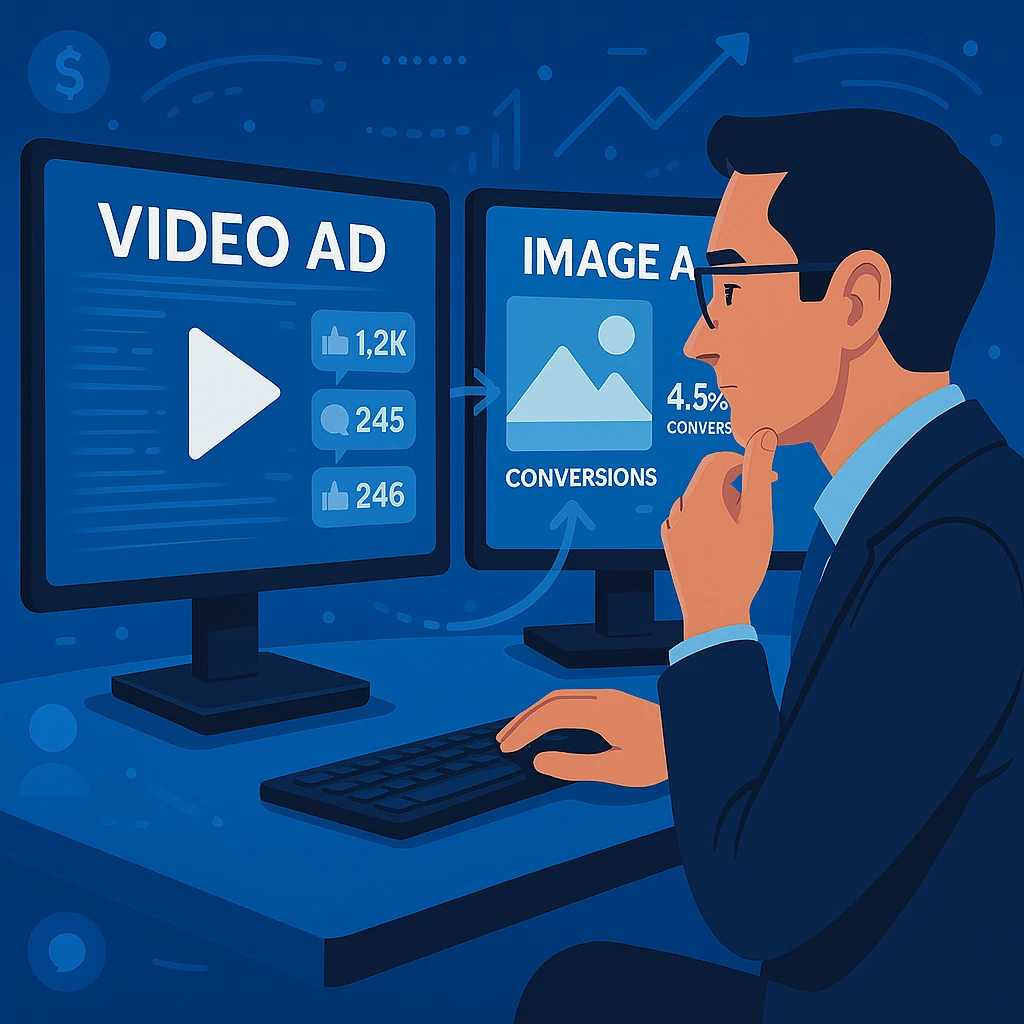
Margabagus.com – The battle between video advertising and static image ads continues to intensify as digital marketing budgets reach unprecedented heights in 2025. Recent data from eMarketer reveals that companies now allocate 68% of their total marketing spend to digital channels, with video advertising commanding $187 billion globally—a 27% increase from just two years ago. Yet despite video’s meteoric rise, image ads still dominate certain platforms and demographics, delivering superior video vs image ad performance metrics in specific contexts. This stark contrast raises critical questions for marketers: When should you leverage the dynamic power of video? When might static imagery prove more effective? And how fundamentally different are the strategic approaches behind each format? The answers aren’t as straightforward as many assume, and the nuances could be determining factors in your campaign’s ultimate success or failure.
The Current Landscape of Digital Advertising Formats

The digital advertising ecosystem has evolved dramatically over the past decade, transforming from a text-heavy environment to a visually rich landscape dominated by compelling imagery and engaging video content.
According to the Interactive Advertising Bureau’s (IAB) 2025 Digital Ad Spend Report, video now accounts for approximately 41% of all digital ad expenditure, while image-based ads represent 35%. The remaining 24% is distributed among text ads, audio formats, and interactive experiences. Mark Weinstein, Chief Digital Officer at Omnicom Media Group, notes that “The diversification we’re seeing isn’t about one format replacing another—it’s about advertisers becoming increasingly sophisticated in matching formats to objectives.”
This isn’t just about following trends. Research from Nielsen’s Digital Ad Ratings in early 2025 found that format-appropriate advertising increases brand recall by up to 31% compared to misaligned format choices. The stakes are high, with the average enterprise company in North America spending $7.2 million annually on digital advertising according to Forrester’s latest industry analysis.
What’s particularly interesting is how different industries gravitate toward specific formats. Technology companies allocate approximately 54% of their budgets to video, while financial services organizations still prefer image ads for their ability to quickly communicate complex offerings. Healthcare maintains the most balanced approach, with a nearly 50/50 split between video and image advertising.
Video Ad Copy: Key Characteristics and Strengths

Video ads possess distinctive advantages that make them particularly powerful for certain marketing objectives. The combination of visual storytelling, audio elements, and motion creates a multi-sensory experience that can forge deeper emotional connections with viewers.
Dr. Samantha Chen, Director of Consumer Psychology at Stanford’s Digital Marketing Institute, explains, “Video content activates multiple neural pathways simultaneously, creating up to 3.4 times the engagement of static imagery when properly executed.” This neurological advantage translates to tangible results: according to HubSpot’s 2025 Video Marketing Statistics, videos generate 66% more qualified leads per year compared to non-video alternatives.
Creating effective video ad copy requires understanding several fundamental principles:
- Narrative Structure: Unlike image ads, videos must follow a cohesive storytelling arc. Research from Wistia reveals that videos with clear three-act structures (setup, confrontation, resolution) retain 73% more viewers to completion than those with disjointed narratives.
- Front-Loaded Messaging: With audience attention spans continuing to decrease (now averaging just 1.8 seconds before deciding whether to continue watching), the most critical information must appear within the first three seconds. Facebook’s Creative Shop reports that ads showing brand elements in the first two seconds experience 23% higher brand recall.
- Audio-Visual Harmony: Sound design is no longer optional. While 69% of mobile videos are watched without sound according to Facebook, those that successfully integrate synchronized audio and visual elements drive 2.7x higher conversion rates according to Google’s advertising research team.
- Length Optimization: Short-form video dominance continues, but with nuanced platform differences. TikTok’s internal research shows 9-15 second videos drive highest engagement on their platform, while YouTube reports 15-30 second ads yield optimal completion rates for pre-roll placements.
Sarah Johnson, Creative Director at BBDO New York, emphasizes that “Video ad copy must respect the cognitive load of viewers. Every second needs to earn its place by either building emotional resonance or delivering clear value propositions—ideally both simultaneously.”
The technical requirements for video ad creation have also evolved. According to a 2025 study by Vidyard, 87% of successful advertising campaigns now incorporate some form of dynamically personalized video elements, such as viewer names, location-specific visuals, or behavior-triggered storylines.
Check out this fascinating article: Meta Ads for Small Businesses 2025: A Complete Guide to Maximize Your Growth
Image Ad Copy: Key Characteristics and Strengths

While video continues to capture headlines, image ad design best practices have evolved in sophisticated ways that maintain their relevance and effectiveness in 2025’s advertising landscape. The power of still imagery lies in its immediacy and cognitive efficiency—characteristics that make it irreplaceable for certain objectives.
Harvard Business School professor Dr. James Ferguson’s recent research on visual processing found that “The human brain can extract meaning from a well-designed image in as little as 13 milliseconds, creating an almost instantaneous impression that video, by its temporal nature, cannot match.” This processing speed advantage means image ads can deliver complete messages in environments where time and attention are extremely limited.
The core strengths of image advertising include:
- Cognitive Efficiency: According to the Journal of Consumer Research, viewers require 37% less mental effort to process a static image compared to video content of similar complexity. This cognitive efficiency is particularly valuable on platforms where users are rapidly scanning content.
- Message Retention: Cambridge University’s Visual Cognition Lab found that properly designed static images achieve 72% information retention after 24 hours, compared to 43% for video ads covering similar content. This is attributed to what researchers call “single-exposure processing completeness.”
- Cost-Effectiveness: The 2025 Digital Advertising Cost Index by Deloitte shows image ad production averages $1,200-$2,800 per asset, while video production ranges from $5,000-$75,000 for comparable quality. This 4-25x cost difference remains significant for many marketers.
- Load Time Advantage: Google’s 2025 Web Performance Report indicates that image ads load approximately 4.3 times faster than video content, resulting in 29% fewer abandonment rates, particularly in regions with bandwidth limitations.
Carlos Mendez, Chief Creative Officer at Publicis Groupe, emphasizes that “The most effective image ads in today’s environment combine immediate visual impact with layered meaning that rewards closer examination. The best examples communicate on multiple levels simultaneously.”
Specific design elements have proven particularly effective in modern image advertising. Eye-tracking studies by Nielsen Norman Group identify that ads incorporating directional cues (like a person looking toward text) increase message comprehension by 42%. Similarly, the strategic use of color contrast to highlight call-to-action elements improves click-through rates by an average of 27% according to Adobe’s Digital Advertising Benchmark report.
Performance Metrics Comparison Between Formats

When evaluating ad format ROI comparison 2025 data, it becomes clear that performance varies dramatically based on campaign objectives, platforms, and audience segments. Understanding these nuances is critical for strategic decision-making.
LinkedIn’s 2025 B2B Advertising Benchmark Report provides a comprehensive analysis across formats:
| Metric | Video Ads | Image Ads | Industry Average |
|---|---|---|---|
| Awareness Lift | +32% | +18% | +22% |
| Click-Through Rate | 0.6-1.8% | 0.4-1.3% | 0.9% |
| Conversion Rate | 2.1-4.7% | 3.2-5.6% | 3.3% |
| Cost Per Click | $5.20-$9.70 | $3.40-$7.20 | $6.40 |
| Return On Ad Spend | 3.2-7.1x | 3.8-6.5x | 4.1x |
What’s particularly interesting is how these metrics shift across different platforms. Instagram data from Meta for Business shows video ads outperforming images by 38% for brand awareness metrics, while static images deliver 24% better conversion rates for direct response campaigns. This pattern is consistent with findings from Twitter’s (now X) Advertising Lab, which reports that video ads generate 26% higher engagement but image ads produce faster conversion paths with 19% fewer touchpoints before purchase.
Age demographics also significantly impact format effectiveness. According to Comscore’s 2025 Digital Consumer Behavior Report, consumers aged 18-34 demonstrate 47% higher engagement with video content across platforms, while those 45+ show only an 8% preference for video over static imagery.
Dr. Michelle Wagner, Director of Analytics at MediaMath, explains that “The performance delta between formats has less to do with inherent superiority and more to do with alignment between format characteristics and specific marketing objectives. The highest-performing campaigns we analyze are those that strategically deploy both formats at different stages of the consumer journey.”
Industry-specific data reveals further patterns. In the technology sector, video ads show a 42% higher conversion rate according to Gartner’s Digital Marketing Analytics. However, in financial services, image ads outperform video by 31% for direct response metrics, likely due to the complex information often presented in these ads.
Check out this fascinating article: How to Optimize Vertical Videos for Social Media Ads
Strategic Decision-Making Framework

Developing a cohesive ad copy strategy requires a systematic approach to format selection based on multiple variables. The following framework, derived from McKinsey’s 2025 Digital Marketing Excellence research, provides a structured methodology for choosing between video and image formats.
The VIPER Model for Format Selection
The VIPER framework (Values, Intent, Platform, Engagement goals, Resource constraints) offers a comprehensive approach:
- Values: Assess whether emotional connection (favoring video) or information clarity (favoring images) is more critical to your brand positioning. Research from the Brand Emotional Value Index shows that luxury brands achieve 3.2x higher engagement with video content that builds aspirational connections.
- Intent: Match format to consumer intent signals. Google’s Consumer Insights team found that informational search queries convert 27% better with image ads, while navigational queries show 41% higher engagement with video.
- Platform: Align format choice with platform-specific user behavior patterns. TikTok users expect video content, with native-feeling ads outperforming obvious advertisements by 73% according to internal platform data. Meanwhile, LinkedIn still shows stronger performance for image ads in professional context, with 31% higher conversion rates.
- Engagement goals: Define success metrics before format selection. Brand awareness campaigns typically benefit from video’s emotionally resonant nature, achieving 43% higher recall rates according to Nielsen. Conversion-focused campaigns often perform better with image ads, shortening the path to purchase by an average of 2.7 steps according to Facebook’s Conversion Lift studies.
- Resource constraints: Honestly assess budget and timeline limitations. While high-quality video generally outperforms high-quality images, low-quality video significantly underperforms professional image ads. Adobe’s Creative Cloud Report indicates that perceived production quality impacts consumer trust by up to 68%.
David Martinez, Chief Strategy Officer at WPP, emphasizes that “The brands achieving the highest ROI are those implementing a format strategy based on rigorous testing rather than assumptions. We’re seeing up to 48% improvement in campaign performance when formats are matched to objectives using data-driven frameworks rather than creative preferences.”
A particularly instructive approach comes from A/B testing methodologies. Optimizely’s 2025 Experimentation Report found that companies conducting format testing prior to full campaign launches improve overall marketing ROI by 31-47% compared to those deploying single-format approaches.
Implementation Examples and Case Studies

Examining real-world applications provides valuable insights into how leading brands effectively implement format strategies. These examples illustrate practical applications of the principles discussed.
Samsung Galaxy Campaign (2024-2025)
Samsung’s launch campaign for their latest Galaxy device presents a masterclass in format orchestration. The campaign utilized:
- Video assets for emotional storytelling and feature demonstrations on YouTube and streaming platforms
- Static image ads for specific feature highlights and price promotions on Meta platforms and display networks
- A sequential targeting strategy serving videos first, then following with image ads for reinforcement
Results: The integrated approach generated a 41% higher conversion rate than their previous single-format campaigns, with attribution modeling showing video driving initial interest and images closing sales.
Campaign director Jessica Wong explained, “We discovered that video created the emotional connection with new features, while image ads provided the cognitive space for consumers to evaluate specifications and offers. Neither format alone delivered comparable results.”
Marriott Bonvoy Membership Drive
Marriott’s membership program recruitment campaign provides an excellent example of audience-specific format selection:
- For 25-34 age demographics: Video-first strategy across social platforms highlighting experiential benefits
- For 45+ age demographics: Image-dominant approach emphasizing loyalty program value in concrete terms
- Consistent visual language across both formats maintained brand cohesion
Results: The tailored approach increased program sign-ups by 37% year-over-year while reducing cost-per-acquisition by 23%. Most notably, engagement metrics showed the exact opposite pattern between demographics, with younger audiences spending 3.2x longer with video content and older audiences showing 2.7x higher engagement with image ads.
Shopify Small Business Solutions
Shopify’s B2B campaign targeting small business owners exemplifies context-based format selection:
- Professional networking platforms: Image ads highlighting specific service benefits and pricing
- Entertainment platforms: Video storytelling featuring success stories from relatable entrepreneurs
- Retargeting: Dynamic image ads showing specifically viewed features and personalized offers
Results: The platform-specific approach improved qualified lead generation by 52% compared to previous campaigns using consistent formats across all platforms. Ryan Chen, Shopify’s Head of Acquisition, noted, “We found that respecting the native context of each platform dramatically improved performance. What worked on YouTube failed on LinkedIn, and vice versa.”
Check out this fascinating article: Targeting Gen Z on TikTok Ads: Music, Trends, and Challenges
Future Trends in Video and Image Advertising

As we look ahead, several emerging developments are reshaping the relationship between video and image ad formats. Understanding these trends is crucial for forward-thinking marketing strategies.
- Format Hybridization: The line between static and video content continues to blur. According to Adobe’s 2025 Digital Experience Report, “kinetic images” (limited motion photographs) are showing 37% higher engagement than static images while maintaining the cognitive processing advantages of still photography. Technologies like Apple’s Live Photos and Google’s Motion Stills are increasingly being adapted for advertising applications.
- AI-Driven Format Optimization: Machine learning algorithms now automatically select between video and image presentations based on individual user behavior. Meta’s Advantage+ campaign tools launched in late 2024 report 29% performance improvements through real-time format selection, serving videos to users with historical video engagement and images to those who typically engage with static content.
- Contextual Responsiveness: Dynamic creative platforms increasingly adjust format based on environmental factors. Research from The Weather Company shows that video ads perform 41% better during leisure weather conditions, while image ads show 27% higher conversion rates during poor weather when consumers are more task-oriented.
- Vertical Video Normalization: The dominance of smartphone-first consumption continues to elevate vertical video formats. Snapchat’s advertiser data indicates that vertical video now achieves 41% higher completion rates than landscape presentations, extending beyond youth demographics into mainstream adult audiences.
- Enhanced Image Interactivity: Static images are gaining video-like engagement properties through technologies like shoppable hotspots and light interactive elements. Data from SCAD’s Interactive Design Lab shows these “enriched images” achieve 78% of video engagement metrics while maintaining the production cost advantages of static formats.
Analyst Maria Gonzalez from eMarketer predicts, “The most significant trend isn’t the competition between formats but rather their growing interdependence. Leading brands are creating unified visual systems where video and static elements are designed simultaneously from the same creative brief, allowing seamless consumer experiences across touchpoints.”
This integration is evident in production methodologies as well. A survey of creative agencies by Digiday found that 72% now shoot video and photography simultaneously rather than as separate productions, enabling consistent visual language while optimizing for each format’s strengths.
Crafting Your Optimal Format Strategy

The evidence is clear: the question isn’t whether video or image ads are universally superior, but rather which format best serves specific objectives within your broader marketing strategy. The most successful advertisers in 2025 approach this decision with nuance and strategic intent rather than following trends or creative preferences.
The research consistently demonstrates several actionable principles:
- Embrace Format Diversity: Campaigns utilizing both formats strategically outperform single-format approaches by an average of 38% according to Kantar’s Cross-Media Effectiveness studies. Your ad copy strategies should incorporate both formats with clear purpose.
- Test Systematically: Implementing structured A/B testing for format performance across different platforms and audience segments can improve overall campaign ROI by up to 47%. Make this testing a standard practice rather than an occasional experiment.
- Align Format with Journey Stage: Video typically excels at awareness and interest stages, while image ads often perform better at consideration and conversion points. Map your digital advertising format comparison to specific points in the customer journey.
- Respect Platform Context: Native-feeling content consistently outperforms generic creative. Tailor your approach to the natural consumption patterns of each platform rather than deploying identical assets everywhere.
- Prioritize Quality Over Quantity: Limited high-quality assets outperform numerous mediocre executions. If budget constraints force choices, fewer premium executions in both formats typically yield better results than many low-quality attempts.
As you implement these principles, maintain focus on your specific business objectives rather than creative preferences or industry trends. The most effective format choices directly support measurable goals rather than subjective aesthetic considerations.
By applying these evidence-based approaches to format selection, you position your advertising efforts for maximum impact in an increasingly complex digital landscape. The winners in this environment won’t be those who commit exclusively to either video or images, but those who strategically leverage both formats’ unique strengths in service of clear marketing objectives.
Ready to apply this to your business?
Let's Talk Strategy →