
GPT-5.3-Codex is OpenAI’s latest agentic coding model, combining GPT-5.2-Codex coding skills with GPT-5.2 reasoning while running about 25 percent faster.
It sets new state of the art scores on SWE-Bench Pro and Terminal-Bench 2.0, and shows strong results on OSWorld and GDPval, so it can handle full software lifecycles and broader knowledge work.
- Use GPT-5.3-Codex in the Codex app, CLI or IDE when you need long running, tool using agents that can research, write and debug code on your behalf.
- Keep GPT-5 or other GPT-5 family models for general chat, writing and analysis that do not revolve around coding workflows.
- Start with small supervised projects, then scale up to multi agent “AI coworker” setups to safely integrate GPT-5.3-Codex into your production engineering process.
GPT-5.3-Codex arrived in February 2026 with a very specific promise, turn the idea of a coding assistant into a general purpose computer side collaborator that can help run long projects, not just generate snippets.[1] OpenAI describes GPT-5.3-Codex as its most capable agentic coding model so far, blending the frontier coding performance of GPT-5.2-Codex with the reasoning and professional knowledge of GPT-5.2, while also running about twenty five percent faster, and setting state of the art results on benchmarks like SWE-Bench Pro, Terminal-Bench 2.0, OSWorld and GDPval.[1] At the same time, analysts covering the launch frame it as a direct response to Anthropic’s Claude Opus 4.6, a signal that the next phase of the AI race is about which models can reliably run whole workflows, not just answer prompts.[2][5]
GPT-5.3-Codex at a Glance
| Aspect | Summary |
|---|---|
| Model type | Agentic coding model in the GPT-5 family, optimized for code, tools and computer use |
| Key upgrade | Combines GPT-5.2-Codex coding skills with GPT-5.2 level reasoning and professional knowledge while running about twenty five percent faster[1] |
| Benchmarks | New state of the art on SWE-Bench Pro and Terminal-Bench 2.0, strong performance on OSWorld-Verified and GDPval[1][6] |
| Primary surfaces | Codex app for macOS, Codex CLI, IDE extensions, Codex in the cloud, and paid ChatGPT plans where Codex is available[3][4] |
| Typical use cases | Software engineering, web development, devops and deployment helpers, automated documentation and testing, spreadsheet and presentation workflows |
| Notable angle | First OpenAI model that was heavily used to debug and support its own training and deployment, including monitoring, evaluation and infrastructure tuning[1] |
| Safety profile | Classified as high capability in cybersecurity under OpenAI’s Preparedness Framework, with extra safeguards and trusted access programs for security work[7] |
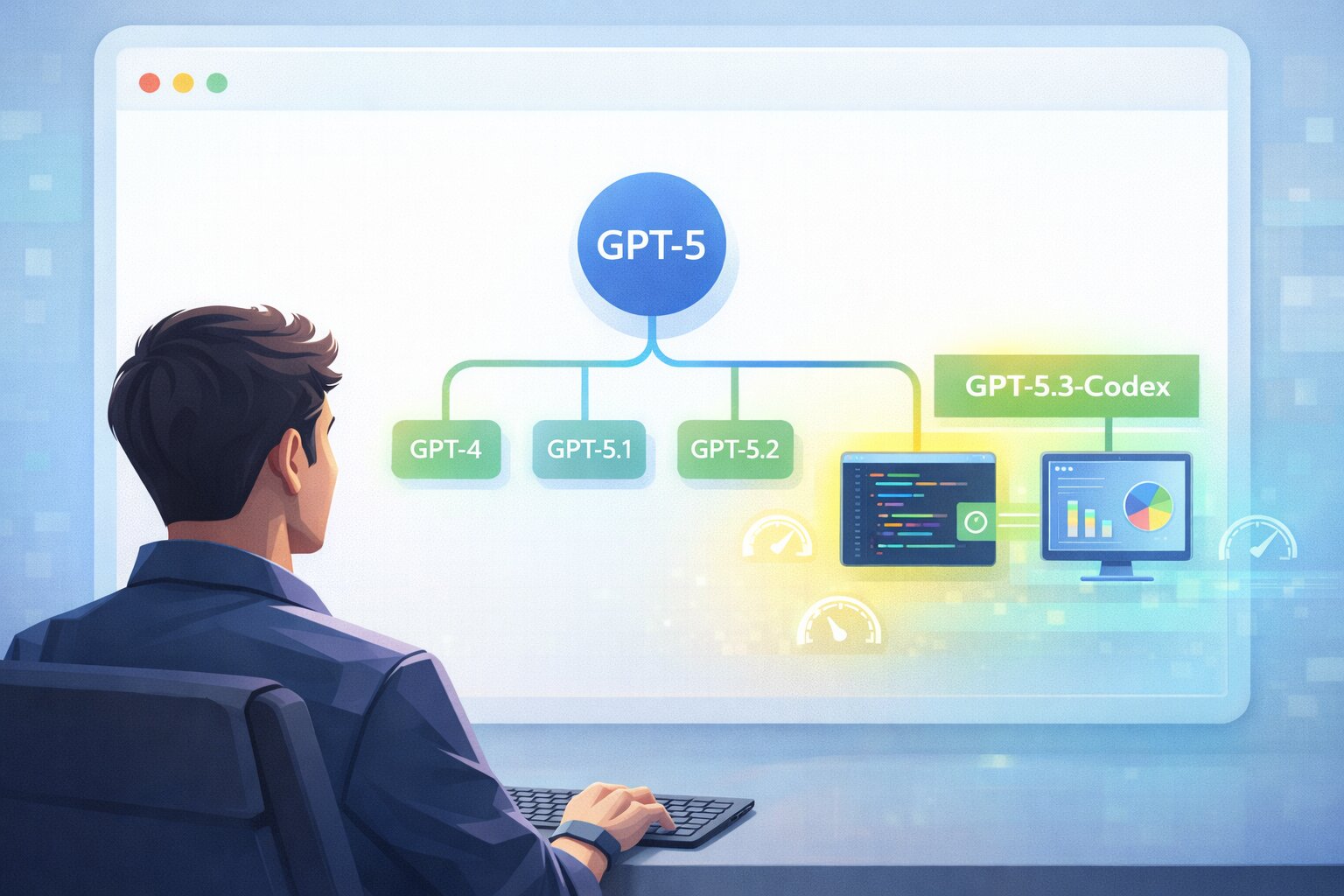
What GPT-5.3-Codex Is and Where It Fits in the GPT-5 Family
GPT-5.3-Codex is not a general chat model in the way GPT-5 is, it is a specialized variant that lives inside the Codex product line and is tuned for coding, tools and computer control. OpenAI’s model release notes first introduced GPT-5-codex in 2025 as a GPT-5 based variant optimized for agentic coding in Codex, and GPT-5.3-Codex is the frontier evolution of that idea.[3] Where the original Codex models focused mainly on code completion and limited refactors inside editors, GPT-5.3-Codex is designed to operate as an agent that can reason about software systems, call tools, and take multi step actions across an entire software lifecycle.
In the GPT-5 family, GPT-5 remains the flagship general purpose model that you might use for writing, research or analysis, while GPT-5.3-Codex is the specialized choice when your task is anchored in code or computer use. The distinction shows up clearly in how OpenAI positions them, GPT-5 is the default in ChatGPT, GPT-5-codex variants are the default inside Codex, and GPT-5.3-Codex in particular is described as the most capable option for long running coding and computer use tasks.[3][1] That split lets teams route different classes of work to the model that is best suited, rather than expecting one model to do everything equally well.
You can also think of GPT-5.3-Codex as the point where Codex stops being “a coding model that can write code on demand” and becomes “a colleague that uses code as a primary tool to get work done on your machine.” The Codex app, CLI and IDE integrations give it a place to live alongside your projects, while the agentic capabilities inside GPT-5.3-Codex let it manage tests, scripts, documentation and automation in a more continuous way.[4][1]
From GPT-5-codex to GPT-5.3-Codex
The first GPT-5-codex release in 2025 was already described as an agentic coding model that could handle interactive edits as well as autonomous stretches of work, including frontend tasks that combined images, screenshots and code.[3] Developers could choose GPT-5-codex in Codex for coding heavy workloads, while keeping standard GPT-5 for non coding tasks. GPT-5.3-Codex takes that foundation and scales it along three axes that matter in practice, coding strength on harder problems, capacity for longer and more complex workflows, and the ability to act as a more interactive collaborator across many surfaces.
OpenAI’s product announcement makes that explicit, GPT-5.3-Codex advances both the frontier coding performance of GPT-5.2-Codex and the reasoning and professional knowledge capabilities of GPT-5.2, then adds infrastructure improvements so the model runs around a quarter faster.[1] This is important because higher reasoning effort models can feel slow in day to day usage, so the speed gains are not just a nice to have, they change whether teams are willing to let the model stay in the loop for interactive work. Faster turnarounds also mean the agent can take more steps for the same latency budget, which directly affects how deeply it can explore a problem before coming back to you.
The other meaningful shift is that GPT-5.3-Codex was itself a heavy user of Codex, OpenAI’s team used early versions of the model to monitor the training run, debug infrastructure, build tools for visualizing metrics and even run analyses over logs of human interactions.[1] That kind of self assisted development has been discussed in AI circles for years, but here it shows up in a very practical way, Codex helped people at OpenAI ship Codex faster, which is a proof of concept for the sort of workflows enterprises may want to adopt.
How GPT-5.3-Codex Performs on Real Benchmarks
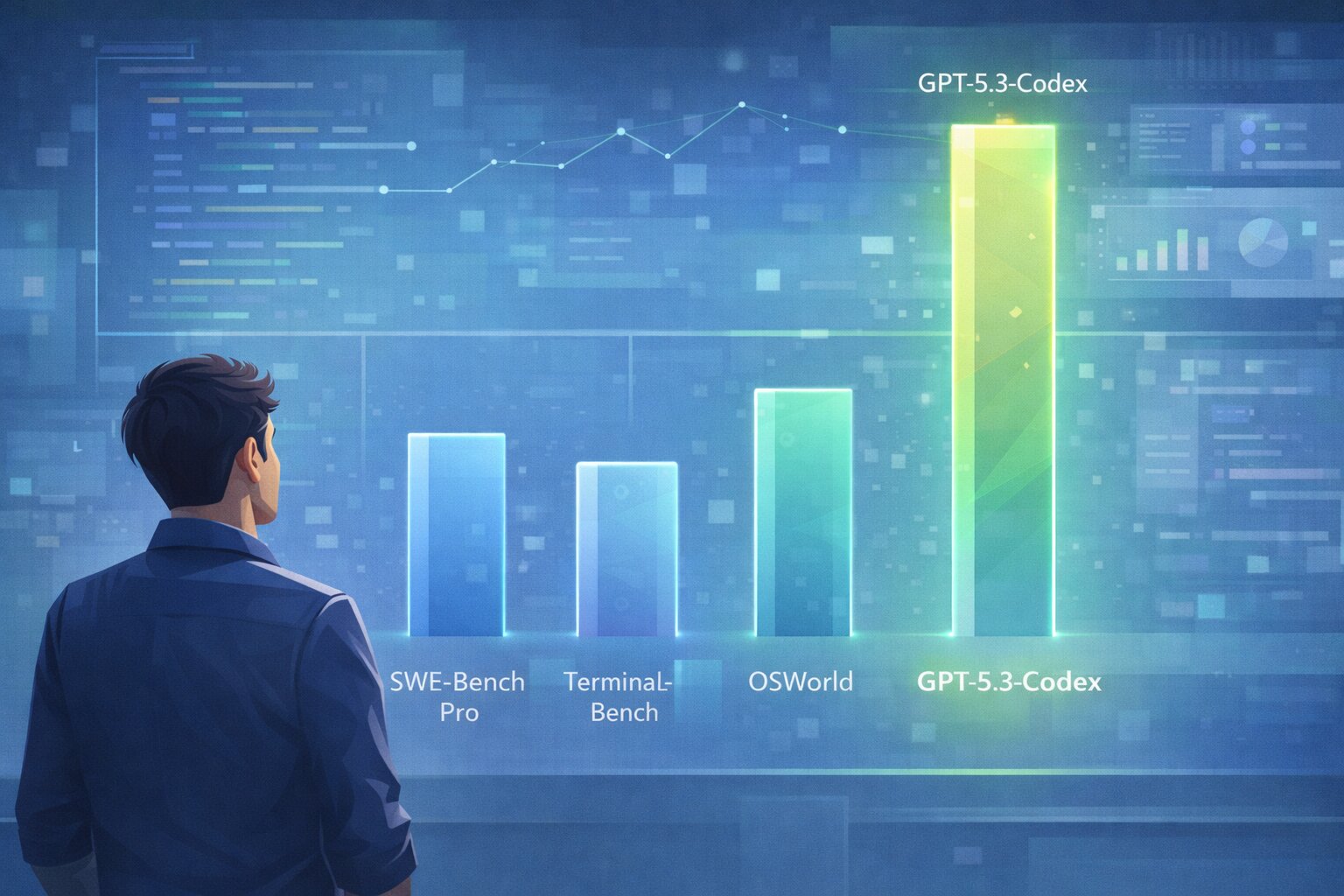
Benchmarks do not perfectly capture real engineering work, but they do give a concrete view of where a model sits relative to alternatives. On that front GPT-5.3-Codex is positioned very clearly, OpenAI reports state of the art scores on SWE-Bench Pro, Terminal-Bench 2.0, OSWorld-Verified and the GDPval knowledge work benchmark when the model runs with high reasoning effort.[1] These are not toy tests, SWE-Bench Pro for example evaluates real world software engineering tasks drawn from GitHub issues across four languages, while Terminal-Bench measures the shell and command line skills that agents need to operate in realistic environments.
In the appendix to the launch blog, GPT-5.3-Codex records a SWE-Bench Pro score of 56.8 percent, slightly ahead of GPT-5.2-Codex at 56.4 percent and GPT-5.2 at 55.6 percent, and it posts a 77.3 percent score on Terminal-Bench 2.0, a very large jump over the previous best.[1][6] OSWorld-Verified, a benchmark where an agent uses vision to control a desktop and complete productivity tasks, shows GPT-5.3-Codex at 64.7 percent versus around 38 percent for earlier GPT-5.2 based models, which is a sign that the model is not just better at code, it is better at using software.[1]
GDPval, an evaluation that OpenAI designed with domain experts across forty four occupations, measures how well a model completes well specified knowledge work tasks like presentations, spreadsheets and structured reports.[1] GPT-5.3-Codex matches GPT-5.2’s already strong performance, winning or tying on about 70.9 percent of tasks in a head to head evaluation. That matters if you want to use Codex to create collateral around the code it writes, such as slide decks that explain technical tradeoffs or spreadsheets that model product metrics.
Independent coverage broadly supports this picture. Fast Company reports that GPT-5.3-Codex extends Codex beyond code into a wider range of work tasks while operating twenty five percent faster than earlier models, and that OpenAI sees it as capable of handling long running tool using workflows rather than just single responses.[5] Geeky Gadgets, drawing on the same benchmark data, highlights the 77.3 percent Terminal-Bench score and frames GPT-5.3-Codex as the speed and coding performance leader in its generation, compared to Claude Opus 4.6 which leans more into very long context and multi agent teams.[6]
Why these benchmarks matter for teams
For engineering leaders the practical question is not just whether a benchmark score is a few points higher, but what that means for risk and throughput. Higher performance on SWE-Bench Pro and Terminal-Bench 2.0 suggests that GPT-5.3-Codex can handle more of the annoying edge cases in real repositories, including shell scripts, build systems and multi language stacks, before it needs human intervention.[1][6] Strong OSWorld results mean it is more likely to successfully click through user interfaces, configure tools and use graphical applications, which opens the door to workflows where the agent can operate software that you do not control as code.
GDPval style evaluations also point to a less obvious benefit, if the same model that writes your service can also generate documentation, training material and executive facing summaries at a high level of quality, you spend less time translating between contexts. That makes GPT-5.3-Codex appealing for teams that want a single agent that can reason about the code and the surrounding business context, and then produce artifacts for different audiences.
GPT-5.3-Codex as an Interactive Agentic Collaborator
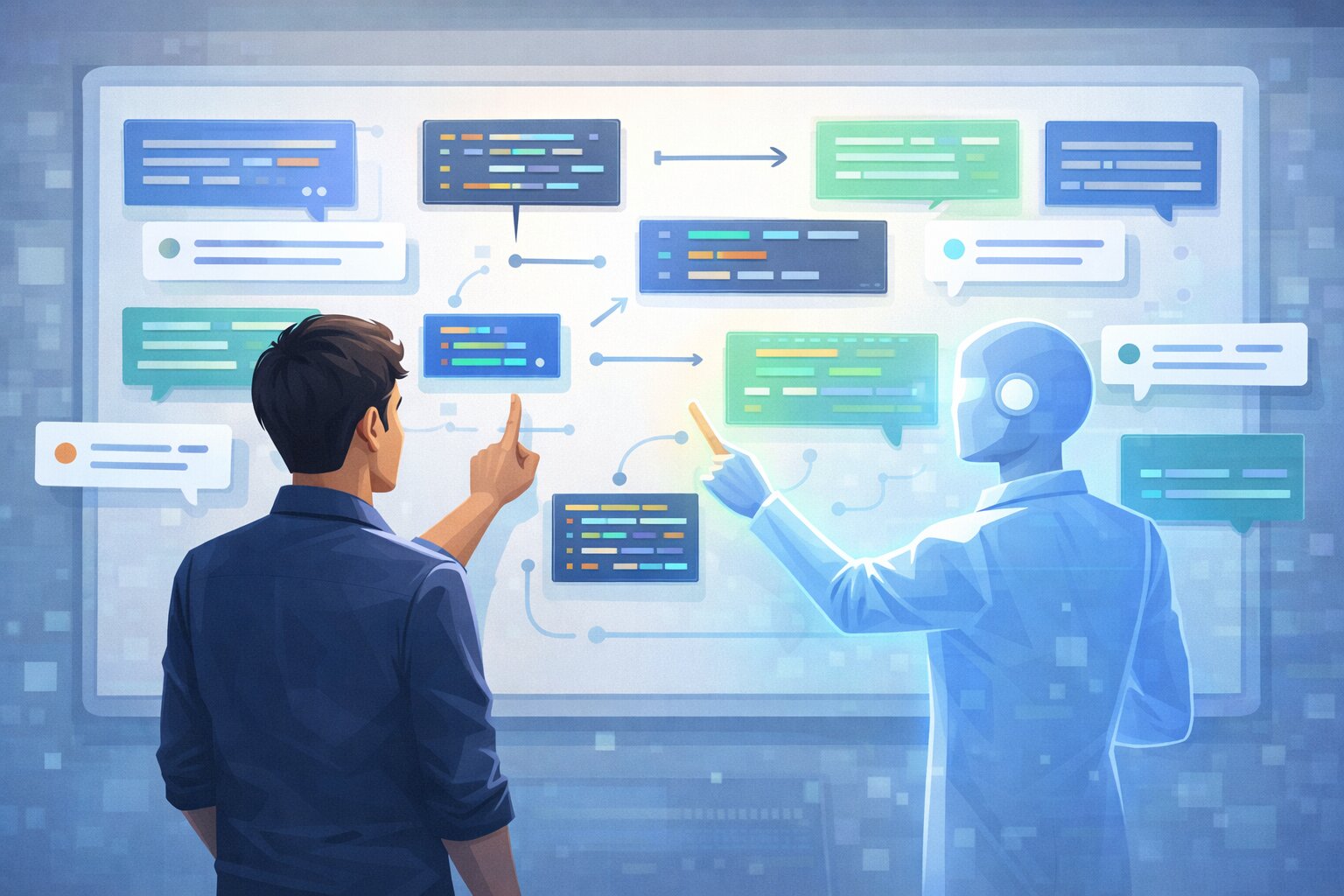
The other major theme in the GPT-5.3-Codex launch is that the model is designed to stay in conversation with you while it works. OpenAI describes a shift from agents that quietly work in the background to agents that talk through what they are doing, provide frequent updates and respond to feedback while tasks are still running.[1] That interaction pattern is supported by the Codex app’s interface, where each project has its own thread and you can see the agent’s changes, diffs and commentary as they accumulate over time.[4]
Instead of submitting a single long prompt and waiting for a finished result, GPT-5.3-Codex can outline a plan, ask clarifying questions, run tools, pause for your approval, then continue, in a loop that feels closer to working with a junior engineer who is proactive and verbose. The app also supports worktrees and multiple agent threads, so different agents can work on different branches of the same repository without stepping on each other, and you can review or merge their work on your own schedule.[4] This design helps developers stay in control, even as the agent takes on larger chunks of work.
Behind the scenes, GPT-5.3-Codex is used heavily by OpenAI’s own researchers and engineers to speed up their day jobs, which provides a kind of real world smoke test. In the system card and blog, the team describes using Codex to monitor training runs, debug strange edge cases, optimize GPU cluster usage and build rich data visualizations to make sense of thousands of experiment results.[1][7] Those are the same categories of work many applied ML and platform teams grapple with, so the examples are directly relevant.
How GPT-5.3-Codex helped build itself
In practice the self assisted development story looks like a series of concrete workflows rather than science fiction. OpenAI engineers used early GPT-5.3-Codex variants to write scripts for monitoring cluster performance, to inspect logs for rare error patterns, and to propose fixes for low cache hit rates in their infrastructure.[1] Researchers asked Codex to help design and implement data pipelines that could slice evaluation results in new ways, then collaborated with the model to interpret the patterns they found.
During alpha testing a researcher even asked GPT-5.3-Codex to quantify how much additional work it was doing per interaction, by designing simple classifiers for logs that marked clarifications, positive and negative user feedback and signs of progress, then scaling that analysis across all session logs.[1] That example captures the core character of GPT-5.3-Codex, not just a code generator, but a partner that can both write analysis code and use it to reason about its own behavior, all while keeping a human in the loop.

Security Posture and Cybersecurity Capabilities of GPT-5.3-Codex
Because GPT-5.3-Codex is so capable with code and tools, especially in environments that look like real systems, OpenAI treats it as a high capability model for cybersecurity within its Preparedness Framework.[7] That does not mean the company has evidence the model can carry out end to end cyberattacks fully autonomously, the system card is explicit that this remains uncertain, but it does mean they deploy extra safeguards, monitoring and access controls whenever the model is used in security sensitive contexts.
Those safeguards include safety training on cybersecurity content, automated monitoring for risky patterns, trusted access programs that gate advanced capabilities, and enforcement pipelines that integrate threat intelligence feeds.[7] OpenAI is also expanding eco system level tools, such as Aardvark, a security research agent, and offering free code scanning for widely used open source projects like Next.js, often in partnership with maintainers.[7] For security teams this is a double edged sword, GPT-5.3-Codex makes it easier to find vulnerabilities but also forces organizations to think carefully about access policies and usage monitoring.
From a defender’s point of view the key takeaway is that GPT-5.3-Codex can help with tasks like static analysis, test generation, exploit reproduction in controlled environments and writing patches, but it should be deployed with clear guardrails. The combination of higher benchmark scores on code understanding and direct training to identify vulnerabilities explains why OpenAI is taking a cautious stance and using the model to strengthen cyber defense rather than simply unlocking all capabilities broadly on day one.[1][7]

Real Agentic Workflows You Can Run with GPT-5.3-Codex
Benchmarks and safety classifications are important, but most teams care about what a model can do for their actual workflows. Because GPT-5.3-Codex is available across the Codex app, CLI, IDE extensions and cloud tasks, you can plug it into very different shapes of work, from a solo developer refining a side project to a platform team orchestrating agents across many services.[4][1] Below are a few patterns that match how OpenAI itself and early adopters are already using the model, along with variations you can adapt.
Modernizing a legacy codebase with GPT-5.3-Codex
One natural use case is the slow and painful work of modernizing a legacy application. In a Codex based workflow you might connect GPT-5.3-Codex to your repository through the CLI or IDE extension, then create a project thread in the Codex app dedicated to the migration. Within that thread the agent can propose a step by step plan, such as introducing tests around high risk modules, upgrading dependencies, replacing deprecated APIs and gradually moving to a new framework.
As the work progresses GPT-5.3-Codex can run tests, suggest refactors, update documentation and flag places where it is uncertain, all while you review diffs before anything lands in your main branch. The same model that understands the code can then draft migration guides or internal training decks that explain the changes to the rest of the organization, drawing on its strong performance on GDPval style knowledge work.[1] This workflow turns what might have been a months long series of manual edits into a more structured collaboration between human maintainers and an agent that never gets tired of reading old code.
Building and iterating on web apps and games
OpenAI’s own testing highlights web development and game building as scenarios where GPT-5.3-Codex shines. The Codex team asked the model to build a new version of a racing game and a diving game, then used generic follow up prompts like “fix the bug” or “improve the game” to let the agent iterate autonomously over millions of tokens.[1][6] The result was a complete racing game with multiple maps, racers and items, and a diving game with reef exploration, collection mechanics and resource management.
For product teams the lesson is that you can treat GPT-5.3-Codex as a persistent game or app developer that works through a backlog of tasks, from new features to bug fixes, while you steer direction and review outputs. For more ordinary web work, such as marketing sites or dashboards, the launch blog notes that GPT-5.3-Codex better understands high level intent than GPT-5.2-Codex and tends to default to more functional, production ready layouts, including sensible pricing displays and richer testimonial sections.[1][6] That makes it attractive for quickly spinning up early versions of interfaces that you can then refine.
Automating documentation, analysis and reporting around code
Because GPT-5.3-Codex inherits GPT-5.2’s professional knowledge capabilities, it can do more than just write code, it can also produce the accompanying narrative for different audiences. OpenAI’s GDPval examples include Codex generating internal slide decks on financial regulation, retail training documents and NPV analysis spreadsheets, often based on web sources and structured prompts from domain experts.[1] In a software organization the same pattern could support release notes, incident postmortems, onboarding guides and stakeholder updates.
A practical workflow might involve asking Codex to watch over a given service, collect key metrics and log snippets during a release, then compile a report and draft communication for relevant stakeholders. Because the model works across code, data and narrative, you do not have to hand off context between different tools every time you move from writing code to writing slides.
Security and reliability workflows
Given GPT-5.3-Codex’s cybersecurity capabilities and safeguards, there are several defensive workflows that are particularly well suited to the model. Security researchers can use Codex to scan open source projects for known vulnerability patterns, reproduce bug reports in isolated environments, and draft patches or advisories once an issue is confirmed.[7]
Platform and SRE teams can ask GPT-5.3-Codex to help automate runbooks, write and validate infrastructure as code templates, or propose changes to monitoring configurations based on observed incidents. Because the model was used internally at OpenAI to monitor GPU clusters, debug training infrastructure and analyze experiment logs, it has already been exposed to similar patterns at scale.[1][7] That gives organizations a credible starting point for designing their own “AI coworker” roles around reliability.
When to Use GPT-5.3-Codex Instead of GPT-5 or Other Models
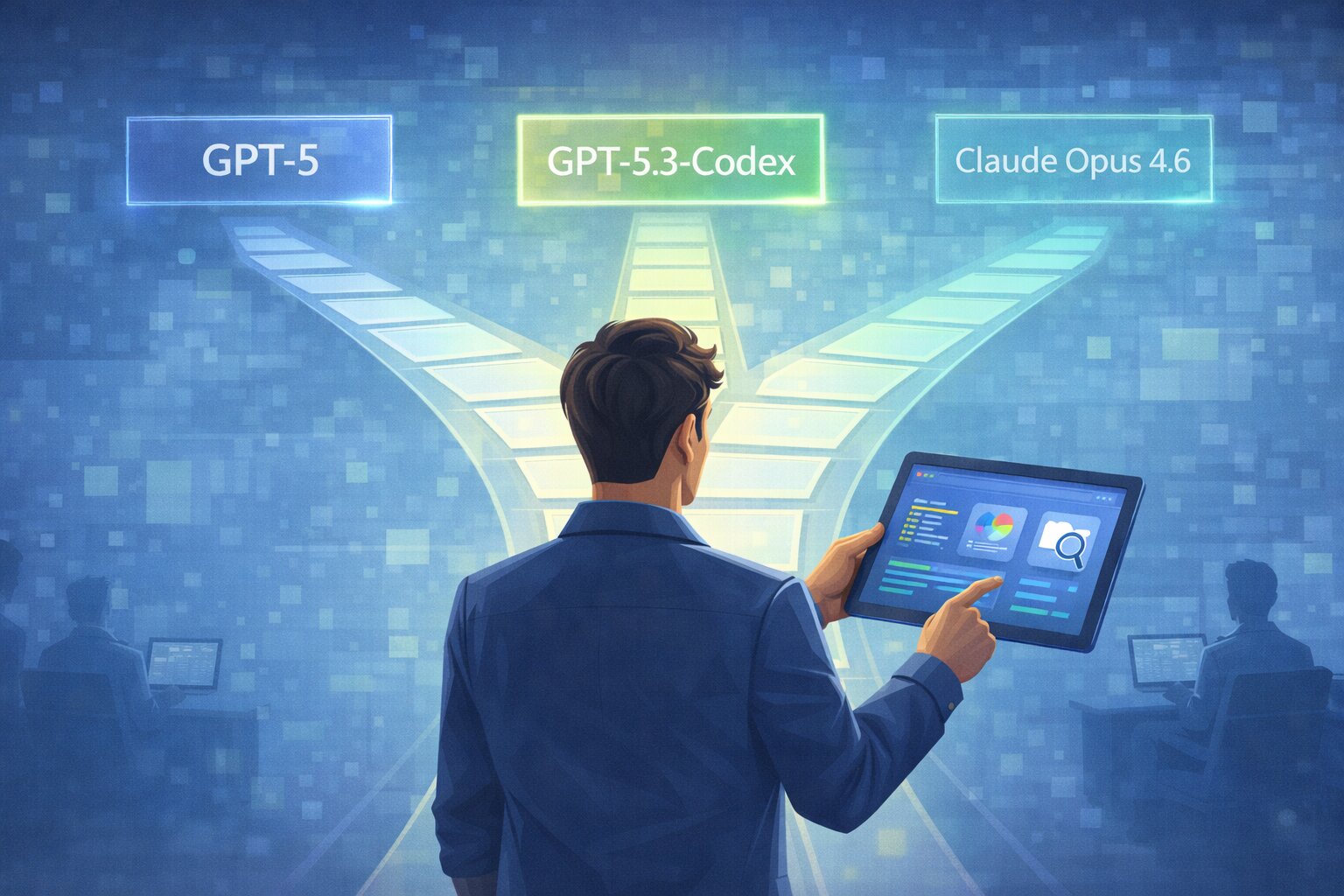
With so many models available, it is reasonable to ask when GPT-5.3-Codex is actually the right choice. The simplest rule of thumb is that you reach for GPT-5.3-Codex when your problem is anchored in code or computer use, and you stick with GPT-5 or other general models when your task is primarily about language, ideas or non technical analysis.[3][6] If the workflow will involve repositories, terminals, IDEs, spreadsheets or slide decks on a regular basis, GPT-5.3-Codex is likely to pay off.
Compared with Claude Opus 4.6, which emphasizes very long context windows, agent teams and collaborative reasoning, GPT-5.3-Codex is positioned as the faster, more coding focused option, with stronger results on Terminal-Bench and similar technical benchmarks.[6][2] That does not make one universally better than the other, instead it suggests a division of labor, Claude for sprawling analytical work that stresses context limits, GPT-5.3-Codex for coding and technical workflows where speed, tool use and tight feedback loops matter most.
Inside the OpenAI ecosystem you might pair GPT-5.3-Codex with other models as part of a larger system. For example GPT-5 could handle high level planning or stakeholder facing communication, o3 style reasoning models could tackle particularly hard math or science problems, and GPT-5.3-Codex could act as the executor that turns plans and analyses into working software, dashboards and documentation.[4][3] Thinking in terms of a portfolio of models rather than a single choice helps avoid the trap of expecting one agent to be best at everything.
Practical guidelines for teams adopting GPT-5.3-Codex
For teams considering GPT-5.3-Codex the most important decisions are less about raw capability and more about scope and governance. Start by defining clear boundaries for what the agent is allowed to change, for example a small service, a documentation section or a set of infrastructure templates, and keep humans firmly in the loop for code review and deployment. Use the Codex app’s project threads and diffs to maintain visibility into what the agent is doing over time.[4]
Next, decide where GPT-5.3-Codex can save the most time without introducing unacceptable risk. Routine refactors, test generation, data migration scripts and internal tooling are often good early candidates, because they are important but rarely the highest risk parts of a system. Over time, as your team gains confidence and builds internal patterns for supervision, you can expand the scope to more critical systems and cross functional workflows that include security, analytics and stakeholder communication.
Finally, invest in education and documentation so that engineers and non engineers alike understand what GPT-5.3-Codex is good at, where its limits are, and how to escalate when something looks wrong. The model’s ability to reason and explain its own actions can help here, but only if you encourage people to treat it as a collaborator that still needs oversight, not an infallible oracle.
A new kind of coding partner, if you are ready to collaborate
GPT-5.3-Codex lands at a moment when the AI tools race is clearly shifting from one off chat experiences to agentic systems that can share real work. Its combination of benchmark leading coding skills, stronger computer use, solid knowledge work performance and a more interactive collaboration style gives teams a credible way to experiment with AI coworkers without abandoning existing tools and workflows.[1][5][6]
At the same time the model’s cybersecurity profile and the arms race with alternatives like Claude Opus 4.6 are reminders that this is not a toy, it is a powerful system that deserves thoughtful guardrails, good monitoring and a clear scope of responsibility.[7][2] If you approach GPT-5.3-Codex as a partner that can accelerate your work rather than a magic box that replaces it, you have a better chance of benefiting from its strengths without being surprised by its limits. And if you have already tried GPT-5.3-Codex in your own stack, or are planning experiments, sharing your experiences and questions in the comments will help others figure out how to make sense of this new generation of coding agents.
References
- OpenAI — Introducing GPT-5.3-Codex
- Mark Sullivan — OpenAI’s GPT-5.3-Codex thinks deeper and wider about coding work
- OpenAI Help Center — Model Release Notes (GPT-5-codex)
- OpenAI — Introducing the Codex app
- Nathaniel Lacsina — OpenAI drops GPT-5.3-Codex minutes after Anthropic’s Claude Opus 4.6
- Julian Horsey — Opus 4.6 vs GPT-5.3, Opus 4.6 excels at long memory while GPT-5.3 steals speed crown
- OpenAI — GPT-5.3-Codex System Card
- 36kr Europe — Overnight Developments in Silicon Valley, GPT-5.3-Codex vs Claude 4.6
Ready to apply this to your business?
Let's Talk Strategy →