Google Ads AI Max testing will expand in September 2026 with new experiments that let advertisers test different budgets and ROI targets across multiple Search campaigns in a single A/B test.
- Google says brand and location controls can remain enabled during AI Max experiments.
- Performance Planner can forecast how budget and bidding changes may affect existing campaign performance before those changes are applied.
- A safer PPC workflow is forecast, experiment, review, then apply, rather than automatically accepting every recommendation.
- Before changing budget or ROI targets, advertisers should verify conversion tracking, campaign constraints, profitability, conversion delays, and the comparison baseline.
- Google says rollout begins in September 2026, but availability may appear progressively across advertiser accounts.
Google Ads AI Max testing is about to become much more useful for advertisers who want to scale Search campaigns without treating automation as a blind leap of faith. On August 20, 2026, Google announced that advertisers will soon be able to test different campaign budgets and ROI targets across multiple Search campaigns within a single A/B test, with rollout beginning in September 2026. The timing matters because AI Max is already becoming a larger part of Google Search Ads automation, while Google says advertisers activating AI Max typically see 14% more conversions or conversion value at a similar CPA or ROAS, based on its internal 2025 data for non retail advertisers, although individual results can vary substantially.[1][2] Follow the sections below carefully, because the most important part of this update is not simply what Google can automate, but how advertisers can test, review, and control those changes before committing more budget.
Google Ads AI Max Testing at a Glance
The August announcement expands the role of experimentation around AI Max from testing automation features toward testing business decisions such as spending and return targets. It also connects experimentation more closely with Performance Planner, where advertisers can forecast changes before implementing them. Most importantly, Google is keeping brand and geographic controls relevant within the testing process rather than requiring advertisers to remove important guardrails just to run an experiment.[1]
| Question | What advertisers need to know |
|---|---|
| What is new? | Google is introducing tests for different budgets and ROI targets across multiple Search campaigns in a single A/B test |
| When does it launch? | Google says rollout begins in September 2026 |
| Does it apply to Search? | Yes, the announcement specifically refers to multiple Search campaigns |
| Can brand controls remain active? | Yes, Google says AI Max experiments can run while relevant brand controls remain enabled |
| Can location controls remain active? | Yes, Google says location controls can remain enabled during AI Max testing |
| What does Performance Planner add? | Advertisers can forecast the likely effect of budget and bidding changes before applying suggested changes |
| Should recommendations be applied immediately? | Not necessarily, a safer workflow is forecast, experiment, review, then apply |
| Will every account receive the tools on September 1? | Google only says rollout begins in September, availability may therefore appear progressively |
What Is Changing in Google Ads AI Max?
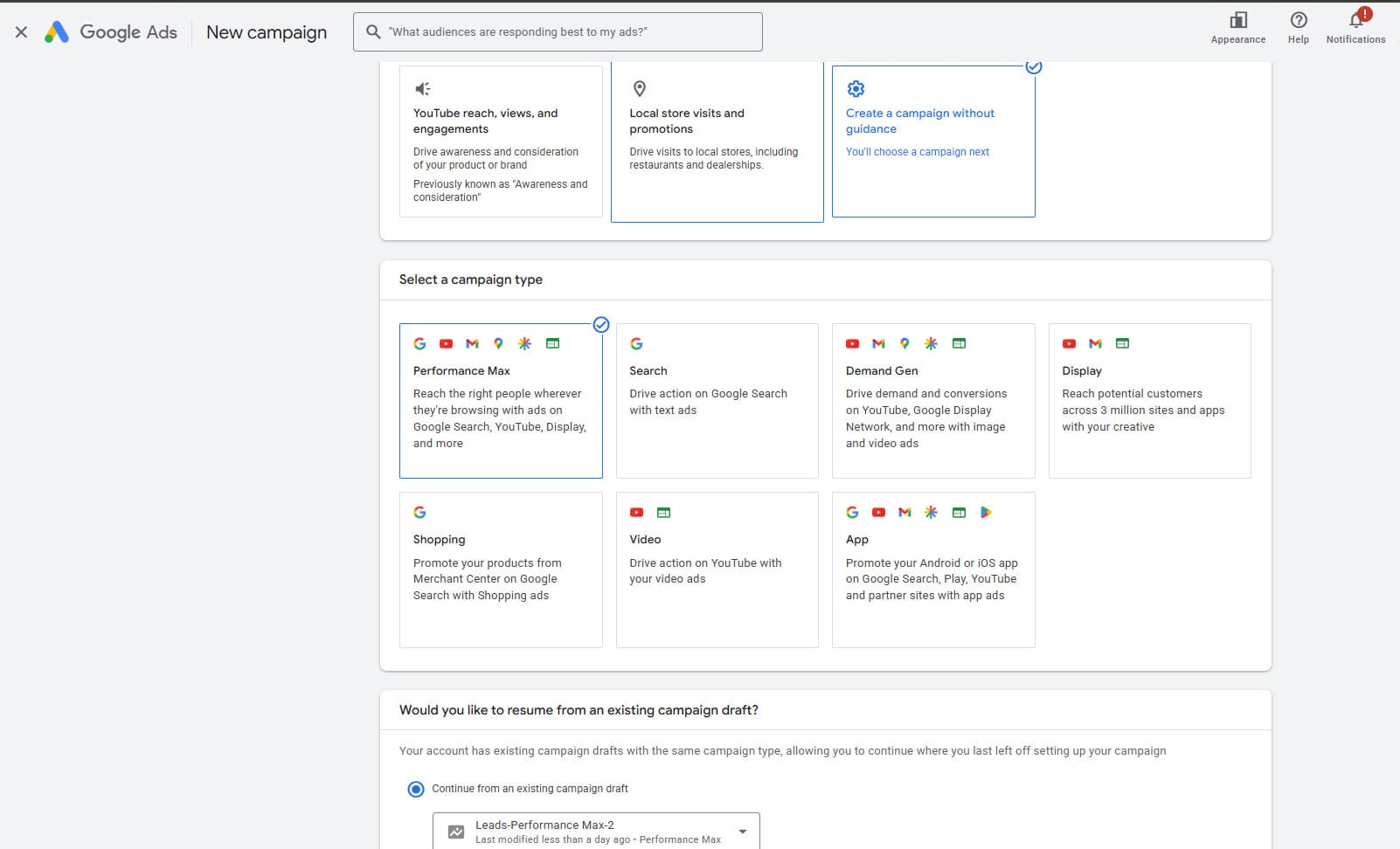
AI Max is not a separate campaign type. Google describes it as an optimization layer for Search campaigns that combines search term matching and asset optimization with controls designed to help advertisers manage how automation expands targeting and creative delivery.[2] The September update adds another layer to that system by making experimentation more useful for decisions involving scale.
Google announced that advertisers will be able to test different budgets and ROI targets across multiple Search campaigns within one A/B test.[1] That is an important change because budget and bidding targets are not cosmetic settings. They directly affect how much opportunity an automated bidding system can pursue and what economic constraints it has to respect.
Existing AI Max experiments already let advertisers compare AI Max against a control within a Search campaign. Google says the current experiment design can divert traffic and budget within the existing campaign rather than requiring a duplicate campaign, which can reduce synchronization errors and potentially shorten the learning period.[3]
The September capability goes further by giving advertisers a way to examine scaling decisions across multiple Search campaigns. Google has not yet published every interface detail for the upcoming budget and ROI testing feature, so advertisers should avoid assuming that every existing AI Max experiment setting will work identically when the new capability reaches their account.
What Can Advertisers Test With the New AI Max Experiments?
The central idea behind the update is controlled scaling. Rather than raising spend or changing return expectations across several campaigns and then trying to determine what caused the resulting performance shift, advertisers will be able to evaluate those changes through an experiment. Google specifically identifies different budgets and ROI targets as variables that can be tested across multiple Search campaigns.[1]
That creates a more useful distinction between an opportunity predicted by automation and a change proven against an advertiser’s own account data. A forecast can suggest what might happen, while an experiment gives the advertiser evidence from controlled campaign traffic before a wider rollout.
Testing Different Campaign Budgets
Budget changes can unlock additional volume, but additional spend does not automatically mean additional profitable growth. A campaign that performs efficiently at one spending level may encounter more expensive auctions or lower quality marginal traffic as the available budget increases. The new AI Max budget testing capability is designed to give advertisers a more structured way to evaluate that tradeoff.
Google says advertisers will be able to test different budgets across multiple Search campaigns in a single A/B test.[1] This should be especially relevant when a business wants to evaluate whether increasing investment across a portfolio of related campaigns produces enough additional conversion value to justify the extra cost.
Before interpreting a higher budget as a growth opportunity, check whether the existing campaigns are constrained by budget, whether conversion tracking is reliable, and whether the business can absorb additional acquisition volume profitably.
Google also notes in its current AI Max documentation that AI Max may not be effective when campaigns are limited by budget, and the system can surface an alert when that condition applies.[4] Budget testing should therefore be treated as an economic experiment, not merely a way to allow Google Ads to spend more.
Testing Different ROI Targets
Changing an ROI target alters the economic instruction given to the bidding system. A more aggressive target may allow the system to pursue additional opportunities, while a stricter target can reduce eligible auctions in exchange for stronger efficiency requirements. That means the correct target should reflect business economics rather than whichever recommendation promises the largest volume.
Google’s August 20 announcement specifically says advertisers will be able to test different ROI targets.[1] Google has not yet documented every configuration option for this new experiment type, so advertisers should follow the terminology and eligible bidding settings presented in their own account once the feature becomes available.
This is particularly relevant in 2026 because Google also changed how campaigns using target based bidding behave when they are limited by budget. Beginning August 17, Google started rolling out changes intended to make those campaigns perform more consistently toward the bidding targets advertisers actually set, including after budget adjustments.[5]
For example, Google explains that a campaign with a Target CPA of $10 that had recently achieved an actual CPA of $5 may begin delivering closer to the stated $10 target after the bidding change takes effect.[5] That makes it even more important to verify that the target entered in Google Ads represents the result the business genuinely wants.
Running Tests Across Multiple Search Campaigns
Many PPC teams manage Search through portfolios rather than isolated campaigns. A change that looks sensible inside one campaign can produce a different outcome when applied across several campaigns competing for budget, demand, and overlapping business goals. Testing across multiple Search campaigns can therefore provide a more realistic view of how scaling decisions affect the account.
Google explicitly says the upcoming tool can test budget and ROI target changes across multiple Search campaigns in one A/B test.[1] This is one of the most meaningful parts of the announcement because it moves the test closer to the way larger advertisers actually manage Search investment.
However, the announcement does not yet specify every eligibility rule, traffic allocation method, minimum campaign requirement, or reporting configuration for the new multi campaign test. Those details should be verified inside Google Ads documentation and the account interface once rollout begins rather than inferred from the current single campaign AI Max experiment workflow.
When Will the New AI Max Testing Tools Become Available?
Google announced the new tools on August 20, 2026 and says rollout will begin in September 2026.[1] That wording is important because a rollout beginning in September does not necessarily mean every advertiser will receive access on September 1. Google frequently deploys advertising features progressively, and the announcement does not provide a universal account activation date.
As of August 26, 2026, advertisers should therefore consider the budget and ROI testing capability an announced upcoming feature. Existing AI Max experiments are already documented and available for eligible Search campaigns, but the newly announced multi campaign budget and ROI experiment should not be presented as universally available before the September rollout begins.[3]
This distinction is worth monitoring closely because September 2026 is already a significant transition period for AI Max. Google has separately said that campaigns using Automatically Created Assets and the campaign level broad match setting will begin upgrading to AI Max starting in September 2026, while the previously announced Dynamic Search Ads transition was extended and is now scheduled to begin in February 2027.[6]
Advertisers should therefore check their account rather than relying solely on a calendar date. When the new experiment option appears, confirm campaign eligibility and review the available settings before changing live budgets or ROI targets.
Can You Keep Brand and Location Controls During an AI Max Experiment?
Yes, Google says new AI Max experiment capabilities allow advertisers to run tests while specific brand or location controls remain enabled.[1] This matters because a useful experiment should not force an advertiser to remove the very restrictions that define where a campaign is allowed to operate. A test conducted without normal business guardrails may produce a result that cannot safely be reproduced in production.
Current AI Max documentation already provides brand controls and geographic intent controls. Brand inclusions can tell Search campaigns which brands should be associated with eligible queries, while brand exclusions can prevent ads from serving for selected branded traffic.[7]
AI Max also includes a locations of interest feature at the ad group level. Google describes this control as a way to reach people based on geographic intent, including situations where the user’s search expresses interest in a particular location.[8]
The current AI Max experiment documentation provides another useful detail. When brand inclusions or exclusions are added during setup, Google says those settings apply to both the control and treatment arms for the duration of the experiment.[3] This helps make the comparison more meaningful because both sides remain subject to the same brand rules.
The broader principle is simple, preserve business constraints while testing automation. If a campaign cannot legally, commercially, or strategically serve certain brands, landing pages, or geographic intentions, those restrictions should be treated as experiment requirements rather than optional settings.
How Does Performance Planner Work With the New AI Max Tools?
Performance Planner gives advertisers a forecast before they make a change. Google describes it as a tool for planning advertising spend and assessing how campaign changes may affect important metrics and overall performance.[9] In the context of the new AI Max tools, that forecasting layer can help advertisers decide which changes are worth testing before exposing more campaign traffic or budget to them.
Google’s August announcement says Performance Planner can now show how changes such as bidding or budget targets may affect existing campaign performance. It can also let advertisers apply suggested changes directly to campaigns.[1] That convenience is useful, but it makes the review step more important because moving from forecast to production has become easier.
Forecasting Budget Changes
A budget forecast gives the advertiser an estimate of what additional or reduced spending could mean for performance. It is not experimental proof, because the prediction is based on Google’s modeling rather than a controlled live comparison. The most useful role of the forecast is therefore to identify plausible scenarios that deserve further testing.
Google says Performance Planner forecasts are refreshed daily and use recent data, with its documentation currently stating that forecasts are based on the previous 7 to 10 days and adjusted for seasonality.[9] That makes the planner responsive to changing conditions, but marketers should still account for promotions, inventory changes, delayed conversions, and unusual demand that a model may not fully represent.
Use the forecast as the first filter. If an increased budget appears economically unattractive even in the modeled scenario, there may be little reason to expose campaign traffic to the experiment.
Forecasting Bidding and ROI Changes
Bidding targets tell automated systems what business outcome they should pursue. Performance Planner can help advertisers examine the estimated effect of changes to those targets before modifying the live campaign.[9] This is particularly valuable when different campaigns have different margins, conversion values, or growth priorities.
The forecast should be interpreted alongside the actual economics of the business. A target that produces more conversion value is not necessarily more profitable if fulfillment costs, discounts, returns, lead quality, or customer acquisition economics make that additional volume expensive.
For ecommerce advertisers, this means comparing the proposed ROAS level with gross margin and contribution margin rather than treating platform revenue as the only outcome. For lead generation, it means checking whether additional conversions produce qualified opportunities and sales rather than simply more form submissions.
Applying Recommendations to Campaigns
Performance Planner now includes an option to apply suggested changes directly to live campaigns.[9] Google says advertisers can review suggested adjustments, including budget or bid changes, deselect campaigns they do not want to modify, and then confirm the changes. This shortens the distance between planning and execution.
That convenience should not remove human review. A recommendation optimized toward an advertising objective cannot automatically know every constraint that exists outside the advertising account, such as margin requirements, staffing capacity, regional restrictions, inventory, sales quality, or a temporary business priority.
A safer sequence is to review the forecast, identify the proposed change, test the hypothesis when experimentation is available, evaluate the result against business KPIs, and only then apply it more broadly.
Should Advertisers Automatically Apply AI Max Recommendations?
Automatic application can save time, but speed is not the same as decision quality. Google Ads can optimize against the data and objectives available inside the platform, while advertisers remain responsible for deciding whether those objectives accurately represent the business. That distinction becomes more important as Google Search Ads automation gains greater influence over targeting, creative selection, bidding, budgets, and landing page decisions.
Current AI Max experiments can already include an option to apply experiment changes automatically if results are considered favorable.[3] Google also allows advertisers to apply the experiment manually after it ends or enable AI Max later from campaign settings.
For many professional PPC teams, a more defensible workflow is:
- Forecast, use Performance Planner to estimate how a proposed budget or bidding change may affect performance.
- Experiment, validate the hypothesis against actual traffic instead of relying entirely on a forecast.
- Review, examine conversion quality, value, spend, search terms, landing pages, brand exposure, geographic behavior, and profitability.
- Apply, deploy the change only after the result supports the business objective.
There is another reason to keep the review step. Google’s experiment documentation recommends allowing experiments enough time to collect meaningful data, and its general experiments guidance recommends at least four to six weeks in relevant cases, with additional time when conversion delays are long.[10] The appropriate duration depends on the experiment and conversion cycle, but a few good days should not automatically be treated as proof.
Automation is most useful when it accelerates a disciplined process. It becomes risky when a recommendation, forecast, experiment result, and production change are treated as the same thing.
What Should You Check Before Changing a Budget or ROI Target?
Budget and return targets influence the amount of traffic an automated bidding system can pursue and the efficiency boundaries it is asked to respect. Before testing either variable, advertisers need a trustworthy measurement foundation and a clear definition of success. Otherwise, an experiment can be statistically tidy while answering the wrong business question.
The checks below should happen before a PPC team increases budget, loosens an efficiency target, or accepts a recommendation from Performance Planner.
Conversion Tracking
Automated bidding learns from the conversion signals provided to Google Ads. If those signals include duplicate transactions, low quality leads, incorrect values, or secondary actions that do not represent business success, the campaign can optimize effectively toward the wrong objective. Accurate measurement therefore comes before more aggressive automation.
Review which conversion actions are primary, whether values accurately represent the business outcome, and whether offline outcomes should be imported for lead generation campaigns. Also examine conversion delays because recent performance may look weaker before all conversions have been reported.
Google’s Smart Bidding documentation emphasizes aligning conversion goals with the business objective used by bidding.[11] Changing budget or ROI targets while simultaneously changing core conversion definitions can make experiment results much harder to interpret.
Campaign Constraints
A campaign should be tested under conditions that resemble the environment in which the final setting will operate. Brand exclusions, brand inclusions, locations of interest, URL controls, compliance requirements, and inventory limitations can all change the traffic available to AI Max. Removing these constraints just to make an experiment easier can reduce the practical value of the result.
Current AI Max experiments also have setup limitations. Google lists conditions such as shared budgets, portfolio bidding strategies, bidding exploration, active experiments, and certain other configurations that can prevent a campaign from using the standard AI Max experiment flow.[3]
The upcoming budget and ROI experiment may receive its own eligibility requirements when rollout begins. Advertisers should verify the actual September documentation rather than assuming existing limitations will map perfectly to the new test.
Profitability
ROAS is a platform efficiency metric, not a complete profit calculation. Two campaigns can report the same ROAS while producing very different margins because their products, customer types, fulfillment costs, discounts, return rates, or lifetime values differ. Budget decisions should therefore use business economics as well as Google Ads metrics.
For ecommerce, identify the minimum acceptable return based on contribution margin rather than choosing a target only from historical platform performance. For lead generation, connect cost per lead with qualification rate, close rate, and customer value.
A test that produces 20% more conversion value but destroys contribution margin is not a successful scaling experiment. The platform can measure advertising outcomes, while the advertiser must define whether those outcomes create value for the business.
Test Duration and Comparison Baseline
An experiment needs enough data to separate a real effect from ordinary campaign volatility. Search demand can change with weekdays, promotions, competitor behavior, holidays, product availability, and conversion delays. Comparing a short test with an unusually weak or strong historical period can produce misleading conclusions.
Google’s experiments guidance recommends running appropriate tests for at least four to six weeks in many cases and allowing for conversion cycles, although the exact duration should reflect the experiment type and the advertiser’s conversion delay.[10] Some value based bidding experiment guidance also recommends allowing an initial ramp period before evaluating the test.[12]
Define the baseline before launch. Decide which metrics determine success, how much efficiency movement is acceptable, which business KPIs will be reviewed, and what conditions would cause the team to stop or reject the test.
How Should PPC Teams Use AI Max Experiments Safely?
Safe experimentation is not the same as resisting automation. It means giving automation room to discover incremental performance while clearly defining what it cannot change and what humans must review. AI Max is specifically designed to combine broader automated matching and asset optimization with controls such as brands, locations, URLs, and reporting transparency.[4]
A practical operating model can look like this:
- Define the business objective first, including the profitability or acquisition threshold that matters outside Google Ads.
- Verify measurement, confirm conversion actions, values, attribution inputs, and conversion delays before testing.
- Preserve guardrails, retain necessary brand, location, URL, compliance, and campaign constraints.
- Forecast the proposed change, use Performance Planner to understand the modeled effect before exposing live traffic.
- Change one decision framework at a time where practical, avoid combining unrelated tracking, creative, budget, and business changes that make attribution difficult.
- Run the experiment for meaningful evidence, avoid reacting to a handful of early conversions.
- Review more than the headline KPI, inspect search terms, selected landing pages, assets, spend, conversion quality, value, geographic intent, and business profitability.
- Require manual approval for high impact changes, especially when scaling budget or altering the economic target used by automated bidding.
- Document the result, record what changed, why it was tested, what happened, and whether the learning can be applied elsewhere.
This approach creates a useful division of labor. Google’s models can identify patterns and execute auction decisions at a scale no human team could manually reproduce, while humans remain responsible for economic intent, permissions, quality control, and final deployment.
What Does This Update Mean for Search Campaign Management?
The direction of Google Search Ads automation is becoming clearer. AI Max is moving beyond query expansion and creative optimization toward a workflow in which forecasting, experimentation, budgeting, bidding, and implementation are increasingly connected. The advertiser’s job is therefore shifting from manually controlling every auction input toward designing better objectives, constraints, tests, and review processes.
That does not make PPC management less important. It changes where professional judgment creates the most value.
Google’s own AI Max documentation emphasizes both automation and control, including improved search term reporting, asset reporting, URL controls, brand controls, and locations of interest.[4] The new September testing tools fit that same pattern by giving advertisers another way to validate automation before making a broader change.
The strongest workflow is not recommendation, then apply. It is forecast, experiment, review, then apply.
When Google Ads AI Max testing for budgets and ROI targets begins rolling out in September 2026, advertisers should use it as a decision tool rather than a permission slip to spend more. Keep the constraints that protect the business, test changes against real campaign evidence, and let a human reviewer decide whether the result deserves wider deployment. If you are already testing AI Max or preparing your Search campaigns for the September update, leave a comment with what you are seeing in your account, or share any questions you want explored further.
References
- Google Ads, Brandon Ervin — Make AI Max work for your business with new testing and planning tools, August 20, 2026
- Google Ads Help — About AI Max for Search campaigns
- Google Ads Help — About AI Max experiments
- Google Ads Help — How AI Max for Search campaigns works
- Google Ads Help — Changes to target based bid strategies
- Google Ads — Dynamic Search Ads upgrade to AI Max, updated June 11, 2026
- Google Ads Help — About brand settings for Search and Performance Max
- Google Ads Help — Target ads to geographic locations
- Google Ads Help — About Performance Planner
- Google Ads Help — Experiments FAQs
- Google Ads Help — Changing conversion goals and actions used for Smart Bidding
- Google Ads Help — Value based bidding using campaign experiments for Search and Shopping
Frequently Asked Questions
Ready to apply this to your business?
Let's Talk Strategy →